Tag: China

  • The Western Nuclear Retreat: A 74-Year Predictive Model of Capacity, Retirement and Industrial Decline

    The Western Nuclear Retreat: A 74-Year Predictive Model of Capacity, Retirement and Industrial Decline

    Original work by The Thorium Network. Support us on [Patreon]. Licensed CC BY 4.0—reproduction permitted with attribution.

    The global nuclear industry is entering a period of structural divergence.

    China, Russia, India, South Korea and several newer nuclear states are expanding reactor fleets, supply chains and technical work forces. The United States, Canada and much of Western Europe still operate large nuclear fleets, but many of those reactors were built during the expansion wave of the 1960s–1990s. Their future depends increasingly on life extensions rather than replacement.

    This creates a powerful asymmetry: the West continues to generate substantial nuclear electricity from old assets while much of Eurasia builds new capacity.
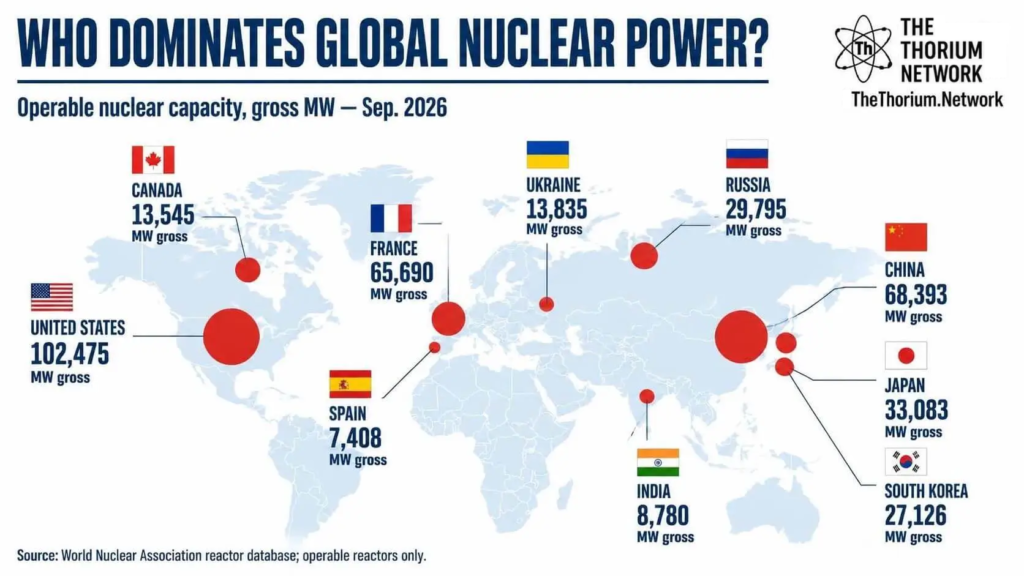
    Current World Fission Energy Production by The Thorium Network

    The model of this article assumes that Western governments do not achieve a sustained nuclear construction revival. Existing reactors may receive selected life extensions, but there is no large-scale replacement program comparable to the original build-out. China, Russia, India and other emerging nuclear states, by contrast, continue building at historically significant rates.

    This is a predictive scenario model with substantive assumptions. Use it to plan your future. Not to predict it.

    The central finding

    Under this scenario:

    • Western nuclear capacity declines from approximately 220 GW in 2026 to near zero by 2100.
    • BRICS+ nuclear capacity rises from approximately 110 GW to about 1,650 GW.
    • Global nuclear capacity increases from roughly 420 GW to approximately 1,970 GW.
    • Annual nuclear generation rises from about 3,100 TWh to nearly 14,700 TWh, assuming an average global capacity factor of 85%.
    • China becomes the dominant nuclear power in the 2030s.
    • India becomes the second-largest long-term growth market.
    • Russia remains both a major domestic operator and the largest international nuclear technology exporter.
    • Japan and South Korea retain substantial technical capability, while Japan’s trajectory depends heavily on reactor restarts and replacement construction.

    The model is deliberately more pessimistic about Western construction than mainstream energy-transition scenarios. It assumes that political support, industrial capacity and public acceptance remain insufficient to produce a sustained Western build out, stifled by legacy coal, oil and gas interests and their focus on maintaining their dwindling profit base.

    1. The existing Western fleet is old

    The Western nuclear fleet is not uniformly obsolete. Many reactors can operate safely beyond their original design and licensing periods if they receive major inspections, component replacements and regulatory approval.

    However, age doesn’t mean out.

    The average age of the United States reactor fleet was approximately 44 years in 2026. Most U.S. reactors entered service between the late 1960s and early 1990s. The newest U.S. reactors are Vogtle 3 and 4, which entered commercial service in 2023 and 2024. Before them, the United States had gone more than 30 years without completing a new commercial reactor.

    U.S. reactors receive an initial 40-year operating license. They may then receive a 20-year extension to 60 years, followed by a second 20-year extension to 80 years. An 80-year operating life is therefore not automatic; it requires additional safety analysis, environmental review, ageing-management programs and capital investment.

    As of the latest available licensing data, a relatively small group of U.S. reactors had received approval to operate for 80 years. The approved units include reactors at Turkey Point, Peach Bottom, Surry, North Anna, Monticello, Oconee, Browns Ferry, Dresden, St. Lucie, Robinson and Hatch. That is significant, but it represents only a portion of the national fleet.

    There is no established commercial pathway in the United States for operating the current light-water reactor fleet routinely to 100 years. A few plants may eventually be studied for operation beyond 80 years, but that would involve another level of engineering review and substantial replacement of ageing systems. It should not be treated as the normal future of the fleet.

    Approximate age structure of Western nuclear assets

    Asset age in 2026Approximate conditionLikely outcome
    Under 20 yearsNew or relatively modernLikely to operate into the 2070s or later
    20–40 yearsMature fleetLikely to require major refurbishment
    40–60 yearsOld operating fleetDependent on licence renewal and economics
    60–80 yearsExtended operationTechnically possible for selected units
    Over 80 yearsBeyond current normal licensing frameworkRetirement or exceptional life-extension decision

    The issue is not that a reactor reaches a magical age at which it must shut down. The issue is that every additional decade requires more expensive inspection, replacement of components, updated safety analysis and continued political commitment.

    2. Western life extensions are important—but they are not a replacement program

    A life extension preserves capacity. It does not create a new industrial base.

    Extending an existing reactor may require:

    • Steam-generator replacement
    • Reactor-vessel inspection
    • Reactor-head replacement
    • Turbine and generator refurbishment
    • New control and instrumentation systems
    • Cooling-system upgrades
    • Seismic reassessment
    • Fire-protection improvements
    • Digital safety-system modernisation
    • Spent-fuel and radioactive-waste infrastructure
    • New training and qualification programs

    These investments can be justified because the plant already has grid connections, operating staff, fuel contracts and a regulatory history. A new reactor must establish all of those systems from scratch.

    The Western nuclear industry’s most serious weakness is therefore not simply the age of its reactors. It is the failure to maintain a continuous construction pipeline.

    The United States currently operates one of the world’s largest nuclear fleets, but its latest large reactors were built after a long interruption. Vogtle 3 and 4 demonstrated that the country can still complete a reactor, but the project took more than a decade from construction start to commercial operation and experienced major delays and cost escalation.

    The Energy Information Administration has reported that the United States has 94 operating reactors, while most of the country’s fleet was built between 1967 and 1990. Current international reactor-construction data show no U.S. large reactor under construction, despite a large number of proposed projects.

    That is critical:

    • Operating: producing electricity now
    • Licensed: legally authorised to operate
    • Planned: some level of policy or corporate commitment
    • Proposed: an idea, study or preliminary site concept
    • Under construction: actual civil works have begun

    Only the last category creates near-term replacement capacity.

    3. Western construction capacity has become intermittent

    France provides the clearest example of a country with enormous nuclear expertise but a disrupted construction pipeline.

    France built most of its nuclear fleet rapidly during the 1970s and 1980s, using a largely standardised reactor design. That fleet still generates the majority of the country’s nuclear electricity. However, France then went decades without completing a new large reactor at home. Construction of the Flamanville 3 reactor began in 2007, but it did not connect to the national grid until 2024—a 17-year construction process that highlighted the difficulty of restarting a dormant nuclear-build program.

    The result is a familiar pattern:

    1. A country constructs a large fleet rapidly.
    2. Construction stops.
    3. Suppliers, engineers and specialised contractors retire or leave.
    4. Regulatory and design knowledge becomes less current.
    5. The next reactor becomes slower and more expensive.
    6. The industry loses confidence and political support.
    7. Existing reactors are extended because replacement projects are difficult.

    The same pattern appeared in the United States, the United Kingdom and parts of Western Europe. The United Kingdom is still pursuing new nuclear projects, and France has announced additional construction ambitions. But announced projects are not equivalent to operating capacity.

    The International Energy Agency has described the current nuclear revival as highly uneven. It reports that advanced-economy fleets are older than fleets elsewhere, while China accounts for roughly half of the nuclear capacity under construction. The IEA also found that, among reactors beginning construction since 2017, Chinese and Russian clearly designs dominate.

    4. The workforce problem is real, “no graduates”

    The Western nuclear workforce is literally producing fewer graduates. Universities still graduate nuclear engineers, radiation-protection specialists, mechanical engineers, electrical engineers, chemists and operators. But at reducing rates.

    The problem is scale, age distribution and experience.

    The United States nuclear sector employed approximately 68,008 workers in 2023, including fuel-cycle and electric-generation employment. Utilities accounted for roughly 41,000 positions. The U.S. Department of Energy reported that 60% of nuclear workers were between ages 30 and 54, while the industry had 23% fewer workers under 30 than the overall energy workforce. Around 90% of professional and business-service employers reported difficulty finding qualified workers. U.S. Department of Energy

    That creates three separate risks:

    Retirement risk

    A reactor is operated through procedures, maintenance practices and engineering judgements that are not fully captured in textbooks. Much of that expertise is held by people who joined the industry during the original build out.

    As those workers retire, companies must replace both the person and the experience base. A new graduate may understand reactor physics but still require years of supervised experience before becoming qualified for high-responsibility plant positions.

    Training-pipeline risk

    A new reactor program requires far more than reactor operators. It needs:

    • Nuclear engineers
    • Welders and pipefitters
    • Quality-assurance inspectors
    • Nuclear safety analysts
    • Radiation-protection specialists
    • Control-room operators
    • Heavy-forging specialists
    • Nuclear lawyers and regulators
    • Project managers
    • Fuel-cycle specialists
    • Waste-management professionals
    • Skilled construction supervisors

    The OECD Nuclear Energy Agency has repeatedly identified ageing and retirement as major human-resource risks for countries maintaining or expanding nuclear programs.

    Project-cycle risk

    A nuclear industry that builds one reactor every few decades cannot maintain the same workforce as an industry building several units every year.

    China, Russia and South Korea benefit from repeated construction. Their engineers, suppliers and contractors move from one project to the next. A Western team may complete a major reactor project and then have no comparable project for many years.

    That difference compounds over time.

    5. BRICS+ is building the industrial base the West is losing

    The term BRICS+ has become politically fluid. Its expanded membership includes Brazil, Russia, India, China, South Africa, Egypt, Ethiopia, Iran, the United Arab Emirates and Indonesia, with the exact status of some members and invited states changing over time.

    The nuclear capability of this group is concentrated in a smaller subset:

    • China
    • Russia
    • India
    • South Africa
    • Brazil
    • Iran
    • United Arab Emirates
    • Egypt, which is building its first nuclear plant ready by 2028

    The group also has connections to other major nuclear-building states, including Pakistan and Türkiye, although those countries are not treated as BRICS members in this model.

    Current and projected BRICS+ nuclear capacity

    CountryApprox. operating capacity, 2026Predictive capacity, 2050Predictive capacity, 2100
    China64 GW300 GW950 GW
    Russia28 GW75 GW180 GW
    India8 GW80 GW400 GW
    United Arab Emirates5.6 GW6 GW12 GW
    South Africa2 GW4 GW20 GW
    Brazil2 GW5 GW25 GW
    Iran1 GW3 GW15 GW
    Egypt0 GW5 GW20 GW
    Indonesia0 GW0–5 GW20 GW
    Ethiopia0 GW0 GW5 GW
    BRICS+ subtotalapproximately 111 GWapproximately 483 GWapproximately 1,647 GW

    These figures are a high-growth scenario based on current construction momentum, announced programs and the assumption that electricity demand continues to rise in developing economies.

    China is the anchor of the projection. It operates roughly 64 reactors and has approximately 38 reactors under construction, with more planned. India has a much smaller installed base but a large long-term target and an expanding domestic reactor program. Russia combines domestic construction with a powerful export business.

    The IEA reported that in 2025 China, India and Russia each completed new reactor capacity, while nine of ten global construction starts occurred in China. It also reported that approximately 94% of reactors beginning construction during the previous decade used Chinese or Russian designs. iea.org

    The World Nuclear Association lists approximately 80 reactors under construction worldwide, with roughly half of the capacity in China. It also lists more than 120 additional reactors as planned, most of them in Asia and other emerging markets.

    6. Russian-built capacity will extend beyond Russia

    Russia’s influence cannot be measured only by reactors physically located inside Russia.

    Rosatom supplies:

    • Reactor designs
    • Engineering services
    • Fuel
    • Enrichment
    • Training
    • Long-term maintenance
    • Financing arrangements
    • Waste and fuel-cycle services

    Russian-designed reactors are being built or proposed in countries including Türkiye, Egypt, Bangladesh, Iran and others. A reactor built in Egypt counts as Egyptian generating capacity, but it also expands Russia’s industrial influence and export ecosystem.

    China is following a similar path, although its overseas nuclear-export position is not yet as extensive as Russia’s. Chinese reactor designs are increasingly standardised, and domestic construction gives Chinese suppliers a large reference base.

    This is one of the most important differences between a declining industrial system and an expanding one:

    • A declining system extends its existing plants.
    • An expanding system builds plants at home and exports the entire technology package abroad.

    7. The 74-year predictive model: 2026–2100

    The following model divides nuclear capacity into three categories:

    • Western capacity: United States, Canada, Western Europe, the United Kingdom and associated mature nuclear economies.
    • BRICS+ capacity: The BRICS+ countries with existing or developing nuclear programs.
    • Other non-Western capacity: Japan, South Korea, Ukraine, Pakistan, Türkiye and other nuclear states outside the two groups.

    The model assumes:

    • No sustained Western nuclear construction revival
    • Selected Western reactors receive 60- or 80-year extensions
    • Western reactor retirements accelerate after 2040
    • China maintains a high construction rate through mid-century
    • India accelerates construction after 2035
    • Russia maintains both domestic construction and export activity
    • Japan restarts most technically viable reactors but builds only moderately
    • South Korea continues a steady replacement and export program
    • Global nuclear capacity factors average approximately 85%

    Installed nuclear capacity and estimated generation

    YearWestern capacityBRICS+ capacityOther non-Western capacityGlobal capacityApprox. annual generation at 85% capacity factor
    2026220 GW110 GW90 GW420 GW3,130 TWh
    2030205 GW170 GW105 GW480 GW3,580 TWh
    2040180 GW300 GW140 GW620 GW4,620 TWh
    2050145 GW500 GW175 GW820 GW6,110 TWh
    2060100 GW750 GW210 GW1,060 GW7,950 TWh
    207060 GW1,000 GW250 GW1,310 GW9,740 TWh
    208030 GW1,250 GW280 GW1,560 GW11,610 TWh
    209010 GW1,450 GW300 GW1,760 GW13,100 TWh
    21000 GW1,650 GW320 GW1,970 GW14,660 TWh

    The generation estimate uses:

    Annual generation=Installed capacity×8,760×capacity factor

    At an 85% capacity factor, each 1 GW of nuclear capacity produces approximately 7.45 TWh per year.

    This model does not consider other power sources. Wind, solar, hydroelectricity, gas, coal, storage and transmission will also expand or decline. The focus is the amount of electricity generated by nuclear power and the,point is that it can rise substantially even while the Western nuclear industry contracts.

    8. Western retirement schedule

    The model assumes that most current Western reactors fall into one of four categories:

    PeriodMain Western nuclear event
    2026–2035Life extensions, restarts and completion of already-committed projects
    2035–2045Increasing retirement of reactors that reach 60 years
    2045–2060Large retirement wave as many reactors reach 70–80 years
    2060–2080Final operation of selected exceptionally extended units
    2080–2100Decommissioning, waste management and site remediation dominate

    The most important point is that retirement is not a single event. Nuclear capacity tends to decline in waves because many countries built fleets in concentrated periods.

    France built much of its fleet between the mid-1970s and early 1990s. The United States also built most of its capacity between 1967 and 1990. This creates a retirement bulge: a large number of reactors eventually reach similar age thresholds at roughly the same time.

    If replacements are not started 10–20 years in advance, a country cannot simply “replace” the fleet when it reaches retirement age. Nuclear construction timelines make that impossible.

    9. A crumbling power infrastructure

    The Western problem is broader than nuclear reactors.

    Nuclear plants are connected to:

    • High-voltage transmission networks
    • Regional control systems
    • Cooling-water infrastructure
    • Rail and heavy-haul logistics
    • Specialised machine shops
    • Nuclear fuel supply chains
    • Emergency-response systems
    • Universities and training institutions
    • Regulatory agencies
    • Waste-storage facilities

    When the nuclear fleet contracts, the surrounding infrastructure also loses scale.

    A shrinking fleet can mean:

    • Fewer apprenticeships
    • Fewer reactor projects for contractors
    • Less demand for nuclear-grade forgings
    • Fewer university nuclear programs
    • More expensive regulator staffing
    • More dependence on foreign fuel and components
    • Loss of domestic design expertise
    • Higher costs for the remaining plants
    • Greater difficulty restarting the industry later

    This is why a temporary construction pause can become a long-term industrial decline. The capability is not preserved simply because a few reactors continue operating.

    10. Oil and coal interests: a forever strong influence

    It is a fact that fossil-fuel interests influence energy policy. Oil, gas and coal companies have financial stakes in maintaining demand for their products, and fossil-fuel industries employ large workforces and possess significant political influence.

    The entire Western nuclear stagnation can be assigned entirely to private families making money from oil and coal.

    There are other factors too. Such as:

    • Nuclear construction cost overruns from inexperienced teams
    • High interest rates
    • Long permitting timelines
    • Public opposition maintained through oil funded campaigns
    • Accident risk perception
    • Waste-disposal disputes
    • Utility deregulation
    • Competition from cheap natural gas
    • Renewable subsidies and rapid solar-cost declines
    • Local opposition to new transmission lines
    • Loss of skilled construction capacity
    • Political changes after major accidents
    • Difficulty financing projects that take a decade to complete

    Fossil-fuel interests reinforce these barriers, and can be tied to all elements. A fragmented political system, weak project execution and inconsistent policy are also part of the collective western problem.

    The observable fact is: the West has not built replacement reactors at the rate required to preserve its existing nuclear share.

    11. Why global nuclear generation can rise while Western nuclear declines

    The Western decline does not necessarily imply a global nuclear decline.

    China, India and other emerging economies have three structural advantages:

    1. Growing electricity demand .They need much more electricity for industrialisation, urbanisation, cooling, transport and digital infrastructure.
    2. Centralised decision-making. Large infrastructure projects can often be approved and financed through state-directed systems more quickly than in fragmented liberal markets.
    3. Continuous construction. Repeated projects preserve engineering teams, manufacturing capacity and regulatory experience.

    This creates a compounding effect. A country that builds ten reactors learns faster than a country that builds one reactor every 20 years. The cost of standardisation, training and supply-chain development is spread across a larger pipeline.

    The IEA estimates that China’s installed nuclear capacity more than triples to mid-century in its policy-based scenario, while emerging and developing economies account for most of the expected growth. It also notes that advanced-economy nuclear fleets are older and that new construction has been affected by delays and cost overruns.

    12. The likely geopolitical result by 2100

    If this scenario is broadly correct, nuclear power becomes entirely associated with Asian and Eurasian industrial systems.

    By 2100:

    • China controls the largest domestic nuclear fleet.
    • India controls the second-largest growth market.
    • Russia remains a major reactor and fuel supplier.
    • South Korea remains a sophisticated reactor exporter.
    • Japan retains high technical competence but operates a smaller and older fleet than China or India.
    • Western countries retain ever decaying nuclear knowledge in universities, laboratories and selected companies but no longer dominate deployment.
    • Much of the world’s new reactor capacity uses Chinese, Russian, Indian or South Korean designs.
    • Western countries become customers, regulators and operators rather than the main builders.

    This becomes a technological defeat. Western countries no longer lead in advanced reactor research, safety analysis, fuel innovation or nuclear medicine. They won’t have the machines. Leadership in research will shift eastwards also.
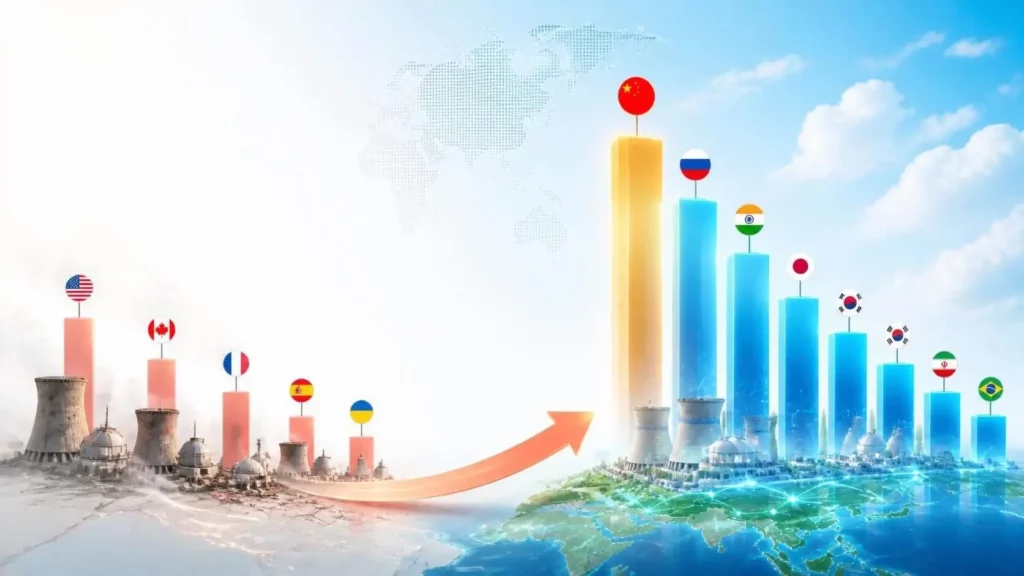
    Rising East and Falling West Fission Energy with The Thorium Network

    Conclusion

    The central story is not that Western reactors suddenly fail. It is that they gradually age out while the industrial system needed to replace them remains too small, too slow and too politically inconsistent.

    The West can extend many reactors to 60 years and selected reactors to 80 years. That will preserve substantial generation through the 2030s and 2040s. It will not, by itself, create a replacement fleet for the second half of the century.

    China, Russia, India and other nuclear-building states are moving in the opposite direction. They are building reactors, training workers, expanding supply chains and creating repeatable construction systems.

    Under the predictive model presented here, Western nuclear capacity falls by approximately 220 GW between 2026 and 2100, while BRICS+ capacity rises by approximately 1,540 GW. Global nuclear generation increases because the additions in Asia and the wider BRICS+ sphere overwhelm Western retirements.

    The likely result is a historic transfer of nuclear industrial power:

    The West owns much of the ageing fleet. Eurasia builds the replacement fleet.

  • A Crib Sheet for Journalists and Students of Thorium

    A Crib Sheet for Journalists and Students of Thorium

    Authored by Jeremiah Josey 7 October 2026

    Are you a journalist, student, humanist, or futurist looking for the inside on Liquid Fission Thorium? Unlimited energy. Secure. Reliable. This page is for you.

    We’ve been asked many times for a summary of resources or key people to speak with.

    Are we biased? Of course we are. The technology allows us to be. Indeed it demands we not be humble.

    Read on and you’ll know why. You’ll want to [Join Us] too.


    A Future Powered by Thorium is our objective. We are leveraging the billions of USD in today’s value and millions of hours invested over 50 years ago in a technology that is demonstrably superior to anything else we have today.

    China already knows this. In 2011 it committed USD3.3 billion and 700 engineers to revive the US Molten-Salt Reactor Experiment from the 1960s. Today, China’s TMSR-LF1 is generating power — the first nation to do so. The original Hastelloy superalloy needed for these reactors was developed in the 1950s by just two companies in the world. China, working with Australia, and Professor Adi Patternson (see below), has now developed an independent supply.

    India is moving next. In 2025, India began opening its Thorium sector to private companies, and NTPC partnered with US-based Clean Core Thorium Energy to deploy Thorium fuel in existing reactors — a first for the country.

    Here’s a summary of that work from [Oak Ridge National Laboratories]:

    The Molten-Salt Reactor Experiment from 1969

    We have this YouTube and other useful 3rd party links on our website here:

    The Thorium Knowledge Base

    See this chart of energy density from an Australian government website.  Everything else pales into insignificance when compared to Liquid Fission Thorium Burners. Some people call them MSR Molten Salt Reactors. We just call them LFTBs.

    ANSTO Energy Density Bar Chart
    ANSTO Energy Density Bar Chart

    Here’s a recent article from Germany (translated into Japanese) that contains extensive information on China’s progress and Japan’s FUJI LFTB project.

    The article also includes information on Japan’s LFTB project –  FUJI.

    Here’s a list of must-do-studies and interviews for background on Liquid Fission Thorium Energy, LFTBs or subjects related, such as radiation safety, the effects of Chernobyl and Linear No Threshold theory.

    Professor Geraldine Thomas
    Director of the Chernobyl Tissue Bank — the world’s preeminent knowledge base for the real effects of radiation. Prof. Thomas is became staunchly pro-nuclear due to her directorship and her discovery of the truth—there was no issue with radiation from the indicent at Chernobyl.

    Site story one: George Monbiot—former leading Greenpeace “anti-nuc” activist, dropped out of Greenpeace and became strongly pro nucelar after an interview he had with Proffessor Thomas. He was writing a nuclear hit piece for the UK’s Guardian he never finished.

    Side story two: When Professor Thomas retired in 2022, she handed over the Chernobyl Tissue Bank to the U.S. National Cancer Institute. It is now a marginalized entity, doing little more than reiterating the century-old LNT narrative.

    Side story three: After a century of radiation rules shaped by LNT, U.S. regulators are reconsidering the framework—renewing the charge that its dominance amounted to a century of lies and misdirection. The proposal changes how the rules are applied, though it retains [LNT] as a scientific basis.

    Want to become an expert in the fraud of LNT, and it’s evidenced based counterpart Hormesis? Start here:

    Geraldine Thomas

    George Monbiot on Wikipedia

    Geraldine Thomas on Wikipedia

    Mr. Daniel Roderick
    Former President and CEO of Westinghouse and then Toshiba Energy Systems. Danny led the sale of Westinghouse for Toshiba, securing a positive multi-billion USD outcome for Japan. He also led negotiations to secure USD 50 billion in funding for a new nuclear build in Türkiye.

    Side story one: Roderick’s project was derailed by the 2016 attempted coup in Türkiye. Mitsubishi subsequently submitted (and withdrew) a fission build near Sinop, northern Türkiye.

    Side story two: Rosatom of Russia is now commissioning the first unit of their fission power station in Akkuyu, southern Türkiye. The first unit will be running very shortly. Once complete, the four-unit plant is designed for 4,800 MW and is expected to supply about 10% of Turkey’s electricity.

    Daniel Roderick

    Dr. Adi Paterson
    Former head of ANSTO and an advocate of Liquid Fission Thorium Energy Technology. During his 11-year tenure, Dr. Paterson steered Australia to membership of the Generation IV forum—the international body for advanced fission designs including LFTBs. This is no small feat given Australia’s historical distance from nuclear energy.

    Dr. Adi Paterson

    Dr. Adi Paterson is a former head of ANSTO and an advocate of Liquid Fission Thorium Energy Technology. During his nine-year tenure, he steered Australia into membership of the Generation IV International Forum, an international body focused on advanced fission designs, including LFTBs. This was no small feat, given Australia’s historical distance from nuclear energy.

    Side story: Dr. Paterson redesigned the South African government’s Department of Science and Technology, which continues to thrive today. Necsa, the equivalent of ANSTO, declined his help. Its last director of research and development—remember, Necsa was founded as a research and development company—retired in February 2023 and was never replaced.

    Generation IV Forum

    Adi Paterson

    Dr. Resat Uzman
    Director of nuclear energy systems at Figes AS, of Türkiye. Dr. Uzman has more than 40 years experience in all things nuclear, Türkiye and rare earths – the materials where Thorium is often found bound with.

    Nukleer Enerji Seminer 3 Dr. Resat Uzmen
    Dr. Resat Uzmen

    Professor Berrin Erbay
    Senior lecturer and former dean of mechanical engineering at Osmangazi University, Türkiye Prof. Erbay has been liaising with the professors in Japan for several decades. You can see one of her presentations on the status of Liquid Fission Technology and LFTBs in Japan here on Youtube: 

    Berrin Erbay
    4. Nesil Nükleer Reaktör Teknolojileri Toplantısı

    Mr. Phumzile Tshelane
    Mr. Tshelane is a former CEO of NECSA South Africa, now holds various directorships across a wide range of industrial sectors. His position as head of a state owned nuclear technology development company gives him a particular view point on commercialisation of nuclear energy technologies, especially LFTBs.

    Mr. Phumzile Tshelane
    S3E6 Africa4Nuclear: The Story of Thorium

    Ms. Rana Önem
    Former president of the Thorium Student Guild. You should hear from someone discovered the benefits of Liquid Fission Thorium and LFTBs when studying their nuclear engineering degree. You can see Rana interviewing Dr. Uzman here. Follow the links at the end of the article to see her role as president of the Guild: 

    President – Ms. Rana Önem, Eng
    Fmr. President – Ms. Rana Önem, Eng

    An important subject to cover is linear no threshold theory – a fraudulent model of radiation management that, unfortunately, has spawned an industry of radiation protection and radiation safety keen on maintaining its own survival. This results in massive, unnecessary overspending on nuclear builds. Professor Edward Calabrese is a leading expert on this subject and you can watch a series of interviews with Ed here: 

    The History of the Linear No-Threshold (LNT) Model Episode Guide

    Together with Professor Jerry Cuttler, Ed presents clearly, laying out how LNT has demonstrably been proven false. (And consequently those that died at Fukushima died unnecessarily, as a direct result of inappropriately applying that theory).

    What would become of nuclear risk if governments changed their regulations to recognize the evidence of radiation’s beneficial health effects for exposures that are below the thresholds for detrimental effects?

    Here’s the background on the Türkiye Japan University (TJU). Our founder, Jeremiah Josey, met with the Japanese Ambassador to Türkiye in 2021 and confirmed Japanese support for technology development of Liquid Fission and LFTBs is easier should such work be included in the curriculum of the TJU. Early planning stages of the TJU can be seen here below. The vice president of TJU is a senior professor at the Tokyo University responsible for nuclear engineering.

    The “only” obstacle to adoption of Liquid Fission Thorium and LFTB technology is the incumbent energy industries, coal, oil and gas. It’s a significant obstacle, and it would be naive to think otherwise. Operating much like the tobacco industry has done in the past, lobbyists and funding at all levels occurs to stymie any potential competitors.

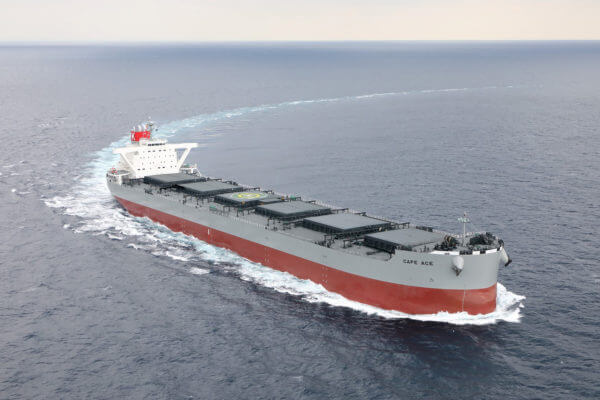
    It is predicted that the 7 Trillion USD per year fossil fuel energy market would shrink to a few hundred billion USD per year with a society powered by Liquid Fission Thorium and LFTBs. This is an obvious disincentive for incumbents to do anything but to obfuscate and delay. For the true scale of these numbers, that means that a world powered by Liquid Fission Thorium energy would require only one ship like the one below to carry ALL WORLD’s Energy for ONE year.

    100,00 DWT Bulk Carrier Cape Ace

    You can see that obfuscation at work here with both Wired and the Bulletin in 2019 on USA presidential candidate Andrew Yang:

    Fact-check: Five claims about thorium made by Andrew Yang – Bulletin


    Andrew Yang Wants a Thorium Reactor by 2027. Good Luck, Buddy – Wired

    The half truths and lies are difficult, if not impossible, for the layperson to identify. We contacted one of Andrew’s advisory team members and confirmed Andrew supports Liquid Fission Thorium, and was committing several billion USD to have USA’s energy footprint 100% on the technology by 2030. Technically very doable. Politically, not.

    It is important to recognise the ecological and economic footprint of energy from Thorium (a substance as common as lead) as being much smaller than even uranium. In the article link above (the Japanese translation one) there are three slides that demonstrate the significant benefits Thorium has over uranium.  These slides are repeated below.

    Thorium and Uranium Compared Slide 1 of 3
    Thorium and Uranium Compared Slide 1 of 3
    Thorium and Uranium Compared Slide 2 of 3
    Thorium and Uranium Compared Slide 2 of 3
    Thorium and Uranium Compared Slide 3 of 3
    Thorium and Uranium Compared Slide 3 of 3

    The IAEA report TE1450 from 2005 is an excellent read. It says Thorium is not an issue and is a good prospect for energy – back in 2005. Once the physics is proven it doesn’t need to be “upgraded” every 6 months like an iPhone.

    And yes, Thorium doesn’t explode. “Walk away safe” is a suitable term for Liquid Fission Technology and LFTBs.

    Here’s the former head of IAEA, Hans Blix, stating that “Thorium shouldn’t be treated like uranium”. 

    Thorium Nuclear Power and non Proliferation Hans Blix IAEA ThEC13

    See more Hans Blix on Liquid Fission Thorium Energy

    Attached below is a brief summary of “Why Thorium didn’t take off” by Bruce Hoglund, 5 November 2010. It’s an excellent starting point for data gathering and research – and not “Wikipedia”. Wikipedia was used as partial evidence why the United Kingdom should’t use Thorium for energy. Around 2012 in a UK government 1.5m GBP funded “study”, rubbished Thorium and directly contradicted the advice of the IAEA’s TE 1450 report.


    The information here is but the tip of the iceberg, however it gives an excellent starting point. There are of course, many, many others who can contribute considerably for a balanced and objective article or articles on Thorium for our energy future with LFTBs. And with today’s communications technology, such conversations are only but a few key strokes away.

    Burning stuff is old tech.

    Star Trek technology is where we have to be now. Fission does that, especially Liquid Fission Thorium Energy Technology and Liquid Fission Thorium Burners – LFTBs.

    Uncle Martin would be proud. Nanu, nanu!


    Post created following a 2 hour interview between Associated Press representative for Japan, [Ms. Yuri Kageyama] and chairman and founder of The Thorium Network, [Jeremiah Josey]


    1. Join The Thorium Network
    2. https://www.youtube.com/watch?v=tyDbq5HRs0o
    3. https://thethorium.network/about-thorium/thorium-knowledge-base/
    4. https://www.ansto.gov.au/our-science/nuclear-technologies/reactor-systems/advanced-reactors/evolution-of-molten-salt
    5. https://thethorium.network/%e3%83%91%e3%83%bc%e3%83%95%e3%82%a7%e3%82%af%e3%83%88%e3%83%86%e3%82%af%e3%83%8e%e3%83%ad%e3%82%b8%e3%83%bc-%e3%83%90%e3%82%a4%e3%83%aa%e3%83%b3%e3%82%ac%e3%83%ab%e8%a8%98%e4%ba%8b-%e6%97%a5%e6%9c%ac/
    6. https://en.wikipedia.org/wiki/Geraldine_Thomas
    7. https://en.wikipedia.org/wiki/George_Monbiot
    8. https://www.chernobyltissuebank.com/contact-us
    9. https://www.linkedin.com/in/danielroderick/
    10. https://www.linkedin.com/in/adi-paterson/
    11. https://www.gen-4.org/
    12. https://figes.com.tr/en/
    13. https://www.linkedin.com/in/resat-uzmen-051a824/
    14. https://thethorium.network/interview-3-dr-resat-uzmen-nuclear-technology-director-of-figes-part-of-the-thorium-student-guild-interview-series-leading-to-nuclear/
    15. https://www.youtube.com/watch?v=NEDK_MAWQD0
    16. https://www.linkedin.com/in/l-berrin-erbay-61b04745/
    17. https://www.linkedin.com/in/phumzile-tshelane-3014945a/
    18. https://www.necsa.co.za/
    19. https://www.youtube.com/watch?v=6MsgDx8K-t4
    20. https://www.linkedin.com/in/rana-%C3%B6nem-57a14718b/
    21. https://thethorium.network/join-us/student-guild/
    22. https://www.linkedin.com/in/ed-calabrese-697a1119/
    23. https://thethorium.network/2022/02/12/the-big-deceit-episode-6-unintended-consequences-chapter-2/
    24. https://hps.org/hpspublications/historylnt/episodeguide.html
    25. https://www.linkedin.com/in/jerry-cuttler-26106763/
    26. https://www.linkedin.com/posts/jerry-cuttler-26106763_what-would-become-of-nuclear-risk-if-governments-activity-6870517584475824128-qr3W
    27. https://www.youtube.com/watch?v=eJSeQIW-X44
    28. https://thebulletin.org/2019/12/fact-check-five-claims-about-thorium-made-by-andrew-yang/
    29. https://www.wired.com/story/andrew-yang-wants-a-thorium-reactor-by-2027-good-luck-buddy/
    30. https://www.youtube.com/watch?v=F4m10Y0rWBY
    31. https://www.youtube.com/results?search_query=hans+blix+thorium
    32. https://www.linkedin.com/in/bruce-hoglund-52194814/

  • The Long Game: Why Liquid Fission Thorium is the Best Investment for the 21st Century

    The Long Game: Why Liquid Fission Thorium is the Best Investment for the 21st Century

    The Imminent Shift in Global Energy Investment

    Based on the insights of Jeremiah Josey, founder of The Thorium Network

    The world stands at a pivotal moment in energy history. As the limitations of fossil fuels become increasingly apparent and the urgency of climate change accelerates, investors are searching for solutions that offer both scale and sustainability. The most compelling opportunity emerging from this convergence of challenges and opportunities is not in the familiar realms of solar or wind, but in the realm of Liquid Fission Thorium Burners—a technology that promises to transform the energy landscape in ways that are both profound and enduring.

    This report examines the dual nature of this investment opportunity: the short-term momentum driven by existing infrastructure and market dynamics, and the long-term generational wealth that can be captured through strategic positioning in the emerging Thorium-based energy ecosystem. By understanding both time horizons, investors can make informed decisions that position them at the forefront of the next energy revolution.

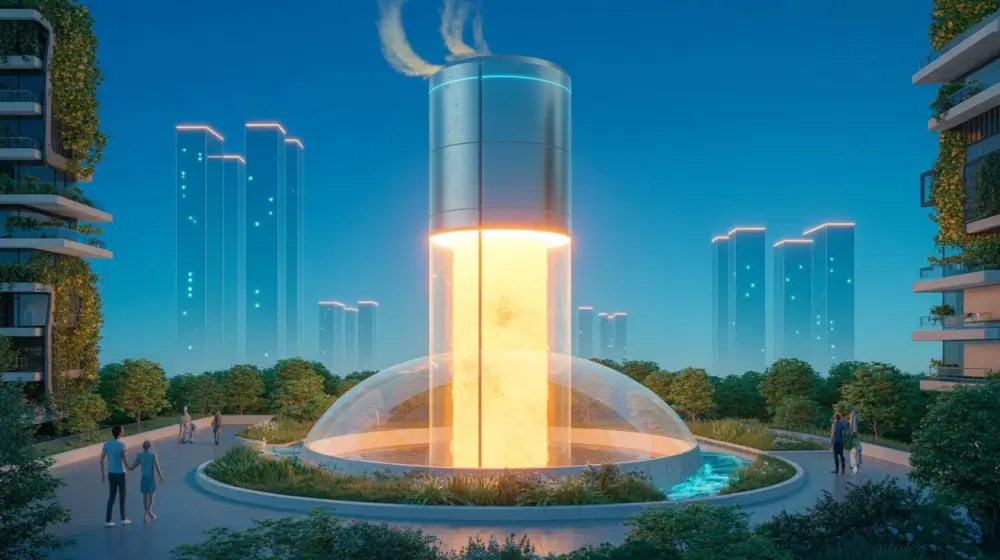
    Liquid Fission Thorium Burner Quietly Powering a Modern City

    The Short-Term Reality: Momentum and Market Dynamics

    The foundation of the current energy investment landscape is being shaped by several powerful forces. The global demand for reliable, 24/7 baseload power is surging, driven primarily by the insatiable appetite of artificial intelligence and data centers. This demand creates a clear and immediate market need that existing energy sources struggle to meet. While renewable energy sources like solar and wind have made significant strides, they are inherently intermittent and require massive storage solutions to provide consistent power. This limitation makes them less suitable for the high-demand, high-reliability applications that define the modern digital economy.

    In this context, Fission stands out as the only scalable, zero-carbon solution capable of meeting these demands. The market is already responding to this reality. The Liquid Fission Thorium Burner technology, while still in its developmental stages, is benefiting from the momentum of the broader Fission energy sector. This momentum is driven by several key factors:

    1. Energy Security and Geopolitical Stability: As nations seek to reduce their dependence on volatile fossil fuel markets, the ability to generate energy from a domestically controlled fuel source becomes a strategic imperative. This has led to increased government support and investment in Fission technologies, creating a favorable policy environment.
    2. Supply Chain Dynamics: The global supply of conventional uranium is constrained by years of underinvestment in mining. This structural deficit creates upward pressure on uranium prices, which in turn drives demand for alternative fuel cycles like Thorium. The Liquid Fission Thorium Burner offers a path to leverage this demand by utilising a fuel cycle that is more abundant and potentially more secure.
    3. Market Capitalisation and Valuation: The existing Fission energy market, including companies involved in fuel production, enrichment, and reactor operations, has seen significant capital appreciation. This creates a positive feedback loop where increased investment attracts more capital, further fuelling growth.

    This short-term momentum provides a critical window of opportunity. It validates the fundamental need for reliable, clean energy and creates a market environment where the benefits of Fission technology are being recognised and rewarded. For investors, this means that the Liquid Fission Thorium Burner is not just a speculative venture, but an investment in a market that is already demonstrating strong demand and favorable economic conditions.

    Liquid Fission Thorium Energy is Safe

    The Long-Term Vision: Generational Wealth and Technological Leadership

    While the short-term momentum is significant, the true value of the Liquid Fission Thorium Burner lies in its long-term potential. This technology represents a fundamental shift in how we generate and manage energy, with implications that extend far beyond simple electricity production. The long-term vision is one of generational wealth, built on the foundation of technological leadership and strategic advantage.

    The Liquid Fission Thorium Burner is not merely an incremental improvement on existing Fission technology. It is a paradigm shift. By utilising Thorium as a fuel source, this technology offers several key advantages that position it to become the cornerstone of future energy systems:

    1. Inherent Safety and Proliferation Resistance: The Liquid Fission Thorium Burner operates on a fundamentally different principle than traditional solid-fuel reactors. Its liquid fuel design allows for passive safety features, meaning that in the event of a malfunction, the reaction naturally shuts down without the need for external intervention. This inherent safety reduces the risk of catastrophic accidents and eliminates the need for complex, expensive safety systems. Furthermore, the Thorium fuel cycle produces minimal amounts of long-lived radioactive waste and is inherently resistant to nuclear weapons proliferation, making it a more secure and politically viable option.
    2. High Energy Density and Fuel Efficiency: Thorium is a remarkably energy-dense fuel. A single ton of Thorium can produce as much energy as several thousand tons of coal or millions of gallons of oil. This high energy density translates into a significant reduction in fuel transportation and storage requirements, as well as a lower environmental footprint. The Liquid Fission Thorium Burner can also be designed to efficiently consume existing nuclear waste, effectively turning a liability into a valuable resource.
    3. Scalability and Global Applicability: The Liquid Fission Thorium Burner is designed to be scalable, from small, modular units suitable for remote communities to large, centralised power plants. This scalability allows for flexible deployment in a wide range of environments, from developing nations seeking to build their energy infrastructure to industrialised nations looking to decarbonize their grids. The technology’s ability to operate in a wide range of climates and conditions makes it a truly global solution.
    4. Economic Viability and Long-Term Returns: The combination of inherent safety, high fuel efficiency, and low operational costs creates a highly attractive economic model. The Liquid Fission Thorium Burner can generate significant returns on investment over its long operational life, often exceeding 50 years. This long-term stability provides a reliable source of income for investors and a predictable source of energy for consumers.

    The long-term vision is not just about generating electricity. It is about creating a new industrial paradigm. The Liquid Fission Thorium Burner has the potential to revolutionise not only the energy sector but also industries that rely on high-temperature process heat, such as hydrogen production, desalination, and industrial manufacturing. By providing a reliable, zero-carbon source of high-temperature heat, this technology can enable the decarbonization of entire sectors of the global economy.

    The Convergence of Short-Term and Long-Term Opportunities

    The true power of the Liquid Fission Thorium Burner lies in the convergence of short-term momentum and long-term vision. The current market dynamics create a favorable environment for the development and deployment of this technology. The demand for reliable, clean energy is real and growing, and the existing Fission energy market is already demonstrating the economic viability of the sector.

    This momentum provides a critical window of opportunity for investors to position themselves in the emerging Thorium ecosystem. By investing in the Liquid Fission Thorium Burner now, investors can capture both the short-term gains from the market’s recognition of Fission’s value and the long-term rewards of being at the forefront of a transformative technology.

    The Liquid Fission Thorium Burner represents a unique investment opportunity that combines the immediate benefits of a growing market with the long-term potential of a technology that could reshape the global energy landscape. For investors seeking to build generational wealth, this is not just an investment in energy—it is an investment in the future of civilisation. The time to act is now, as the world moves towards a new era defined by clean, safe, and abundant energy.

    Resources

    This post is based on the experience of Jeremiah Josey founder and chairman of The Thorium Network. He gave the details of this in a presentation to over 1000 investors in Hong Kong. You can see that post here on our Patreon.

  • Thorium Triumph: How China Is Shattering Myths and Powering the Future

    Thorium Triumph: How China Is Shattering Myths and Powering the Future

    Article by Jeremiah Josey, founder of The Thorium Network. Dated 13 December 2025

    The website whatisnuclear.com/thorium-myths.html presents a series of arguments that attempts to cast doubt on the viability and advantages of Thorium-based Fission technology. We won’t dwell on the psychological tactics used—such as answering a different question to the headline “myth” or relying on technical jargon to create an aura of authority. They’re unnecessary distractions. And we don’t need to. Recent developments, particularly in China, have decisively demonstrated that the supposed technical hurdles previously cited are not only surmountable but are actively being overcome. China’s progress in Thorium Liquid Fission Burner (LFTB) technology reveals a future where energy independence is not just a goal, but a reality that will reshape global energy dynamics.

    Addressing the “Myths” with Chinese Achievements

    • Myth #1: Thorium Burners were cancelled due to economics, not weapons.
      China’s Thorium Fission programme, launched in 2011 by the Chinese Academy of Sciences, has shown that with sustained investment and state support, economic barriers can be surpassed. The country has not only constructed a complete industrial supply chain for Thorium Fission machines but has also achieved the world’s first conversion of Thorium into uranium-233 within a their LFTB called “TMSR-LF1”. This achievement marks a pivotal step toward self-sustaining Fission cycles, driven by strategic energy security rather than mere economics. Link​
    • Myth #2: Thorium Burners never need enrichment.
      While initial fissile material is required to start the process, China’s TMSR-LF1 machine has successfully bred uranium-233 from Thorium, proving that self-sustaining cycles are achievable. This milestone is a major leap toward reducing dependence on enriched uranium, making Thorium Liquid Fission Burners a cornerstone of China’s long-term energy strategy. Link​
    • Myth #3: Thorium Burners cannot make bombs.
      The claim that Thorium Burners could be used to produce weapons-grade material is categorically false. The process of separating protactinium-233 from the fuel solution is technically complex, highly detectable, and practically impossible to achieve covertly. Moreover, the presence of uranium-232 and its intense gamma radiation makes handling and weaponisation not only hazardous but effectively unfeasible. China’s approach to Thorium Fission prioritises civilian energy and employs strict safeguards, ensuring that weaponisation is not a realistic concern. Link​
    • Myth #4: Thorium is more abundant, but that’s not important.
      China’s discovery of over 1 million tons of Thorium and the mapping of 233 Thorium-rich zones highlight its strategic significance for energy security. For a country with limited uranium, Thorium’s abundance is not just important—it is essential. China’s road map targets commercial deployment by 2029, aiming to secure energy independence for hundreds of thousands of years. This will dramatically reduce China’s reliance on fossil fuels and lead to a significant decline in global demand for coal and oil. Link
    • Myth #5: Thorium Burners don’t uniquely make safer waste.
      China’s TMSR produces far fewer long-lived transuranic elements, and its waste decays much faster than that of conventional Fission machines. The technical capability for online fission product removal and passive safety is being proven in real-world operation, making Thorium Liquid Fission Burners a leader in reducing Fission waste hazards. Link
    • Myth #6: Thorium Burners and molten salt machines are the same thing.
      China’s programme combines both, but the advances in metallurgy and materials—such as the development of specialised alloys for molten salt environments—are critical. The United States historically restricted sales of Hasteloy N, a key material for liquid fission machines, to control technology spread. China has now overcome this by developing its own high-performance alloys, supported by Australia ensuring supply chain independence and technological leadership. Link

    China’s Energy Independence and Global Impact

    China’s Thorium Fission programme is not just about technological advancement; it is about energy independence for hundreds of thousands of years. The end of fossil fuels for China is in sight, and considering the country’s massive energy consumption, this will lead to a dramatic decline in global demand for coal and oil. China’s progress in Liquid Fission Thorium Burner technology is setting a new benchmark for advanced energy solutions worldwide, with the potential to transform global energy markets and reduce reliance on fossil fuels. Link

    Australia’s Role in Supporting China

    Australia has played a crucial role in supporting China’s Thorium Fission ambitions. Under the leadership of Professor Adi Paterson, Australia has become a key partner in the development and supply of Thorium and advanced materials for Liquid Fission Machines. This collaboration not only strengthens bilateral relations but also positions Australia as a vital contributor to the global shift toward sustainable energy solutions. Link​

    China’s achievements in Thorium Fission Burner technology have decisively refuted the notion that Thorium-based Fission is impractical or hindered by insurmountable technical challenges. The technical hurdles cited by critics globally are being overcome, and China’s progress is setting a new benchmark for advanced energy solutions worldwide. The future of energy is not just about technological innovation but about strategic independence and global sustainability. Link

    ​References

    Debunking this article: https://whatisnuclear.com/thorium-myths.html

    Tags

    #China #LiquidFissionThoriumBurners #LFTB #Thorium #Fission

    Credits

    Credits to the respective contributors to this article, including Discovery Alert for the images.

    Article Links

    Telegram: https://t.me/thethoriumnetwork/14561

    LinkedIn: https://www.linkedin.com/posts/thethoriumnetwork_liquidfission-gotthorium-thorium-activity-7405792701608218624-nlyJ

    Facebook: https://www.facebook.com/share/p/17VxJUyRx8/

    Instagram: https://www.instagram.com/p/DSOhU7zjhrk/

  • How U.S. Policy Shifted Energy & Technology Hegemony to China

    How U.S. Policy Shifted Energy & Technology Hegemony to China

    Post created by Jeremiah Josey and the team at The Thorium Network on 11 October 2022

    By James Kennedy, President of ThREEConsulting.com and John Kutsch, Executive Director of Thorium Energy Alliance, October 3, 2022.

    Ordinally appearing in LinkedIn Pulse. Reproduced for educational purposes and with permission.

    The Pentagon recently halted the delivery of F-35 fighter jets when it was discovered that they contained Chinese rare earth components. If the Pentagon would look a little more closely, they would find that Chinese rare earth derived components are ubiquitously distributed throughout all U.S. / NATO weapon systems.

    It isn’t only U.S. weapon systems, China controls global access to rare earth metals and magnets (and other downstream critical materials) for EVs, wind turbines, and most other green- technology.

    However, China’s vision is much more ambitious than controlling the supply-chain for high-tech commodities, they are leveraging their dominance into the clean energy sector. Last month Chinese authorities authorized the startup of what should be considered the world’s only Generation-5 nuclear reactor: a reactor that is inherently safe, non-proliferating, and can consume nuclear waste.

    The goal of Net-Zero, and any potential economic benefits, are entirely under China’s control.

    China’s leadership position in both of these areas can be traced back to irrational policies and legacy prejudices specific to Thorium, a mildly radioactive element that is commonly found in heavy rare earth minerals.

    The words that follow, detail the history of how China surpassed the U.S. with its own nuclear technology and displaced its historic leadership position in rare earths.

    A Short History on U.S. Nuclear Development

    In 1962 Nobel Prize Winning scientist Glenn Seaborg responded to President John F. Kennedy’s request for a Sustainable U.S. Energy Plan. The report titled “Civilian Nuclear Power” called for the development and deployment of Thorium Molten Salt Breeder Reactors.

    Glenn T Seaborg 1961
    Glenn T. Seabourg – Nobel Prize winner and adviser to 10 Presidents – knew a thing or two about Atomic Energy

    Abstract
    This overarching report on the role of nuclear power in the U.S. economy was requested by U.S. President John F. Kennedy in March, 1962. The U.S. Atomic Energy Commission was charged with producing the report, gaining input from individuals inside and outside government, including the Department of Interior, the Federal Power Commission, and the National Academy of Sciences Committee on Natural Resources. The study was to identify the objectives, scope, and content of a nuclear power development program in light of prospective energy needs and resources. It should recommend appropriate steps to assure the proper timing of development and construction of nuclear power projects, including the construction of necessary prototypes and continued cooperation between government and industry. There should also be an evaluation of the extent to which the U.S. nuclear power program will further international objectives in the peaceful uses of atomic energy.

    Civilian Nuclear Power, a Report to the President by Glenn T Seaborg, Atomic Energy Commission, U.S.A. 1962

    These ultra-safe reactors are nothing like the legacy reactors that make up today’s Light Water fleet (LWR). When deployed globally, many believe they will be the primary backbone of Green Energy – replacing the existing natural gas dispatchable power that makes up over 70% of the ‘balance-of-power’ in renewable systems.

    Unfortunately, Seaborg’s plan died with Kennedy. The cold-war preference for uranium and plutonium over Thorium in the 1960s and 70s, coupled with the 1980s modification to U.S. Nuclear Regulatory Committee (NRC) and International Atomic Energy Agency (IAEA) regulations that also impacted how Thorium is classified and processed, led to the termination of the U.S. Thorium Molten Salt Reactor program and, effectively, the U.S. (French and Japanese) rare earth industry.

    Today, China controls the downstream production of rare earth metals and magnets (used in EVs, Wind Turbines and U.S. / NATO weapon systems) and is boldly pursuing Glenn Seaborg’s plan for clean, safe energy. China’s nuclear regulatory authorities have cleared the 2MWt TMSR-LF1, China’s first Thorium Molten Salt Reactor (Th-MSR), for startup. There is no U.S. equivalent program on the horizon.

    TMSR LF1 Cutaway SINAP
    TMSR LF1 Cutaway SINAP

    Considering that the U.S. initially developed this reactor, it begs the question of why China is leading with its commercial development. That requires a bit of a history lesson.

    The goal of harnessing nuclear energy began shortly after World War II. At that time, a number of Manhattan Project scientists were tasked with quickly developing civilian nuclear power. One of the mission goals was to distribute the ongoing cost of producing bomb-making materials across our secretive Manhattan Project campuses onto a ‘civilian’ nuclear energy program. That program eventually morphed into the Atomic Energy Commission and then to the Department of Energy.

    From an accounting standpoint, the DOE’s primary purpose was to divert the balance- sheet cost of our nuclear weapons programs off the military’s books.

    For its entire history, 70% or more of the Department of Energy’s budget has been directed towards nuclear weapons development, maintenance, and research programs (and cleanup funding of legacy Manhattan Project sites). As the budget priorities demonstrate, solving America’s energy needs was never the first priority of the DoE. Accept that reality, and the long history of DoE mal-investment begins to make sense.

    James Kennedy

    Results came quickly. The first reactor designs, still in use today, are essentially ‘first concept reactors’: something more than a Ford Model T, but possibly less than a Model A, as economies of standardization were purposely never attempted in the USA, and therefore the USA never achieved the economies of scale that comes from making only 1 type of reactor model like the French and Japanese do.

    The rollout of Thorium MSRs will be the equivalent of a modern-day automobile (with standardization of parts and licensing, automated assembly-line production and centralized operation permitting).

    Every U.S. Light Water Reactor (LWR) facility is uniquely engineered from the ground up— maximizing its cost. Every permit application is unique. Permit requirements, timelines and outcomes are fluid. The timeline from initial funding for permitting to buildout can take decades. This equates to tying up tens of billions of dollars in financial commitments over a very long time for an uncertain outcome (a number of reactor projects were terminated during the buildout phase, with some near completion). There is an incentive to drag projects out because the EPC builders of the plan are not the operators, so they have to make all their money in the build. For example, the most recent U.S. nuclear buildout is 8 years behind schedule and at twice the estimated cost. This is a recipe for failure.

    Plant Vogtle

    The original LWR designs, largely developed by Alvin Weinberg, boiled water under immense pressure to turn a shaft, similar to the turbines of a coal fired power plant. The use of water as a coolant is one of the largest contributors to LWR system complexity, risk and costs.

    Water’s liquid phase range at normal pressure is 1 to 99°C. Water’s natural boiling temperature does not generate sufficient pressure to economically operate traditional steam turbines so all LWR type reactors use high pressure to force water to remain liquid at higher temperatures. The need to contain coolant failures in such a high-pressure operating environment greatly effects the safety and cost of the entire system. All water-cooled reactors have an inherent design risk, no matter how small, built in.

    Weinberg knew there must be a better design, but government and military support rushed in to prop up the development of the Light Water Reactor design. Admiral Hyman Rickover was the leading advocate, quickly developing the first nuclear-powered submarine. The U.S. Army also got in the game, developing a prototype mobile field reactor. The Air Force, feeling left out, looked to Alvin Weinberg to develop a nuclear-powered aircraft.

    The Air Force Reactor project required that he develop something entirely new; keeping in mind that this reactor would operate inside an airplane with a crew and live ordinance. These are truly remarkable constraints in terms of weight, size, safety, and power output. Weinberg’s insight led to a reactor that used a liquid fuel instead of solid fuel rods. It was simply known as Alvin’s 3P reactor, all he needed was a Pot, a Pipe and a Pump to build his new reactor design.

    High Temperature Reactor Experiment 3 ARE
    High Temperature Reactor Experiment 3

    Elegant in its simplicity, its safety was based on physics and geometry – not pumps, valves, backup generators and emergency protocols.

    The Air Force Reactor program was able to prove out all requirements of the program. It was / is possible to build a nuclear-powered bomber aircraft and keep the crew ‘reasonably safe’. However, the development of nuclear-launch capable submarines and the Inter-Continental Ballistic Missile supplanted the need for a nuclear bomber.

    The original Air Force Reactor Experiment evolved into the Molten Salt Reactor Experiment (MSRE) developed at Oak Ridge National Lab. This moderated reactor operated for 19,000 hours over 5 years. The reactor was designed to run on a Thorium-uranium mixed fuel. Prior to termination of the project, all operational, safety, material science, and corrosion issues were resolved.

    More importantly, the MSRE project proved that you could build a revolutionary nuclear reactor that eliminated all of the inherent safety concerns of the LWR while minimizing the spent fuel issue (what some people call nuclear waste).

    The new reactor, commonly known as a Molten Salt Reactor (MSR), used heated salt with a liquid-to-boil temperature range that can exceed 1000°C (a function of chemistry), to act both as coolant and fuel. The recirculation of the liquid fuel/coolant allowed for the fuller utilization (burn up) of the actinides and fission products. The salt’s higher temperature operation that did not need water for cooling, eliminated the need to operate under extreme pressures.

    The Molten-Salt Reactor Experiment

    This salt coolant cannot overheat, and meets the definition of having inherent safety – MSR’s are inherently safe reactors that eliminate scores of redundant systems, significantly increasing the simplicity of the overall system while lowering risks and cost and increasing its safety profile.

    Another advantage is that MSR’s higher operating temperatures allow it to utilize liquid CO2 (or other high compression gases), thus eliminating H2O steam from the system. Moving away from the Rankine turbine system to much smaller and more efficient Brayton turbines delivers a much higher energy conversion at lower costs. The real promise of the MSR was that it produced process heat directly, for hydrogen, desalination, fertilizer, steel production – avoiding inefficient electricity production all while utilizing 100% of the heat energy directly.

    Another beneficial feature is the reduced quantity and timeframe of storage requirements for spent fuel (aka: nuclear waste). Inherent to their design, MSRs use-up nuclear fuel far more efficiently than LWRs, less than 1% of the original fuel load can end up as spent fuel, and due to acceleration of decay under the recirculation of the fuel/coolant load the residual spent fuel decays to background (radiation levels equal to the natural environment) in as little as 300 years.

    LWRs utilize about 3% of the available energy in solid fuels and the spent fuel does not decay to background levels for tens of thousands of years.

    The most promising MSR design feature was found to be that fission criticality (a sustained chain reaction) is self-regulating due to the reactor’s geometry and self-purging features that dumped the fuel/coolant into holding tanks and regulated fission rates (again, based on geometry) if the reactor exceeded design operating temperatures. These features made a reactor “meltdown” impossible and “walk-away safe”.

    Because the salt coolant has such a high liquid phase the system can be air cooled (in any atmosphere: the artic, the desert , even versions for space). The elimination of water from the system eliminates the primary failure-point of all conventional nuclear reactors, including explosive events that can occur with water cooled reactors.

    NOTE: LWR reactor explosions are due to disassociation of water into hydrogen and oxygen when exposed to Zirconium at high temperatures during coolant system failure. The zirconium fuel casings act as a catalyst, causing a massive rapid atmospheric expansion. This atmospheric expansion was the cause of the explosive event associated with the Fukushima disaster.

    The elimination of any high-pressure hydrogen event excludes the potential for widespread radiation release and thus, the need for a massive containment vessel.

    Alvin Weinberg’s reactor design also solved another challenge of that time. Prior to the mid- 1970s the U.S. government believed that global uranium resources were very scarce. This new reactor, fueled with a small amount of fissile material added to the Thorium salt, could breed new fuel. In fact, it turned out that the reactor could also be used to dispose of weapons grade plutonium or even spent fuel (stockpiled nuclear waste).

    ABSTRACT
    The Molten Salt Reactor (MSR) option for burning fissile fuel from dismantled weapons is examined. It is concluded that MSRs are very suitable for beneficial utilization of the dismantled fuel. The MSRs can utilize any fissile fuel in continuous operation with no special modifications, as demonstrated in the Molten Salt Reactor Experiment. Thus MSRs are flexible while maintaining their economy. MSRs further require a minimum of special fuel preparation and can tolerate denaturing and dilution of the fuel. Fuel shipments can be arbitrarily small, all of which supports nonproliferation and averts diversion. MSRs have inherent safety features which make them acceptable and attractive. They can burn a fuel type completely and convert it to other fuels. MSRs also have the potential for burning the actinides and delivering the waste in an optimal form, thus contributing to the solution of one of the major remaining problems for deployment of nuclear power.

    ORNL – Thorium MSRs From Using Dismantled Weapons, 1991

    Unlike natural mined Uranium, which needed intensive processing to concentrate the fissile U235, Thorium is widely abundant and a byproduct of phosphate, titanium, zircon and rare earth ores. Thorium can be used in a nuclear reactor after minimal processing, all benefits that were unheeded in the 60s and 70s.

    Since MSRs run at a much higher temperature than LWRs, the greatest benefit would be the direct utilization of thermal energy for industrial processes requiring thermal loads (allowing for the carbon free production of steel, cement and chemicals that make up nearly 25% of all CO2 emissions). Possibilities seemed endless.

    Glenn Seaborg’s 1962 report to President Kennedy devised a national plan for sustainable civilian nuclear power. Evaluating the relative safety, efficiency, and economy of the Th-MSR vs. the LWR, Seaborg recommended that the U.S. phase out LWRs in favor of Alvin Weinberg’s Th- MSR Thorium “breeder reactor”.

    So why didn’t this reactor design prevail? Considering its economic advantages, the Th-MSR would cause the phase out of the existing nuclear fleet and would be more cost competitive than coal or natural gas (and could replace petroleum via a nuclear-powered Fischer Tropes process), it is no wonder that the reactor was rejected by the prevailing political-economy of cold-war industrialism and what was primarily a hydro-carbon based economy.

    The production cost for these reactors was a key concern. The relative cost of assembly line built MSRs reactor would be a fraction of traditional LWRs (these are small modular reactors). As such, MSRs could bring installed cost per megawatt in line with coal fired power plants.

    The construction cost advantages are numerous: inherent safety based on geometry (translates into simplicity of design and construction), small, modular, assembly-line built, roll-off permitting, air cooled (eliminating the primary critical failure risk of LWRs and, thus the possibility for a wide-spread radiation event), no need for a massive containment vessel, and small Bryton turbines.

    The Thorium fuel would be a byproduct of rare earths (no enrichment is necessary). Rare earths would be a byproduct of some other mined commodity.

    Regardless of the economic opposition, there was also a geopolitical conflict. Fueled with Thorium, the MSR did not produce plutonium (fissile bomb making materials) or anything else that was practically usable for the production of nuclear weapons. The reactor was highly proliferation resistant—and who would not like that?

    The Nixon Administration, for one. American politics in 1968 were largely influenced by the U.S.’s relative status in the nuclear weapons arms race with Russia. Nixon, a nuclear hawk, killed the MSR program and committed the country to the development of fast spectrum breeder reactors (the program was a total failure), circa 1972.

    As early as 1970 a new, safe, clean, cost-efficient, and self-generating energy economy was technically possible but was sacrificed to the objectives of the cold war and preservation of the existing LWR fleet.

    If the U.S. had followed Seaborg’s advice the entire world could be pulling up to the curb of Net-Zero today and U.S. energy hegemony would be preserved long into the future.

    Instead, today, China is leading the world in the development of Thorium fueled reactors and Thorium based critical materials. They intend to use it as a geopolitical tool: the Chinese version of “Atoms for Peace”. This would end U.S. energy hegemony.

    Sadly, most Americans can’t fathom how that would impact their standard of living and create a domestic energy source that would cement their position in the world.

    But the story of how Thorium politics and policy derailed U.S. energy and national security interests does not end there.

    The Story of Rare Earths

    A decade later, the production and proliferation of nuclear weapons material became an international matter of concern. In 1980 the NRC and IAEA collaborated on regulations to ratchet down on the production and transportation of uranium. The regulatory mechanism 10 CFR 40, 75 applied the rules and definitions specific to the uranium mining industry to all mining activity, using the 1954 Atomic Energy Act terminology of nuclear “source material” to define the materials to be controlled.

    Uranium, plutonium and Thorium are all classified as nuclear fuel: source material. However, Thorium cannot be used for nuclear weapons (Thorium is fertile, not fissile).

    James Kennedy

    This caused a new and unintended problem. At the time, nearly 100 percent of the world’s supply of heavy rare earths contained Thorium in their mineralization and were the byproduct of some other mined commodity. Consequently, when these commodity producers extracted their target ores (titanium, zirconium, iron, phosphates, etc.) they triggered the new regulatory definition of ‘processed or refined ore (under 10 CFR 40)’ for these historical rare earth byproducts, causing the Thorium-bearing rare earth mineralization to be classified as “source material”.

    In order to avoid the onerous costs, regulations, and liabilities associated with being a source material producer these commodity producers disposed of these Thorium-bearing resources along with their other mining waste and continue to do so today.

    Currently, in the U.S. alone, the annual quantity of rare earths disposed of to avoid the NRC source material regulations exceeds the non-Chinese world’s demand by a factor of two or more. The amount of Thorium that is also disposed of with these rare earths could power the entire western hemisphere if utilized in MSRs.

    The scale of this potential energy waste dwarfs the collective efforts of every environmentalist on a global basis (including all of the World Economic Forum programs being forced on farmers and consumers across the globe).

    As a result, all downstream rare earth value chain companies in the U.S. and IAEA compliant countries lost access to reliable supplies for these rare earth resources.

    Capitalizing on these regulatory changes, China quickly became the world’s RE producer.

    World Rare Earth Production

    During the 1980s, China increased its leverage by initiating tax incentives and creating economically favorable manufacturing zones for companies that moved rare earth technology inside China.

    U.S., French and Japanese companies were happy to off-shore their technology and environmental risks (mostly related to Thorium regulations). The 1980 regulatory change and China’s aggressive investment policies allowed China to quickly acquire a foothold in metallurgical and magnet capabilities.

    For example: China signed rare earth supply contracts with Japan that required Japan to transfer rare earth machinery and process technology to mainland China while establishing state-sponsored acquisition strategies for targeted U.S. metallurgical and magnetic manufacturing technologies.

    By 1995 the U.S. had sold its only NdFeB magnet producer, and all of its IP, to what turned out to be Deng Xiaoping’s family.

    In just two decades China moved from a low value resource producer to having monopoly control over global production and access to rare earth technology metals.

    By 2002 the U.S. became 100% dependent on China for all post-oxide rare earth materials. Today, China’s monopoly is concentrated on downstream metallics and magnets. In 2018, Japan, the only country that continued to produce rare earth metals outside of China, informed the U.S. government that they no longer make “new” rare earth metals.

    Japan stated the reason for terminating all new rare earth metal production is “China controls price”.

    Thorium policy was the leading culprit in America’s failure to lead the world in the evolution of the rare earth dependent technologies. From its powerful vantage point, China was able to force technology companies to move operations inside China. From a practical standpoint all past and future breakthroughs in rare earth based material science and technology migrate to China.

    Cumulative Patent Deficit USD vs China
    Cumulative Patent Deficit USD vs China

    The best example of this is Apple. Because the iPhone is highly rare earth dependent, Apple was forced to manufacture it in China. In January 2007 Apple introduced its revolutionary iPhone. By August of the same year high quality Chinese knockoffs were being produced by a largely unknown company named Huawei. By 2017 Huawei was outselling Apple on a worldwide basis.

    This story is not uncommon. It is typical of what happens to Western companies who move manufacturing inside China. Apple knew this but had no choice: developing a domestic rare earth value chain was impossible for any single company, industry, or even country by this point in the game.

    Today China’s monopoly power allows them to control the supply chain of the U.S. military and NATO defense contractors.

    From its diminished vantage point, the Pentagon is somehow unable to understand that China’s monopoly is a National Program of Industrial and Defense Policy.

    Instead, the Pentagon pretends that this is a problem that can be solved by ‘the free market’, naively betting U.S. national security on a hodgepodge of junior rare earth mining ventures with economically questionable deposits, no downstream metal refining capabilities and no access to the critical heavy rare earths.

    The Pentagon twice bet our national security on a geochemically incompatible deposit in California. The first time was in 2010. The Pentagon was forewarned that the deposit controlled by Molycorp, was incompatible with U.S. technology and defense needs, due to its lack of heavy rare earths, and that its business plan was “unworkable”. The company was bankrupt in just 5 years.

    In 2020, despite the same deposit’s intractable deficiencies, Chinese ownership and a commitment to supply China, the Pentagon backed a venture capital group ‘developing’ the deposit under the name MP Materials. The new company has made the same unfulfillable promises as its predecessor but further domestic downstream capability into metallics is unlikely.

    MP may remain profitable as long as it continues to sell concentrate and oxides into China, but profitable downstream refining into metallics / magnets is not possible when accounting for China’s internal cost, scale and subsidy advantages (and control over price).

    The Pentagon, like so many other investors, fails to accept the reality of China’s monopoly.

    It is both an economic monopoly, and a geopolitical monopoly.

    Consequently, there have been over 400 bankruptcies in rare earth projects since 2010. Only two western controlled rare earth mines went into production: Molycorp, mentioned above, and Lynas, the Australian company Lynas. Lynas’s success is mostly due the current environment of higher prices (ultimately under China’s control) and a modestly superior rare earth chemistry when compared with the Molycorp Mt. Pass deposit. Lynas survived the 2015 downturn through direct subsidies form the Japanese government, price supports and debt forgiveness from its customers and investors.

    Today the U.S. and all western governments find themselves outmaneuvered in rare earths (and other critical materials), the green economy and Thorium nuclear energy.

    China is leading the world in the development of Thorium MSRs. Their first two-megawatt prototype reactors was recently cleared for startup (August, 2022). China’s MSR program was built on massive direct investment by the Chinese government and the direct transfer of technology and technical support by the U.S. Department of Energy.

    China’s first to market strategy can be expected to conform to their tendency to vertically and horizontally monopolize industries, like rare earths. As such, China is poised to control the global roll out of this technology—displacing the U.S. as the global energy hegemon.

    Because the U.S. failed to rationalize Thorium policy it has lost control of its destiny in rare earths and the future of safe, clean, affordable, and sustainable nuclear energy.

    Unchallenged, China will be the global champion of net-zero energy.

    What are the domestic obstacle to achieving Thorium MSR?

    Opposition is directly linked to the cold war policies of the past and the intersection of legacy energy producers (LWR nuclear, coal, natural gas and petroleum) and renewable energy producers. These energy sectors individually and collectively are the political constituents of the DoE. So, despite the opposing interests between each of these energy sectors, the threat of Th-MSR expresses itself as DoE opposition (that is beginning to change).

    The other problem with Th-MSR development is the regulatory environment. Regulations are more about protecting legacy interests than public safety. In nuclear regulation it is all about protecting the legacy fleet from new entrants.

    For example, the company Nuscale spent over $600 million, over a decade, to certify a new nuclear reactor design. This expense was not to build a reactor. It was the regulatory cost of permitting a new reactor design that (highly conforms to existing LWR designs).

    What people overlook is that the real cost and risk in new reactor design is a function of time, money and investor expectations.

    In the case of Nuscale, the regulatory and construction cost of a new reactor will be in the multi-billion-dollar range, with over a decade of investor money tied up in the highly speculative investment (speculative in regulatory outcomes and customer orders against existing and alternative technologies) makes this the highest investment risk imaginable.

    Accounting for the magnitude of these risks and return expectations, this type of investment is at the outer bounds of what is achievable — in the absence of a monopoly. That is why public investment was always necessary in the nuclear industry. China understands this and has acted accordingly.

    What are the domestic obstacles to a domestic rare earth value chain?

    The current rare earth issue has not been a mining issue but rather a regulatory issue. The U.S. continues to mine enough rare earths, as the byproduct of some other commodity, to exceed the entire non-Chinese world demand. These resources would quickly become available if the U.S. rationalized its Thorium policy.

    The larger downstream problems resulting from China’s massive overinvestment and negligible return requirements in its rare earth industry have yet to express themselves, as the U.S. government blindly funds non-compatible, non-viable, non-economic downstream projects.

    Without a production tax credit to off-set Chinese subsides, all of these projects will fail.

    Balancing the comparative cost of capital and investor return expectation also must be answered.

    Solutions

    There are potential solutions. For rare earths there is a production tax credit bill that could off- set China’s generous subsidies, zero-cost capital and production cost advantages (comparative labor & environmental costs). There may also soon be proposed legislation to solve the Thorium problem. This same proposal would also provide a funding and development platform for a U.S. based Thorium MSR reactor industry.

    There are solutions, but time is running out.

    To learn more about advancing U.S. interests in the development of MSRs and ending China’s rare earth monopoly please visit the ThoriumEnergyAlliance.com or ThREEConsulting.com.

    Authors

    James Kennedy is an internationally recognised expert, consultant, author, and policy adviser on rare earths and Thorium energy.

    John Kutsch is the executive director of Thorium Energy Alliance, an organisation dedicated to the advancement of Thorium for power and critical materials applications.

    References and Links

    1. http://threeconsulting.com/
    2. https://www.linkedin.com/in/james-kennedy-5622bb50/
    3. https://thoriumenergyalliance.com/
    4. https://www.linkedin.com/in/kutschenergy/
    5. https://www.linkedin.com/pulse/how-us-policy-shifted-energy-technology-hegemony-china-james-kennedy/
    6. https://www.politico.com/news/2022/09/07/pentagon-suspends-f-35-deliveries-china-00055202
    7. https://en.wikipedia.org/wiki/Glenn_T._Seaborg
    8. https://pastdaily.com/2018/10/29/october-29-1961-dr-glenn-seaborg-has-a-word-or-two-about-nuclear-energy-meet-the-press-past-daily-reference-room/
    9. https://www.osti.gov/servlets/purl/1212086
    10. https://www.world-nuclear-news.org/Articles/Chinese-molten-salt-reactor-cleared-for-start-up
    11. https://www.augustachronicle.com/story/news/2021/11/04/georgia-power-nuclear-reactors-plant-vogtle-cost-doubles-energy-costs/6286729001/
    12. https://en.wikipedia.org/wiki/Hyman_G._Rickover
    13. https://energyeducation.ca/encyclopedia/Aircraft_reactor_experiment
    14. https://en.wikipedia.org/wiki/Molten-Salt_Reactor_Experiment
    15. https://www.youtube.com/watch?v=tyDbq5HRs0o
    16. https://www.nuclear-power.com/nuclear-engineering/thermodynamics/thermodynamic-cycles/rankine-cycle-steam-turbine-cycle/
    17. https://www.energy.gov/ne/articles/sandia-researchers-deliver-power-grid-new-brayton-cycle-technology
    18. https://threeconsulting.com/mt-content/uploads/2021/04/th_msrs_heufrom_dismantled_weapons.pdf
    19. https://web.archive.org/web/20151107033818/https:/inldigitallibrary.inl.gov/sti/2664750.pdf
    20. https://www.nrc.gov/reading-rm/doc-collections/cfr/part075/index.html
    21. https://threeconsulting.com/mt-content/uploads/2021/04/chiarepatent.pdf
    22. https://en.wikipedia.org/wiki/Deng_Xiaoping
    23. https://www.congress.gov/115/crpt/hrpt676/CRPT-115hrpt676.pdf
    24. https://threeconsulting.com/mt-content/uploads/2021/04/sme-rareearthsdeceptionwebv.pdf
    25. https://www.world-nuclear-news.org/Articles/Chinese-molten-salt-reactor-cleared-for-start-up
    26. https://www.nextbigfuture.com/2022/08/chinas-2-megawatt-molten-salt-thorium-nuclear-reactor-has-start-up-approval.html
    27. https://threeconsulting.com/mt-content/uploads/2021/04/casdoetech.pdf
    28. https://www.congress.gov/bill/117th-congress/house-bill/5033/text?r=164&s=1

    #rareearths #nuclearenergy #nationalsecurity #nationaldefense #china #criticalminerals #departmentofenergy #departmentofdefense #EV #netzero #netzerocarbon #greentech #geopolitics #renewableenergy #cobalt #nickel #graphite #lithium #weapons #defensetechnology #mining #miningindustry #miningnews #greensteel #neodymium #terbium #pentagon #hegemony #monopoly #intellectualproperty #windenergy #solarenergy #hydrogen #thorium #thoriumenergyallianc #energy #scienceandtechnology #aviationindustry #aviationnews #airforce

  • China leading the way in Thorium Molten Salt Technology Development

    China leading the way in Thorium Molten Salt Technology Development

    Post by Jeremiah Josey and the team at The Thorium Network

    More than 50 years since the MSRE ended in Oak Ridge, Tennessee, USA, another starts up. This time in China. Whilst Oak Ridge’s machine was 8 MWt, China’s is 2MWt. This article by Gernot Kramper was published in the German Star online magazine on September 20, 2021. Well done China.

    https://www.stern.de/digital/technik/sicher–klein-und-billig—china-baut-den-ersten-thorium-reaktor–30632008.html