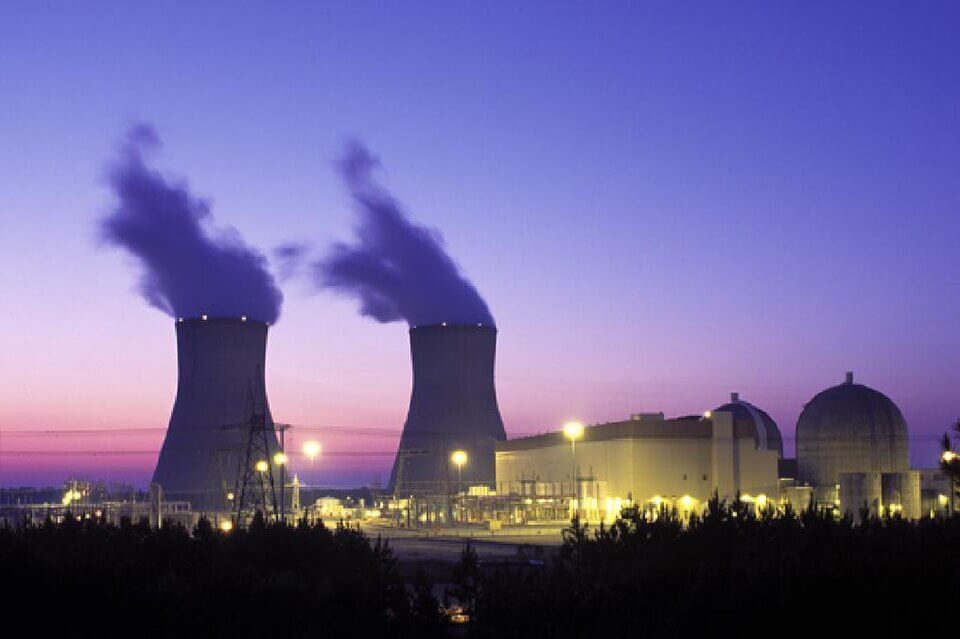
U.S. investor appetite for large nuclear fell sharply after Vogtle’s cost—USD 15,000 per installed KW—coupled with schedule failures, driven by lost on‑site generation skills, financing risk, and contingency inflation. China’s program, by contrast, uses volume, standardisation, domestic supply chains and state capital to drive large‑reactor costs toward and potentially below USD 1,000 per installed kW and to compress build times toward multi‑unit serial schedules under three years in aggressive scenarios. The result is diverging investment signals: risk‑averse private capital in the U.S. vs. state‑enabled industrial scaling in China.
Root causes of U.S. investor retrenchment
Vogtle created visible multibillion‑dollar overruns, amplified perception of extreme first‑unit risk and raised lender risk premia; utilities now avoid large private finance absent strong government guarantees.
Decades‑long U.S. construction hiatus has led to loss of tacit skills, fragmented and broken supply chains and higher contingency allowances—raising capital/ schedule estimates and scaring investors.
Contractual disputes and vendor failures (e.g., Westinghouse bankruptcy) increased perceived counterparty risk and pushed insurers/lenders away.
China’s pathway to very low unit costs and short schedules
Policy levers: state coordination, cheap capital, and centralised approval reduce financing and permitting premiums.
Industrial levers: standardised designs, high domestic content, supplier capacity kept warm between projects, large apprenticeship pipelines, and offsite modular fabrication drive down per‑unit engineering, QA and onsite labour.
Trend targets: Chinese programs publicly target USD 1,800/kW and aim lower (USD 1,200– USD 1,000/kW or below in high‑volume optimised scenarios), with repeat build schedules compressing toward 36–50 months for mature serial units in aggressive programs.
Comparative percentage declines (observable from China’s infrastructure programs)
Coal‑fired plants (China): capital USD / kW down ~40–60% since 2000s through 2010s/2020s.
Construction time for serial civil projects: down ~25–50% with repeat designs and modular practices.
On‑site labor/productivity: hours per kW reduced by ~30–50% via prefab and continuous pipelines.
Table — China’s Progress: percentage drops
Category
Historical drop range
Coal plant capital cost (USD/kW)
40–60%
Construction time (repeat projects)
25–50%
On‑site labor/productivity
30–50%
Investment implications — U.S. vs China
In the U.S.: private investors price in Vogtle‑level contingencies, require credit enhancements or government guarantees, and prefer alternatives with clearer cost predictability; this kills large private‑financed reactor projects absent policy intervention.
In China: state absorption of early risk plus high serial volume creates a downward spiral of cost and time that further lowers investment risk and reinforces future scaling — enabling targets toward or below USD 1,000/kW.
Conclusion
Without major U.S. policy action (direct subsidies, loan guarantees, standardised national designs, long‑term offtake guarantees, or state‑backed industrial rebuilding), U.S. investors will remain shy of large reactors; China’s evidence shows that scale + state coordination can compress costs and schedules dramatically, producing percentage declines similar to those already achieved in coal, rail and bridge programs.
A modern, 1 GW LWR generates 9,000,000 kWhrs per year which, at 10 cents per kWhr, creates revenue of USD 900,400,000 per year. Deduct USD 220 million for operating expenses for a profit of USD 680 million per year. California’s Diablo nuclear plant generates electricity for about 3 cents per kWhr.
If the plant’s two reactors cost USD 7 billion, their combined profit will repay the 7 billion in 5.7 years, after which they will net USD 1.3 billion/year while employing about 1,000 well-paid workers.
While we temporise, Russia and South Korea are building modular reactors (conventional and MSRs), for sale abroad, some of which will be mounted on barges that can be towed to coastal cities, thus making long transmission lines, with their 10% power loss, unnecessary. In 2020, the first of these barges began operation in Pevek, a town in eastern Siberia. (China makes a 1 GWe reactor for USD 3B in less than 5 years – Dr. Alex Cannara.)
In 2016, Russia inaugurated a commercial Fast Breeder Reactor (FBR) that extracts nearly 100% of the energy value of uranium. (LWRs utilize less than 5%.) The FBR creates close to zero waste and guarantees that we will never run out of thorium, uranium and plutonium, which yield 1.7 million times more energy per kilogram than crude oil.
Instead of pursuing these profitable programs, we [USA] have spent USD 400 billion on worthless F-35 jet fighters plus USD 2 billion PER WEEK in Afghanistan – AND there’s that missing USD 8.5 TRILLION that the Pentagon can’t find. [The Pentagon’s $35 Trillion Accounting Black Hole, by Michael Rainey, January 23, 2020]
Meanwhile, according to the GUARDIAN, “in 2013, coal, oil and gas companies spent USD 670 billion searching for more fossil fuels, investments that could be worthless if action on global warming slashes allowed emissions.”
California plans a USD 100 billion high speed train to serve impatient commuters between San Francisco and Los Angeles, and in 2014, Wall Street paid over USD 28 billion in bonuses to needy executives. If you include greedy sports team owners and players who, between 2000 and 2010, received 12 billion tax dollars to help pay for their arenas, the total could exceed USD 1 trillion.
With that money, we could easily build enough MSRs to end the burning of fossil fuels for generating electricity while drastically cutting carbon dioxide production.
According to WORLD NUCLEAR NEWS, Russia’s Rosatom Overseas intends to sell desalination facilities powered by nuclear power plants to its export markets: Dzhomart Aliyev, the head of Rosatom Overseas, says that the company sees ‘a significant potential in foreign markets,’ and is offering two LWRs producing 1200 MW each to Egypt’s Ministry of Electricity as part of a combined power and desalination plant.
“Desalination units can produce 170,000 cubic meters of potable water/day with 850 MWh of electricity per day. This would use only about 3% of the output of a 1200 MWe nuclear plant. In addition, two desalination units are also being considered for inclusion in Iran’s plan to expand the Bushehr power plant with Russian technology, and another agreement between Argentina and Russia also includes desalination with nuclear power.” Dzhomart Aliyev, chief executive officer of Rusatom Overseas.
In 2016, the Vice President of Rosatom reported that the company plans to build more than 90 plants in the pipeline worth some USD 110 Billion, with the aim of delivering 1000 GW by 2050.
“By 2030 we must build 28 nuclear power units. This is nearly the same as the number of units made or commissioned over the entire Soviet period… ROSATOM, the Russian nuclear power corporation and builders of the Kundamkulam nuclear power plant in India, has orders for building many nuclear power units abroad.” (XXII Nuclear Inter Jura 2016 Proceedings of the Congress)
Stratfor Global Intelligence reported in an October, 2015 article titled Russia: Exporting Influence, One Nuclear Reactor at a Timethat “Rosatom estimated that the value of orders has reached USD 300 billion, with 30 plants in 12 countries. From South Africa to Argentina to Vietnam to… Saudi Arabia, there appears to be no region where Russia does not seek to send its nuclear exports.”
However, our [USA] nuclear industry, opposed by Climate deniers like Donald J Trump, fervent “greens” and powerful carbon companies that put profit before planet, struggles to stay alive.
In Why Not Nuclear?Brian Kingdescribed our failure to build Generation IV nuclear plants that, unlike LWRs, take advantage of high-temperature coolants such as liquid metals or liquid salts that improve efficiency.
“Argonne National Laboratory held the major responsibility for developing nuclear power in the U.S. By 1980, there were two main goals: Develop a nuclear plant that can’t melt down, then build a reactor that can run on waste from nuclear power plants…
“In the early 80’s Argonne opened a site for an experimental breeder reactor in Idaho. About five years later [two weeks before Chernobyl], they were ready for a demonstration. Scientists from around the globe were invited to watch what would happen if there was a loss of coolant to the reactor, a condition similar to the event at Fukushima where the cores of three reactors overheated and melted.
“Dr. C. Till, the director of the Generation IV project, calmly watched the gauges on the panel as core temperature briefly increased, then rapidly dropped as the reactor shut down without any intervention!
“The Argonne Generation IV project was a success, but it couldn’t get past the anti-nuke politics of the 1990’s, so it was shut down by the Clinton administration because they said we didn’t need it.
“One can only imagine what the world would look like today, with a fleet of Generation IV nuclear plants that would run safely for centuries on all of the waste at storage sites around the globe. No heat-trapping carbon dioxide would have been created – only ever increasing amounts of clean, reliable power. So why not nuclear power?
“Unfortunately, most environmentalists oppose nuclear power, as do many liberals. The Democratic Party is afraid of anti-nuclear sentiment… like the Nation Magazine, the Sierra Club and others. Why are all these people against such a safe and promising source of energy?
“… nuclear power has been tarred with the same brush as nuclear weapons. Nuclear power plants can’t explode like bombs, but people still think that way….
“There is also a matter of group prejudice, not unlike a fervently religious group or an audience at a sports event of great importance to local fans. People are afraid to go against the beliefs of their peers, no matter how unsubstantiated those beliefs may be.
”Finally, some good news: In July, 2018, Advanced Reactor Concepts (ARC) and Canada’s New Brunswick Power agreed to build a sodium-cooled, small modular reactor (SMR) – and thereafter at other sites worldwide.
“The ARC-100 includes a passive, “walk away-safe” design that ensures the reactor cannot melt down – even if the plant loses all electrical power. The ARC-100 can consume the nuclear waste produced by LWRs and operate for 20 years without refuelling. Ontario approves nuclear.
OPG paving the way for Small Modular Reactor deployment, 6 October 2020
Under the agreement, the Korea Atomic Energy Research Institute and Samsung Heavy Industries plan to develop molten salt reactors for marine propulsion and floating nuclear power plants, using molten fluoride salts as the primary coolant at low pressure.
Thorium has the potential to transform the future of energy. The most important developments are taking place in laboratories, supply chains, and technology projects around the world—not only in the headlines.
We send updates when we have important information to share about the Liquid Fission revolution.
Our Covenant
Frequency: We send updates only when we have something important to share.
The Social Circle: Follow us on [LinkedIn] for regular updates and developments.
Exclusive content: Join us on [Patreon] for in-depth analysis and exclusive material.
Real-time nuclear news: Join our [Telegram] community for daily posts and conversations from around the world.
Transform a country: Join the [Indian Chapter] and support 1.5 billion people get Thorium energy.