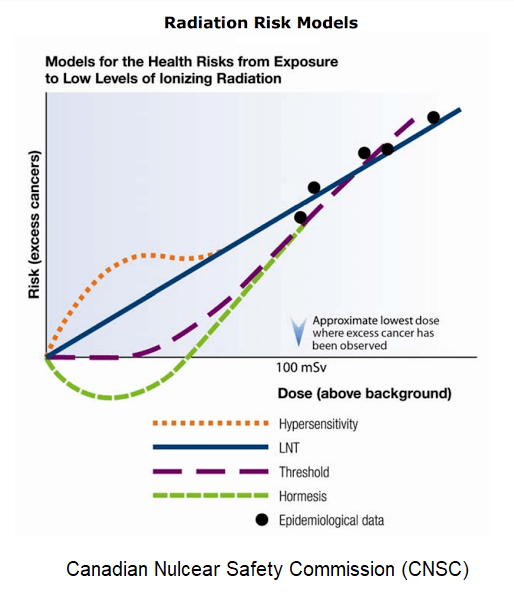
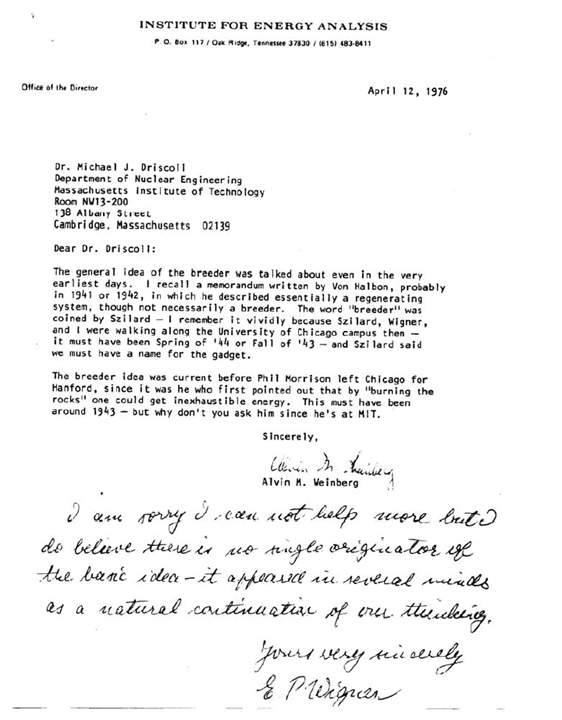
In 1928, Hermann Muller, the originator of the Linear No Threshold (LNT) theory, exposed fruit flies to 2,750 milliSieverts (mSv) of radiation in just 3 1/2 minutes, which caused gene deletions and deformities. Radiation dose, which we measure in Sieverts, is the biologically effective energy transferred to body tissue by ionizing radiation.)
Although the dose that Muller used was equivalent to receiving 1,000 mammograms in just 3.5 minutes, he called it a low dose, even though it was extremely high. (Even Japanese atomic bomb survivors didn’t receive such a large dose.)
Muller then extrapolated his results down to ZERO mSv without testing low levels of radiation and continued to promote his theory into the fifties, perhaps because he wanted to heighten fear of fallout from testing nuclear bombs. Muller argued that there is no safe level for radiation and claimed that even tiny amounts of radiation are cumulative. (According to LNT dogma, a butcher who cuts his finger fairly often will be dead in ten years from blood loss – despite his continuing to work.)
Ernst Caspari
Muller’s results were disputed by several of his colleagues, one being a researcher named Ernst Caspari, whose work Muller praised. (We learned this after Muller’s correspondence became public late in the 20th century). Muller wrongly asserted that, even at low dose rates over long times, the risk is proportionate to the dose.
In the fifties, no one knew that our cells routinely repair DNA damage, whether caused by radiation or oxidation, a normal body process, so we accepted his theory. (DNA is “short” for deoxyribonucleic acid, a complex, spiral, chain-like molecule that contains our genetic codes.)
By Zephyris – Own work, CC BY-SA 3.0, https://commons.wikimedia.org/w/index.php?curid=15027555
Muller’s theory is analogous to the earth-centered solar system that everyone “knew” was true for thousands of years, and it’s regrettable that so many still believe it. From its beginning, the LNT theory was based on a fraud, and it has been perpetuated by anti-nuclear fearmongers.
Excerpt from Muller’s Nobel acceptance speech.
So why wasn’t Muller truthful? During a radio interview on IEEE SPECTRUM’s “Techwise Conversations,” Dr. Calabrese explained it this way:
“Ernst Caspari and Kurt Stern were colleagues, and Muller was a consultant to Stern. Muller provided the fruit fly strain that Stern and his coworkers used. Stern and Muller thought there was a linear dose-response relationship even at low doses….
“In the chronic study, which was done far better in terms of research methodology than an earlier study, they found that the linear relationship was not supported, and what they observed would be supportive of a [safe] threshold dose- response relationship. This created a conflict—not for the actual researchers like Caspari—but for his boss, Kurt Stern, who tried to convince Caspari that his study didn’t support the linear model because his control group values were artificially high.
Calabrese Explaining the Fraud of Linear No Threshold Theory
“So Caspari… got lots of unpublished findings from Muller and put together a case that his boss was wrong. Ultimately, he got Stern to accept his findings that supported the threshold dose response. [Which actually meant that there was a threshold below which low levels of radiation were safe.]
“They sent Caspari’s paper to Muller on Nov. 6, 1946. On Nov.12 he [Muller] wrote to Stern indicating that he went over the paper, and he saw that the results were contrary to what he thought would have happened, that he couldn’t challenge the paper because Caspari was an excellent researcher, that they needed to replicate this, and that this was a significant challenge to a linear dose response because this study was the best study to date, and it was looking at the lowest dose rate that had ever been used in such a study.
“A month later, Muller went to Stockholm to accept his Nobel Prize, and in his speech, he tells the scientists, dignitaries, press… that one can no longer accept any consideration of a threshold model, that all you can really accept is the linear dose- response model. …Yet Muller had actually seen the results of a study that he was a consultant on, that was the best in showing no support for the linear model – but support for a [safe] threshold model.
“He had the audacity to actually go in front of all these dignitaries and mislead the audience. He could have said, ‘This is a critical area, and we need to do more research to try to figure this out.’ It would have been intellectually honest and the appropriate thing to say, but that’s not what he says. He tries to actually mislead the audience by saying there’s not even a remote possibility that this alternative exists, and yet he has seen it.”
Because Muller had also strongly (and appropriately) opposed the atmospheric testing of nuclear weapons, and because he wanted to persuade Congress and the American public to oppose the expansion of nuclear energy, he seems to have concluded that the end would justify his lie, even if it compromised his integrity.
In November, 2014, Dr. John Boice, president of the National Council on Radiation Protection, stated, ”…the reason they were concerned about the risk of radiation doses all the way to zero was because they used a theory [LNT] for genetic effects that assumed that even a single hit on a single cell could cause a mutation, and they did not believe there was any such thing as a beneficial mutation.”
When the LNT model was adopted by the National Academy of Sciences in 1956, its summary stated: “Even small amounts of radiation have the power to injure.” The report, which was published in the New York Times, inflated the fear of radiation, even at extremely low levels.
NAS Adopts Fraudulent LNT Theory
However, newly discovered letters between some of the members of the National Academy of Science committee indicate that the reason for adopting the LNT model was not that small amounts of radiation might be dangerous, but that Muller’s deception (and possibly self-interest), had trumped science – with one individual writing, “I have a hard time keeping a straight face when there is talk about genetic deaths and the dangers of irradiation. Let us be honest—we are both interested in genetics research, and for the sake of it, we are willing to stretch a point when necessary… the business of genetic effects of atomic energy has produced a public scare and a consequent interest in and recognition of the importance of genetics. This is good, since it may lead to the government giving more money for genetic research.”
In 2015, while reading Dr. Siddhartha Mukherjee’sThe Emperor of All Maladies, a Pulitzer Prize winner about our long battle with cancer, I came upon the following passage:
“In 1928, Dr. Hermann Muller, one of Thomas Morgan’s students, discovered that X-rays could increase the rate of mutations in fruit flies…” [Morgan, by studying an enormous number of fruit flies, had discovered that the altered genes and mutations could be carried from one generation to the next.]
“Had Morgan and Muller cooperated, they might have uncovered the link between mutations and malignancy. But they became bitter rivals Morgan refused to give Muller recognition for his theory of mutagenesis…
“Muller was sensitive and paranoid; he felt that Morgan had stolen his ideas and taken too much credit. In 1933, having moved his lab to Texas, Muller walked into a nearby woods and swallowed a roll of sleeping pills in an attempt at suicide. He survived, but was haunted by anxiety and depression.”
Knowing this, I wonder if Muller’s need for recognition and his resentment of Morgan, who received the Nobel Prize for his work on fruit fly genetics in 1933, might have caused him to hide the work of Ernst Caspari and others because it would have jeopardised his “fifteen minutes of fame.”
Muller received his Nobel Prize in 1946, but his deception has promoted the fear of all forms of radiation, however feeble. In addition, it has caused the deaths of millions and accelerated Climate Change by stunting the growth of CO2-free nuclear power, which has required us to burn huge amounts of polluting,health-damaging coal, oil and natural gas.
(Muller’s claim that tiny amounts of radiation are cumulative is like arguing that 50 jumps off of a one-foot step will be as damaging as one jump from a 50-foot cliff.)
For the great enemy of the truth is often not the lie – deliberate, contrived, and dishonest – but the myth – persistent, persuasive, and unrealistic. Too often we hold fast to the clichés of our forebears. We subject all facts to a prefabricated set of interpretations. We enjoy the comfort of opinion without the discomfort of thought.
US President John F Kennedy 1960-1963
“To overturn orthodoxy is no easier in science than in philosophy or religion.” Ruth Hubbard
Due largely to LNT, only a few new nuclear power plants have been designed and built since the NRC was created. There are at least 1,000 papers that prove LNT wrong—all of them ignored by NRC and EPA. On average the NRC creates one new regulation per day, and it can cost a billion dollars just to get approval for a test reactor of a new design.
It’s unfortunately when good science is spun to create bad press.
Fusion is nowhere near a solution. In the very same article Qout (thermal and not electrical) is 11 MW. Qin is 1 GW. Hence Q = 0.011.
It’s just media hype, BBC style. Europe’s ITER has collected Euro 65b of public money on the fusion lie. Well not a lie, but misinformation. To maintain funding. If politicians – and the handful of duped investors – really new the science it would be given a few million, but that’s a digression…
From the data in the BBC/Oxford/JET article the ratio of energy out to energy in is only 1.1%, and only for 11 seconds…
Q= 0.011
Hype.
One suspects BBC/Oxford trying something similar to collect some of the billions going into UK fission projects for the JET project. There’s 300 scientists working on JET after all.
(Point to note: 14,000 people worked on the first molten salt project in 1954. It’s not because they didn’t have iPads).
The downside of hyping such projects is it delays public acceptance of fission (the same way the fossil fuel industry plays the green renewable card to the public).
Most investors are more savvy – it’s their purpose to be savvy. Eg, now Bill Gates, and of course the Turkish, Chinese, Russians and French.
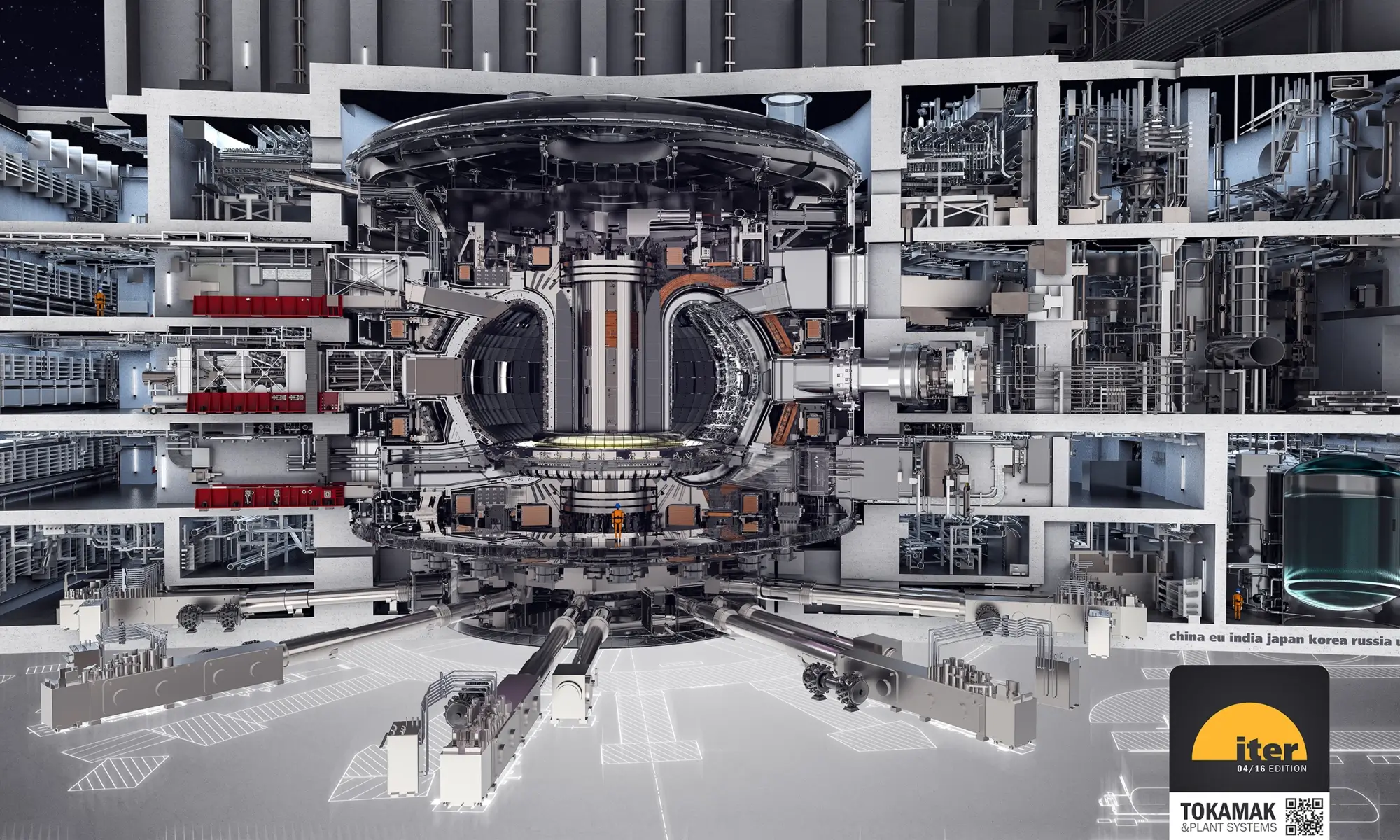
Note that ITER is aiming for Q-Plasma parity. Not Q-Total… A small detail even the director of ITER opening ignores, and I am sure an ignorance he promotes. What’s his budget after all? Watch the YouTube in this article:
Whilst it’s not our focus – ours is production of energy using Molten Salt Fission Energy technology and Thorium – we’ve found it appropriate for a couple of focused articles – this one on JET and one on ITER – to highlight the inappropriate gap between the science and the spin. Both articles are be found here.
This spin on fusion distracts from real progress on carbon free power production for our societies. It diverts attention from real technologies. It confuses the public. It diverts public money – and a few duped private investors – who, given full knowledge, would provide their support to such projects more judiciously.
For more comprehensive study on the inadequacies of fusion for power production we refer you to the work of Steven B. Krivit and this site New Energy Times.
So, let’s go back to basics. Energy = Life. I don’t think anyone disagrees. More energy = more life, and for humans, it means a better society. There are ample studies on this, but we do like to study the obvious, don’t we. It’s the not-so-obvious that this post is about.
Specifically, let’s talk about the ratio of energy obtained compared to the effort expended to obtain that energy in the first place. Hence let’s define EROI: Energy Return on Investment. EROI is far more encompassing than ROI or LCOE. I’ll leave it to others to explain those two. EROI provides “full boundary enclosure” – and that means you include the entire planet – to properly assess the impact and suitability of an energy system. The evidence of this can be described through an empirical timeline of humanity. For an eon of human development no fire meant an EROI ranging from 1 (let’s call it one human power -> direct effort in = direct effort out) to 4 (horses have about 4 times as much power as a human).
Then fire is harnessed. What happens? Civilisations are born. Massive growth in population and subsequently culture, technology and thus quality of life. The EROI? It’s between 7 and 12 for burning biomass (i.e. trees). It depends on the water content, cell density etc. It turns out that the magic number for humans to Thrive is about 7:1. Seven is the bare minimum for a society to move from survival to thriving. Otherwise the search effort for energy is too much for anything more than a simple lifestyle (Think: Inuit, Australian Aboriginals, or American Indians, et al).
Another eon passes, and coal is harnessed. With an EROI of 30:1 suddenly there’s excess energy. What happened? The Industrial Revolution. Steel production. Steam power. Drill bits, oil derricks and…. oil… Rocket ship stuff.
Oil: with an EROI of 80:1 what a panacea it became! (Saving the whales along the way – another story for another day). But hold your breath because burning oil stinks and so does coal.
The story is almost done.
With such a high EROI (80:1) our civilisation truly becomes global. And… we are able to develop Fission Energy! (Nuclear for those not in the know). Solid fission is about 75:1, so again incredible and just perfect for our civilisation – no CO2 is produced. Unfortunately, oil had already a 100 year head start and the piles of money stashed away were quite ready, willing and able to snuff out any competitor. Which they did with great efficaciousness. (That’s another story too).
So, that’s the short story of humanity based on energy, but more importantly EROI – Energy Return on Investment.
What is the EROI of solar? Check the chart below. It’s 1.6:1. Not good. What about wind? 3.9:1. Not good either. These systems do produce energy and yes, a house, a village, perhaps a city can be “green” using only wind and solar. But their neighbours take the burden of everything that can’t be made in that society. Because nothing can work at such a low EROI, except providing for a nice simple lifestyle. Even food production will suffer.
If the entire world switched to EROIs below 7, the net result will be a generational decline in living standards for everyone. This is actually impossible, as there are many who understand EROI. There are however countries that will try to do it. The impacts can be seen after only 20 years in Germany.
Post by Jeremiah Josey and the team at The Thorium Network
“The same oceans that nourished human evolution are poised to unleash misery on a global scale unless the carbon pollution destabilizing Earth’s marine environment is brought to heel.”
In 1866, Svante Arrhenius, a Swedish chemist, estimated that doubling our Earth’s atmospheric carbon dioxide would raise its temperature by 9 degrees F, which is why CO2 and its “associates” are called greenhouse gases (GHG).
Svante Arrhenius
Then, in 1958, Dr. Charles Keeling, the American chemist and oceanographer began to record the level of atmospheric CO2 at Hawaii’s Mauna Loa Observatory, which, being 10,300 feet above sea level and far out in the Pacific Ocean, avoided misleading data from mainland sources that could skew his research. Although Keeling proved that CO2 levels were soaring, his work had little influence for more than 20 years.
Acting like blankets, greenhouse gases limit how much of the Earth’s heat can escape into space. If the blanket becomes too thin for too long, too much heat escapes, and an Ice Age follows. However, if it thickens excessively, as it already has, too much heat is trapped, and the Earth develops a fever.
If we give water vapor a rating of 1, carbon dioxide would rate a 5, but methane, (CH4 – the primary component of natural gas), is initially 80 times worse than CO2, averaging 20 times worse as it slowly oxidizes to CO2 and H2O, which takes decades.
However, despite the fact that CO2 is 5 times more potent than water on a molecule to molecule basis, water vapor is a more powerful accelerator of climate change because there is a lot more water vapor, and as the planet warms, even more is created. That extra water vapor traps additional heat, which raises ocean and land temperatures even higher.
For millions of years, our planet has been nurtured by a gassy comforter that, like Goldilocks’ bed, has been just right. Those gases have served us well, especially since the last Ice Age, varying only a little while periodically providing nothing worse than a string of harsh winters or abnormally hot summers before returning to normal. That has changed, and the rate of change is rapidly increasing.
Thanks to air trapped in ice from Greenland and Antarctica, we know that the level of atmospheric CO2 has been hovering near 280 parts per million (ppm) since the age of the dinosaurs. However, that number slowly began to rise about 250 years ago when the Industrial Revolution allowed us to burn increasing amounts of carbon. By 1950, atmospheric CO2 levels had reached 300 ppm.
Spurred on by increasing industrialization and burgeoning populations, that number reached 421 ppm in May, 2021. Now that we are no longer hampered by an anti-environment President, his carbon-loving, anti-science cabinet and a badly distracted Congress, we can and must elevate planet above profit if we and the environment that supports us are to survive.
As temperatures rise, heat-reflecting snow and ice become water, which absorbs 90% of the greenhouse gas (GHG) heat and creates water vapor. Warming the oceans increases their volume, which will bring coastal flooding plus serious economic and social upheaval. Nevertheless, Florida’s Governors have ordered employees to avoid discussing climate change, and Miami is launching a building boom despite street flooding from increasingly higher tides.
The loss of snow and ice exposes land, which, as it warms, produces more water vapor, which brings heavier rains and stronger thunderstorms and tornadoes. In addition, our warming planet will experience a decrease of snowfall, which will reduce the mountain runoff needed to replenish reservoirs that store precious water for agricultural, industrial and personal use.
As the land-based ice in the Antarctic and Greenland melts, rising sea levels will destroy coastal cities, create millions of refugees and cause civil unrest. The insurance industry knows this, and it has already begun to adjust its rates.
Rising seas will displace 300 million people by 2050
The world is at its hottest for at least 12,000 years
The Guardian, 2021
For eons, Nature has relied on three primary methods to capture CO2. The first is photosynthesis by forests, crops and ocean plants that range from huge kelp “forests” to tiny phytoplankton, but we are clear-cutting forests equal in area to West Virginia every year while polluting our oceans. The second also involves the oceans, which can absorb huge amounts of CO2, and the third depends on CO2-hungry basalts that have been stripped of their carbon dioxide by the heat of volcanoes.
However, adding CO2 to water creates carbonic acid, which impedes the formation of the calcium carbonate shells of crabs, shrimp, lobsters, oysters, scallops, and most importantly, tiny organisms like the phytoplankton that comprise the foundation of the ocean food chain.
Acidifying our oceans is already causing greater damage than sea level rise, and it will have far more serious consequences.
We now have evidence that the concentrations of CO2 and other greenhouse gases will, within a few decades, equal those that caused the Permian extinction that occurred some 250 million years ago – when more than 90% of all oceanic species died due largely to huge eruptions of CO2 and methane in Siberia.
Because these conditions developed over hundreds of thousands of years, many organisms had time to evolve, but our anthropogenic (human-caused) Climate Change, being much more rapid, will leave too little time for many species to evolve. (The Cretaceous-Paleogene die-off 56 million years ago also followed a significant drop in the pH of the oceans.)
Like it or not, the problems we face are the direct result of our creating 2.1 trillion tons of Industrial Age CO2, to which we are adding 50 billion tons per year. Only 1/3 of that CO2 has dissolved in our seas, and as the remainder is absorbed, our oceans will become even more acidic (less alkaline) and increasingly hostile to life.
In April, 2021, atmospheric CO2 levels reached 418 ppm.
Our oceans have been slightly basic for millions of years, having an average pH of 8.2. (7.0 is neutral, being neither acid nor basic). However, in the last 250 years, our excesses of CO2 have made our oceans more acidic as their pH has dropped from 8.2 to 8.1.
That might seem trivial, but because the pH scale is logarithmic, not linear, this represents a large increase toward acidity, and a pH of 8.0 or 7.9 couldl mean death to many species, including phytoplankton, and near-death to the oceans that provide 20% of our protein and 50% of our oxygen.
Even if we stop burning carbon today, we will still have almost 1.2 trillion tons of excess, man-made CO2 in our atmosphere to deal with. It is no exaggeration to say that we only have about 15 years, not decades, to prevent the next 0.1 drop in pH.
Since 1980, we have melted 72% of the Arctic’s ice, and in 2014, scientists at California’s Jet Propulsion Laboratory who monitor the rate of arctic melting reported that at least 50 cubic miles of the Greenland ice sheet melted during just 2013. And in early April, 2017, the Coast Guard International Ice Patrol, which tracks icebergs, sighted 450, which is far more than the historical average of 83 in the same area at that same time of year.
As the Arctic warms, the tree line is slowly moving north, as are robins, black bears and a host of “southern” insects. I have seen these changes and many more.
Beginning in 1961, I spent parts of the next 38 summers “bush flying” in northern Canada and Alaska. There, winters are now at least five weeks shorter than they were just 50 years ago, and the shrinking ice pack is leaving many polar bears insufficient time to fatten up on seals, with some bears coming off of the springtime ice severely underweight. Some are drowning, having become too weak to survive what was once an easy 100-mile swim to shore for a healthy bear.
Once ashore, these weakened bears face a new hazard: Grizzly bears are expanding their range, and even a healthy polar bear is no match for a grizzly.
When the winter of 2016 began, the North Pole was 36 degrees F above normal, and in July, 2017, an ice shelf the size of Delaware broke free from Antarctica.
With NOAA reporting that 2019 was, globally, the hottest year ever recorded, (with arctic temperatures running as high as 16 degrees F above normal), and that 2020 has been the hottest on record, what hope is there for these magnificent animals – and for many other species that are not as photogenic or obvious? In March, 2020, Antarctica broke previous records with a high of 68 degrees F.
In Oregon, Washington and British Colombia, oyster farmers must now add lime to their tanks of ocean water to counter its increasing acidity. And according to the World Wildlife Fund, over fishing just between 1970 and 2014 has reduced the number of fish and other ocean species by 50%, with tuna and mackerel down by 74%. In addition, several new studies show that even current levels of oceanic CO2 can even “intoxicate” fish, which can impact their ability to survive.
Plankton Surface Mass
The year scale in this image ranges from 1850 to 2100. The dark blue line shows decreasing pH – increasing acidity – and the green line reveals the decrease in carbonate available for making shells. In the chart, “NOW” is 2014. We will be farther down the dark blue line when you read this book.
In 2014, Canadian scientists discovered that the volume of arctic phytoplankton had dropped an alarming 40% since 1950, and since then it has continued to drop by 1% per year.
Why should we care about these tiny organisms? Because phytoplankton provide the base of the food pyramid that sustains most oceanic life, and no phytoplankton will eventually mean “no fish.” In addition, as previously noted, phytoplankton produce 50% of our oxygen and consume most of the carbon- dioxide we produce by using carbonates to build their shells.
When they die, their tiny shells accumulate on the ocean floor, eventually becoming limestone – the end result of the most effective carbon sequestration process on earth. That process can sequester a billion tons of CO2 per year, which sounds impressive, but, as noted earlier, we are emitting 50 billion tons of CO2 every year. Worse yet, since prehistoric times, the amount of oxygen in our atmosphere has declined by a third, almost entirely due to deforestation and the decrease in phytoplankton.
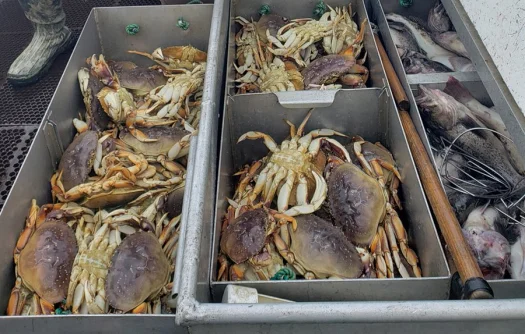
Deepwater Horizon PhytoplanktonDungeness CrabsHealthy North Sea larvae on left side, sick on the right
Carbon emissions are acidifying the ocean so rapidly that the seafloor is disintegrating.
National Academy of Science, 2018
Australia’s Great Barrier Reef is 50% dead. Caribbean corals are 80% dead (PBS May, 2021). By 2050, shellfish calcification and survival could become impossible. Our carbon dioxide emission rate is even greater than the volcanic emission rate that caused the Permian extinction 250 million years ago when the world lost 90% of its species.
Even if we find a way to emit less CO2 than is being absorbed, our oceans will continue to acidify because the CO2 we have already created will persist in our atmosphere for hundreds of years, and in the oceans for tens of thousands of years, which is why we must develop some form of corrective geo-engineering. However, that will require huge amounts of CO2-free, non-polluting nuclear power.
Reducing acidification must become a worldwide priority if we are to avoid a life-changing oceanic and humankind disaster. Extinctions of sea life are certain if we do nothing.
“We cannot cheat on DNA. We cannot get around photosynthesis. We cannot say I am not going to give a damn about phytoplankton. All of these mechanisms provide the preconditions of our planetary life. To say we do not care is to say that we choose death.”
1. Mimic the natural carbon sequestration process of the oceans: Use CO2-free, highly efficient nuclear energy to heat limestone or dolomite to release lime (calcium oxide and magnesium oxide), which we distribute across the ocean to neutralize the carbonic acid. The CO2 produced when limestone is heated would be sequestered in porous basalt, with which it chemically combines. Refining enough lime from limestone will require about 900 1-Gigawatt (GW) nuclear plants, and that’s only enough to neutralize our present emissions.
[A team led by Dr. Ken Caldeira, a climate scientist at the Carnegie Institution for Science, used an alkaline substance to alter the chemistry of seawater at a small atoll in Australia’s Great Barrier Reef. The resulting decrease in seawater acidity mimicked pre-industrial ocean conditions – so this remedy could work.]
[If we had adopted the Atomic Energy Commission’s 1962 recommendation to expand nuclear power, we’d already have those nuclear plants, we’d have created less CO2, and we’d have saved MILLIONS of lives that have been lost due to carbon-related pollution.]
2. Spread finely ground basalt into the oceans. Basalt, which is created by volcano1es, is “carbon hungry,” so basalt would remove CO2 from the oceans. Lime and basalt, being basic, would assist shell formation by neutralizing the carbonic acid. Volcanic ash, which is primarily powdered basalt, can also be used to improve soil quality, so scattering “powdered” basalt across farm fields could help remove the excess carbon dioxide from our troubled atmosphere.
“Our current anthropogenic carbon dump rate is about 33.4 gigatons of CO2/year. Each ton of powdered basalt can “fix” about 0.2 tons of carbon (0.73 tons CO2), so we’ll need to mine, grind, and disperse about 46 billion tons of basalt powder/yr to keep up with our current CO2 dump rate (about the total amount of sand & gravel now mined/yr). At 100 kWhr/ton, the power needed to convert that much rock to powder would require the electrical output of 500, 1 GWe nuclear reactors. However, basalt contains many minerals, some of which might be harmful to sea life, so basalt might have to yield to lime, which is as natural as the organisms that incorporate it in their carbonate shells and skeletons. In any case, marine biologists should oversee these actions and the production of the materials.
Enhanced chemical weathering as a geoengineering strategy to reduce atmospheric carbon dioxide, supply nutrients, and mitigate ocean acidification
“For this to work on land, fields should be warm, watered, tilled and biologically active. The world’s 400 million acres of rice fields seem to fit that bill. Land currently devoted to corn and soybean production would probably also be suitable.
“This approach is more affordable than scenarios that invoke electrochemistry or the calcination of limestone. In addition, it would appeal to countries that want to increase agricultural productivity.
3. “Pump water and CO2 from the air into the basalt that underlies huge areas of the globe. The volcanic basalt, will combine with the carbonic acid to LOCK UP the CO2. This is not same as just pumping compressed CO2 down a hole and hoping it stays there.“Iceland studies reveal that up to about 150 pounds of CO2 can be stored in just one cubic meter of basalt, and if we could also apply this process to the basalt in ocean ridges, we could sequester the 5,000 Gigatons of CO2 created by burning all of the fossil fuel on Earth. If this were done worldwide, it could drastically shorten the timescale of carbon trapping. Instead of taking centuries, CO2-trapping via basalt carbonation could be completed within a few decades, but it will require huge amounts of CO2-free electrical power.” In 2017, scientists at Caltech and USC found a way to speed up part of the reaction that helps sequester CO2 as limestone in the ocean. By adding the enzyme carbonic anhydrase, the researchers made the sequestering process proceed 500 times faster, and in 2018, a new process for sequestering carbon dioxide in concrete was developed.
We must also electrify cement making, which requires huge amounts of energy, by using electricity generated by CO2– free nuclear power, then sequester the CO2 released during the process in basalt and use the lime to assist the ocean.
To summarize: Our planet’s ocean life can sequester a billion tons of CO2 per year by making shells, skeletons, limestone, etc. However, the 1/3 of the 2 trillion tons that the ocean has already absorbed has already lowered ocean pH close to extinction levels for many organisms.
Ocean warming has worsened the threat, and 2050, not 2100, is the key oceanic end-of-life date, and this doesn’t include the warming caused by methane liberated by thawing permafrost and sub-sea methane hydrates.
Therefore, getting CO2 levels down to 350 is probably meaningless if we don’t protect ocean chemistry.
To sequester CO2 one must chemically remove about 500 CO2 molecules from every 1,000,000 molecules of air – and then store them FOREVER.
We will also need to connect the removal sources to basalt formations that permanently store CO2 as rock. Then, we must address methane leakage, which is adding about 200 ppm of equivalent CO2 to the air because our natural gas wells and our porous distribution systems are leaking so severely.
We must get serious. Our yearly 40+ trillion tons of CO2 emissions have already brought ocean chemistry 2/3 of the way to the death of the oceans that create 50 % of our oxygen.
Bad news: If we add the effects of methane leaking from fracking wells and our porous distribution system, and methane released from thawing permafrost, our May, 2021 CO2 level of 421 ppm would, in effect, be over 500.
More bad news: Because humans cool their bodies by sweating, rising heat and humidity will increase stress while decreasing comfort and efficiency. Further increases will cause medical issues that can even be fatal.
Even more bad news: 50 % of the Arctic’s shallow permafrost is predicted to thaw by 2100. As it does, some of its 40 million gallons of previously immobilized, hazardous mercury will be released into the polar ocean and the atmosphere.
At least 30,000 plant and animal species are threatened with extinction.
Dr. James Hansen, former chief climate scientist at NASA, now chief climate scientist at Columbia University, is well known for bringing definitive evidence of global warming to Congress in 1988:
“Environmentalists and world leaders must accept nuclear power now to avoid catastrophic climate change…Mass species extinction, extreme weather events, dry spells and fires are climate change impacts which are happening now.
“A warmer atmosphere and warmer oceans can lead to stronger storms,” he explained. (Superstorm Sandy, for example, remained a hurricane all the way up the Eastern seaboard to New York because Atlantic waters were abnormally warm.)
Planet is trapping almost twice as much heat in atmosphere as it did 15 years ago.
NASA, 2021
“Amplifying impacts” and feedback loops will accelerate the changes, says Hansen. “It will happen faster than you think,” he said. (If major coastal cities become dysfunctional because of sea level rise, which he believes is possible, the global economy could be in peril of collapse.)
Only when the last tree has died, the last river has been poisoned and the last fish has been caught, will we realize that we cannot eat money. – Cree Indian Proverb
This piece was written as part of the oneday2050.org program, created by Jaume Enciso Cachafeiro of Sabadell, Catalonia, Spain. Reach out to Jaume if you want also to contribute.
“Our minds are the most powerful tools we have. Applied correctly, we can achieve anything”
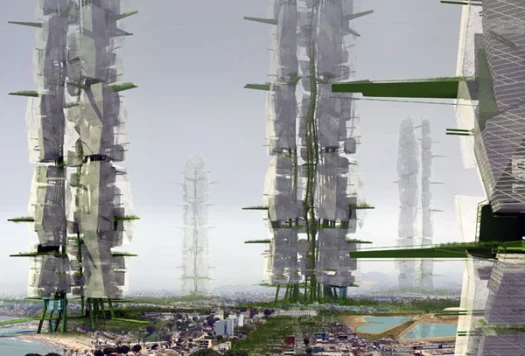
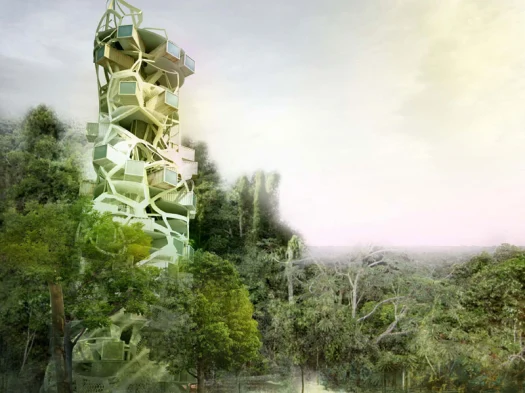
The sun rises and over a verdant green vista. My home awakes me with the gentle sounds of birds and the curtains slightly to let in the Eastern rising sun. I motion with my hand and the curtains fully open. Other folk have the electrostatic polymer window panes installed but I still like the feel and texture of a material window covering. Even if it is 100% fabricated from grown polymer fibres. Through my windows I see the tops of thousands of trees lit by the brilliant, new, fresh gold of the morning sun. These trees are less than 30 years old and spread as far as I can see.
I also see 5 other residential towers like the one I’m in. Each is 1,000 metres high and with the same 10,000 apartments. All are connected beneath the trees by boulevards and underground maglev personnel pods and shuttle carriages. I can also see the faint steam coming up from several areas among the tees.
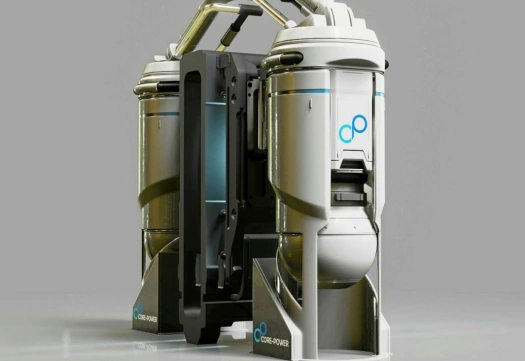
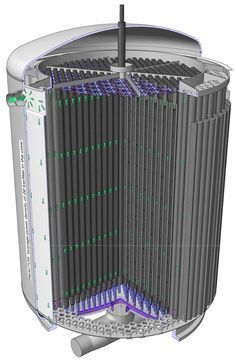
That’s why I live here. Cheap electrical energy, and thermal domestic heating. 10 times less than even the cheapest fossil fuel from 30 years ago. Hidden beneath the trees and 20 metres of earth are tiny power generators driven by Thorium Molten Salt Fission Technology. I had a small hand in that – I was one of the scientists in the early design teams.
Safe, clean and green. The power units are entirely replaced every 20 years – even though they have a lifespan of 30. These power units are second generation already. Maybe 40 years they can be here. No overhead cables. No step down transformers. No cooling towers. No fuel lines. No coal conveyor belts. No waste heaps. Wow, what a change.
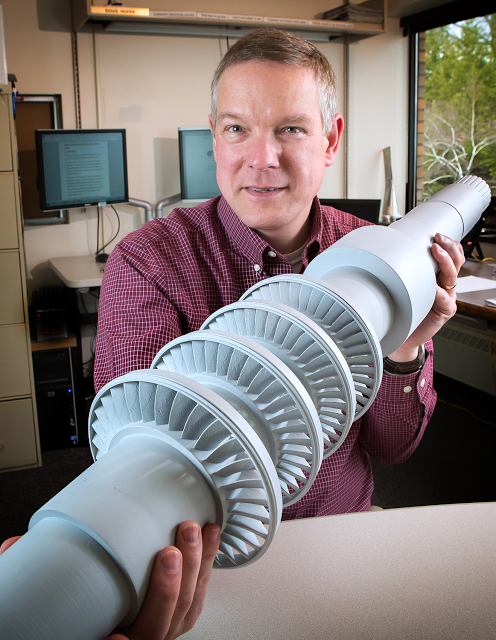
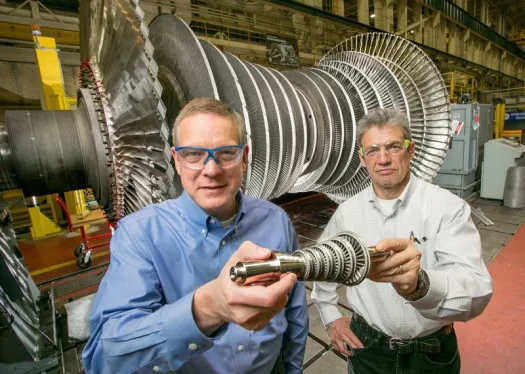
The supercritical CO2 turbo-machinery was developed by Mitsubishi and Siemens. They are tiny and work for decades with no maintenance. Heck, we are even using Stirling cycle machines in 3 of the power units. Maybe we’ll switch over soon for all of them.
This device produces the same energy output as the one behind. That’s the power of Super Critical CO2
Power generation in 2050 has become easy. No more oil wars, oil blockades, gas transit or border disputes. Each country has access to technology as common as the once common internal combustion engine.
Thankfully Elon Musk finally killed that infernal fossil driven machine 20 years ago. It’s all electric from here – neutrons to electrons. Everyone is happy. There’s still lots to do: millions have had to move because of rising sea levels. At least now we can build it right.
Post by Jeremiah Josey and the team at The Thorium Network
What’s the Fossil Fuel Record? Millions of Air Pollution Deaths each year Because the carbon industries are heavily subsidised, one might expect them to have exemplary safety and social records, but one would be wrong!
According to the Guardian(2021-10-21) “The IMF found the production and burning of coal, oil and gas was subsidised by USD 5.9tn in 2020″ Or USD 11 million a minute every day. This is according to a startling new estimate by the International Monetary Fund. The IMF has noted before that existing fossil fuel subsidies overwhelmingly go to the rich, with the wealthiest 20% of people getting six times as much as the poorest 20% in low and middle-income countries.
In 2006, the Sago coal mine disaster killed 12. A few years later, a West Virginia coal mine explosion killed 29. In May 2014, 240 miners died in a Turkish coal mine.
The ash derived from burning coal averages 80,000 pounds per American lifetime. Compare that to two pounds of nuclear “waste” for the same amount of electricity. The world’s 1,200 largest coal-fired plants cause 30,000 premature U.S. deaths every year plus hundreds of thousands of cases of lung and heart diseases.
Normal Operations – Ash from Coal Fired Power Station – Tennessee Valley Authority
Generating the 20% of U.S. electricity with nuclear power saves our atmosphere from being polluted with 177 million tons of greenhouse gases every year, but despite the increasing consequences of Climate Change and Ocean Acidification, the burning of carbon to make electricity is still rising.
Scientific American, 13 Dec 2007: “Coal-fired plants expel mercury, arsenic, uranium, radon, cyanide and harmful particulates while exposing us to 100 times more radiation than nuclear plants that create no CO2. In fact, coal ash is more radioactive than any emission from any operating nuclear plant.” How Coal Kills 17 Feb 2015
In one year, a CO2-free, 1,000 MW nuclear plant creates about 500 cu ft of spent fuel that can be recycled to retrieve useful U-238, reducing its bulk by about 90%. (An average U. S. bathroom is about that size.) In that same year, a 1,000 MW coal plant creates 65,000 tons of CO2 plus enough toxic ash to cover an entire football field to a height of at least 200 feet.
Every year, we store 140 million tons of coal ash in unlined or poorly lined landfills and tailing ponds. In 2008, five million tons of toxic ash burst through a Tennessee berm (see below), destroying homes and fouling lakes and rivers.
Coal-fired power plants leak more toxic pollution into America’s waters than any other industry. (A June, 2013 test found that arsenic levels leaking from unlined coal ash ponds were 300 times the safety level for drinking water.)
And in 2014, North Carolina’s Duke Energy’s plant (now bankrupt) “spilled” 9,000 tons of toxic coal ash sludge into the Dan River. Why do they always say “spilled” – never “gushed?”
Coal companies like to promote their supposedly “clean coal,” which really means “not quite so filthy,” but despite making an attempt at carbon capture and storage (CCS) at a new power plant in Saskatchewan, the plant has been a failure. (Burning fossil fuels causes 4.5 million early deaths per year.)
CO2 removal devices use natural gas or electricity, which is usually generated by burning carbon. The moral hazard of removing CO2 from the air is that it justifies burning fossil fuels.
Technology to Make Clean Energy from Coal is Stumbling in Practice An electrical plant in Saskatchewan was the great hope for industries that burn coal. In the first large-scale project of its kind, the plant was equipped with a technology that promised to pluck carbon out of the utility’s exhaust and bury it, transforming coal into a cleaner power source. In the months after opening, the utility and the government declared the project an unqualified success, but the USD 1.1 billion project is now looking like a dream.
Known as SaskPower’s Boundary Dam 3, the project has been plagued by shutdowns, has fallen way short of its emissions targets, and faces an unresolved problem with its core technology. The costs, too, have soared, requiring tens of millions of dollars in new equipment and repairs.
“At the outset, its economics were dubious,” said Cathy Sproule, a member of the legislature who released confidential internal documents about the project. “Now they’re a disaster….”
New York Times by Ian Austen, 29 March 2016, Ottawa
Even modern, 75% efficient coal-burners with thirty-year lifespans can’t compete with nuclear plants that have lifespans of 60 years and provide CO2-free power at 90% efficiency, and the new plants are even safer. In addition, our coal reserves will last 100 years at best. And as we “decarbonize”, we will require increasing amounts of electricity, and the only source of economical CO2-free, 24/7 power must be our new, super-safe, highly efficient nuclear reactors that cannot melt down.
Note: The word “efficiency,” AKA “capacity factor,” in this book means the amount of electricity created over an extended period by wind, solar, etc. compared to their maximum power rating. Unfortunately, the maximum power rating is often used to sell the project. For nuclear reactors, this figure is at least 90%, but it is 33% for windmills and just 19 -22% for pv solar – and solar panel efficiency degrades by 1% per year during their short, 20 year lifespan. (Thermal efficiency is a separate matter.)
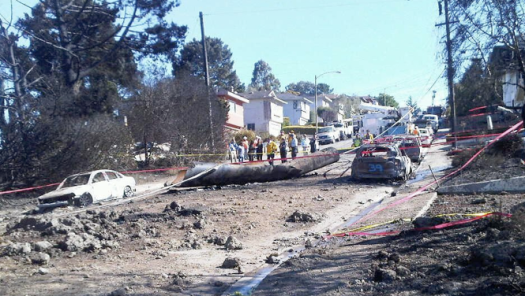
When a gas pipeline exploded in 2010 at San Bruno, California, 8 people died, 35 homes were levelled and dozens more were damaged. In 2016, a federal government report stated that natural gas explosions cause heavy property damage, often with deaths, about 180 times per year– that’s every other day.
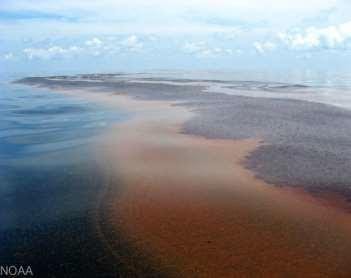
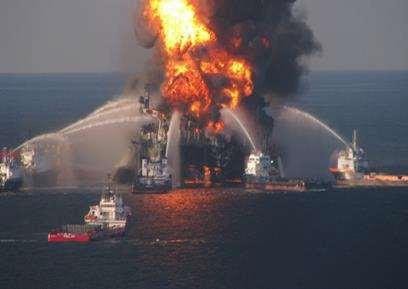
In 2010, British Petroleum’s Deepwater Horizon disaster in the Gulf of Mexico “spilled” 200 million gallons of oil and killed 11 workers and 800,000 birds. Prior to that, an explosion at a Texas BP refinery killed fifteen workers. And BP, which was also involved in the Exxon Valdez “spill” in Alaska’s Prince William Sound, is just one of the many oil companies that we subsidise with USD 2.4 billion every year.
“‘Evolution is driven by the tendency of all organisms to expand their habitat and exploit the available resources… Just as bacteria in a Petri dish grow until they have consumed all of the nutrients, and then die in a toxic soup of their own waste.”
William Ophuls
Later in 2010, an Enbridge pipeline ruptured in Michigan, eventually “spilling” more than a million gallons of tar sands crude into the Kalamazoo River. When monitors at the Alberta office reported that the line pressure had fallen to zero, control room staff dismissed the warning as a false alarm and cranked up the pressure twice, which worsened the disaster. In 2018, Enbridge’s “cleanup” was still incomplete.
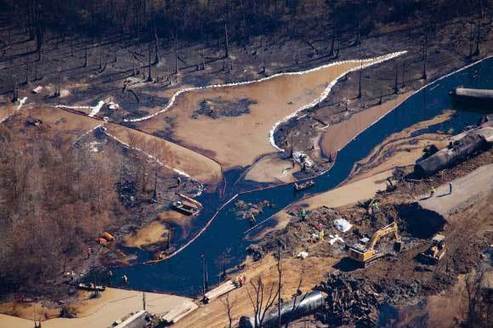
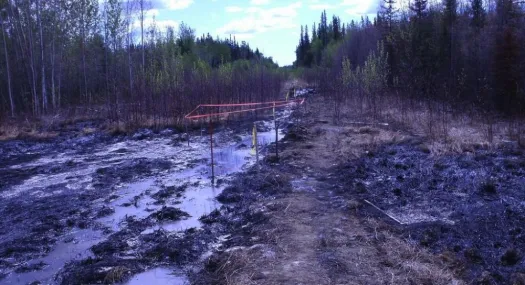
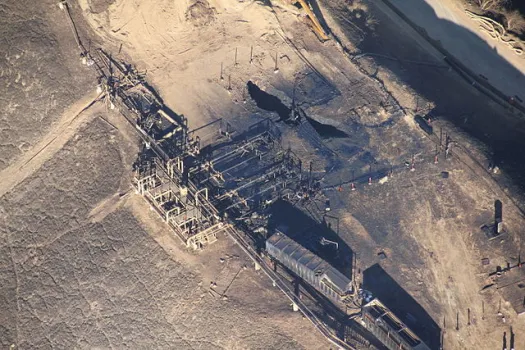
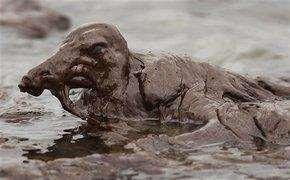
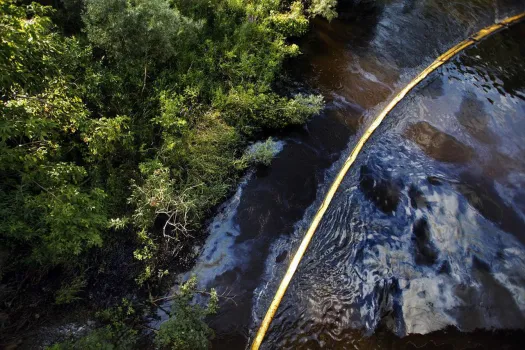
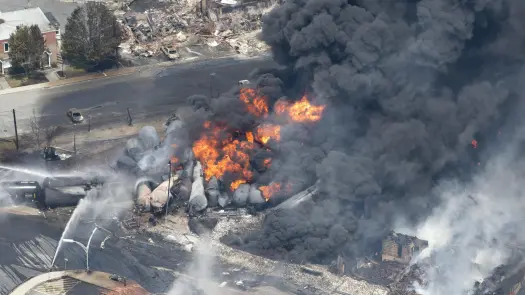
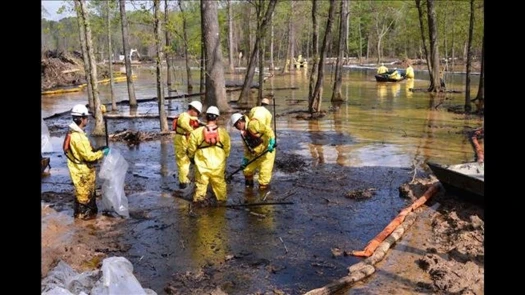
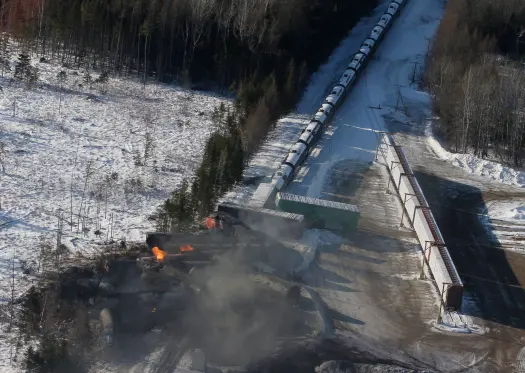
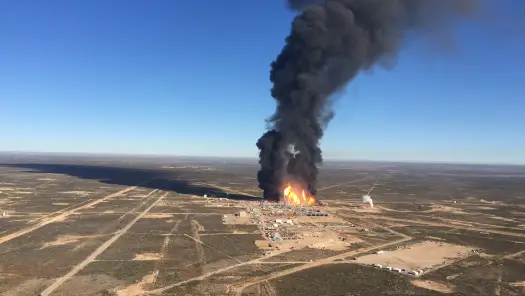
800 Mile Oil Spill Alaska 1989Alabama Oil Train Crash 2013Alberta Waste Oil Spill 2014Aliso Canyon Methane Leak 2014Bird in Oil Alaska 1989Enbridge Tar Sands Oil Pipeline Spill Kalamazoo 2010Fire at BP Deepwater Horizon 2010Lac Megantic Quebec Oil Train Crash 2013Mayflower, Arkansas Exxon Oil Spill 2016Oil Train Derailment in New Brunswick, Canada 2014Ramsey Natural Gas Processing Plant in Orla, Texas 2015San Bruno Gas Pipeline Explosion 2010
In 2013, a spectacular train wreck dumped 2 million gallons of North Dakota crude oil into Lac Megantic, Quebec, killing 47 residents and incinerating the centre of the town – but that’s just another page in the endless petroleum tale that includes Exxon’s disastrous, 2016 “spill” in Mayflower, Arkansas, that received scant notice from the press.
And in November 2013, a train loaded with 2.7 million gallons of crude oil went incendiary in Alabama, followed in December by a North Dakota conflagration.
2014 began with a fiery derailment in New Brunswick, Canada, and in October 2014, 625,000 liters of oil and toxic mine-water were “spilled” in Alberta.
July, August and September brought Alberta’s autumn, 2014 total to 90 pipeline “spills.” 2015 brought four, fiery oil train wrecks just by March, and 2016 delivered two Alabama pipeline explosions – one close to Birmingham.
In late 2015, California’s horrific, Aliso Canyon methane “leak” (think “geyser”) erupted, spewing forth 100,000 tons of natural gas, the equivalent of approximately 3 billion gallons of gasoline or adding 500,000 cars to our roads for a year.
The Southern California Gas Company finally managed to throttle the geyser in February, 2016. Incidentally, Aliso’s 100,000 tons of “leakage” is just 25% of California’s allowed leakage, which is an indication of the political power of the natural gas industry. (Five months later, a new headline appeared: “Massive Fracking Explosion in New Mexico”)
The Aliso “leak” caused the loss of 70 billion cubic feet (BCF) of gas that California utilities count on to create electricity for the hot summer months. As a consequence, the California Independent Service Operator, which manages California’s grid, estimated that due to Aliso, 21 million customers should expect to be without power for 14 days during the summer.
According to Reuters, (June 2016), “SoCalGas uses Aliso Canyon to provide gas to power generators that cannot be met with pipeline flows alone on about 10 days per month during the summer, according to state agencies.”
However, during the summer, SoCalGas also strives to fill Aliso Canyon to prepare for the winter heating season. State regulators, however, subsequently ordered the company to reduce the amount of gas in Aliso to just 15 BCF and use that fuel to reduce the risk of power interruptions in the hot summer months of 2016. Fortunately, State regulators have also said that they won’t allow SoCalGas to inject fuel into the facility until the company has inspected all of its 114 storage facilities.
The Aliso disaster wiped out all of the state’s Green House Gas (GHG) reductions from its wind and solar systems – and led to a USD 1.8 billion judgement against SoCalGas in September, 2021. In 2016, California officials also reported leakage at a San Joachim County storage facility that was “similar to, or slightly above, background levels at other natural gas storage facilities.”
Dr. Alex Cannara, a California resident writes, “Combustion sources [unlike nuclear power], aren’t burdened with their true costs. Natural gas, for example, is not cheaper than nuclear or anything else. In 2016, our allowed leakage wipes wind/solar out by 4 times. In other words, ‘renewables’ in a gas state like California wipe out their benefits every 3 months because they depend on gas for most of their nameplate ratings. The Aliso storage was largely used to compensate for ‘renewables’ inevitable shortfall.“The most important combustion cost is the unlimited downside risk of its emissions for the entire planet, but in February 2016, our CEC approved 600MW of added gas burning in the San Diego region simply because the San Onofre nuclear plant wasn’t running, due to possibly corrupt actions by SoCla Gas, SCE, Sempra Energy and Edison Intl.
“Such practices were prevented for 75 years by the 1935 PUHCA, but the Bush administration repealed it in 2005 after decades of carbon combustion-interest lobbying. Some states – not California – passed legislation to correct for the 2005 PUHCA repeal.”
There’s more: In August, 2016, the PennsylvaniaEPA admitted that oil and gas production in the state emitted as much methane as Aliso Canyon. The Aliso “leak” was deemed a disaster, but the hundreds of equally damaging Pennsylvania “leaks” were considered business as usual.
Finally, also in August, 2016, a thirty-inch pipeline exploded in southeast New Mexico, killing five adults and five children while leaving two other adults in critical condition in a Lubbock, Texas hospital.
All of this could have been avoided if, instead of pursuing intermittent, short-lived, carbon-dependent windmills and solar panels (Chapters 9 and 10), we had expanded safe, CO2-free Nuclear Power.
Dr. Wade Allison, in Nuclear is For Life, wrote: “Critics of civilian nuclear power use what they fear might happen due to a nuclear failure – but never has – but ignore other accidents that have been far worse: – The 1975 dam failure in China that killed 170,000; – The 1984 chemical plant disaster in Bhopal, India where 3,899 died and 558,000 were injured; – The 1889, Johnstown. PA flood that drowned 2,200; – The 1917 explosion of a cargo ship in Halifax, N. S. where 2,000 died and 9,000 were injured; – Turkey’s 2014 coal mine accident that took 300 lives; – The 2015 warehouse explosion in China that cost 173 lives. “
The list seems endless, but no one advocates destroying dams or closing chemical plants.
The way the world has reacted to the Fukushima accident has been the real disaster with huge consequences to the environment, but the accident itself was not.”
“In California, defective, Japanese-built steam generators at the San Onofre plant could have been replaced for about USD 600 million, but the plant is being decommissioned at a cost of USD 4.5 billion because of Fukushima and anti-nuclear zealotry. The plant could be replaced with two, CO2-free AP-1000 reactors for USD 14 Billion.” – Mike Conley
In this foolish way, California lost the CO2-free electricity generated by San Onofre – 9% of California’s needs – which was replaced by carbon burning power plants and/or carbon-reliant wind and solar.
Nuclear plants are required to set aside part of their profits to pay the cost of decommissioning, but no such requirement is made of wind and solar farms. Neither are carbon companies required to pre-fund the removal of miles of pipelines, the cleanup of refinery sites, or the sealing of their abandoned wells.
I repeat, NO ONE has died from radiation created by commercial nuclear power production in Western Europe, Asia or the Southern and Western hemispheres, but more than 2,000,000 people die prematurely every year from the burning of coal, gas, wood and oil.
If you REALLY care about safety, check this chart!
A 2019 study lowered the nuclear death rate from 0.0013 to 0.0007/Twh.
The original version of this chart, which rated nuclear power at 0.04 deaths per Terawatt hour, included thousands of LNT-predicted Chernobyl deaths that never happened.
As a consequence, this image, which reflects reality instead of LNT [Linear No Threshold] errors, reveals that nuclear power is far safer than initially thought, and that nuclear is actually 115 times safer than wind – not 4,340 times safer than solar – not 10, 3,000 times safer than natural gas, 27,000 times safer than oil – and coal is out of sight.
Comparing Daily Fuel requirements and CO2 production for a 1,000 MW Power Plant
Power Train
Fuel Quantity
Fuel Quantity (kg)
CO2 Production (Tons)
Solid Fission (U232)
7 Pounds
3.2
Zero
Coal burning
9,000 tons
9,000,000
26,000
Natural Gas Burning
240,000,000 cu ft
4,621,309
15,210
Coming up next week, Episode 5 – The Big Melt and The Acid Bath.
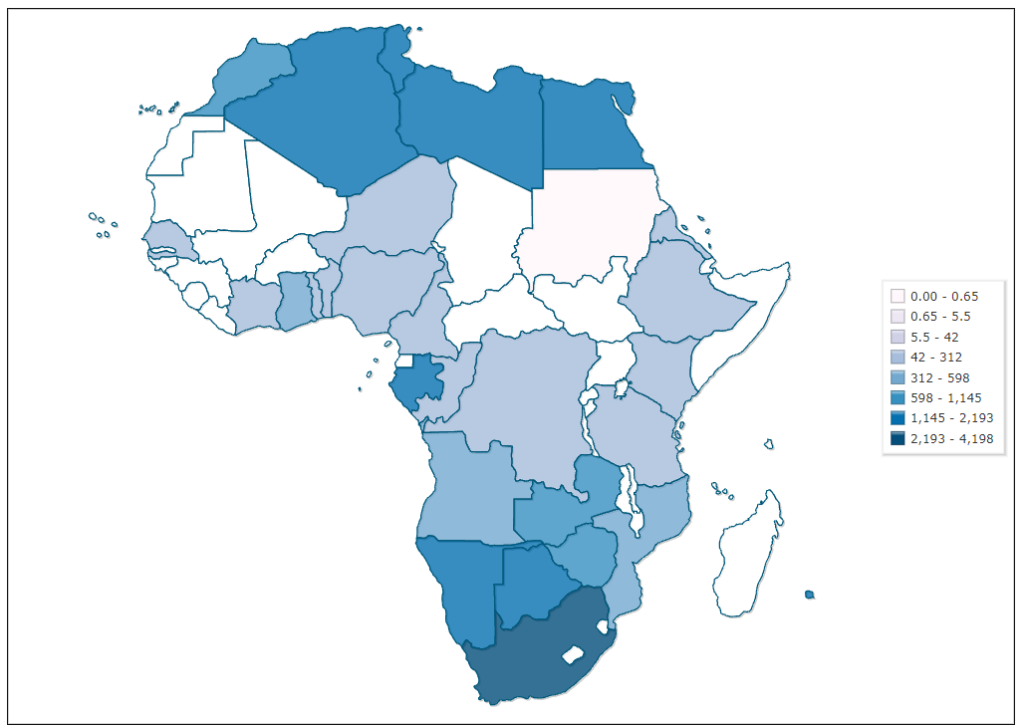
The African continent is a behemoth of people, resources and potential. The area of the combined 58 countries and regions is 1.8 times larger than Russia; 3 times larger than the European Union; and 84 times larger than Germany. The 1.3 billion people living in Africa (16% of the worlds’ population) have available to them a combined power generating capacity of ~230 GW. This equates to about 1,500 kWh per person per year in energy consumption.
A Billion More People
Over the next 30 years there will be another 1 billion new people born on the African continent. Africa will be the youngest and most dynamic region on earth. With global “peak child” happening in 2014 (a demonstrable fact) the number of children coming to the planet has plateaued and will remain that way for the foreseeable future as societies improve their living standards and reduce the size of families. This is also so in Africa, yet the population will grow no matter what. Furthermore, the African continent will hold more than 3 billion people by 2100.
And energy will be the prime enabler to provide those billions with a decent quality of life.
Improving Lifestyle means Increasing Energy Consumption
South Africa has the highest energy consumption per person, at 4,100 kWh per year. Yet this is still below the 5,500 kWh average across Europe. Further across the continent it is clear that some countries lack basic energy infrastructure to bring energy to their people.
Let’s assume that by 2050 the present average of 1,500 kWh per person per year increases to 3,000 kWh*. Thus the total energy generation capacity becomes almost 800 GW. Thus 570 GW of new power generating capacity is required to be built from now to 2050.
*This means a 50 MW ‘burner’ will produce the energy needed for about 150,000 people.
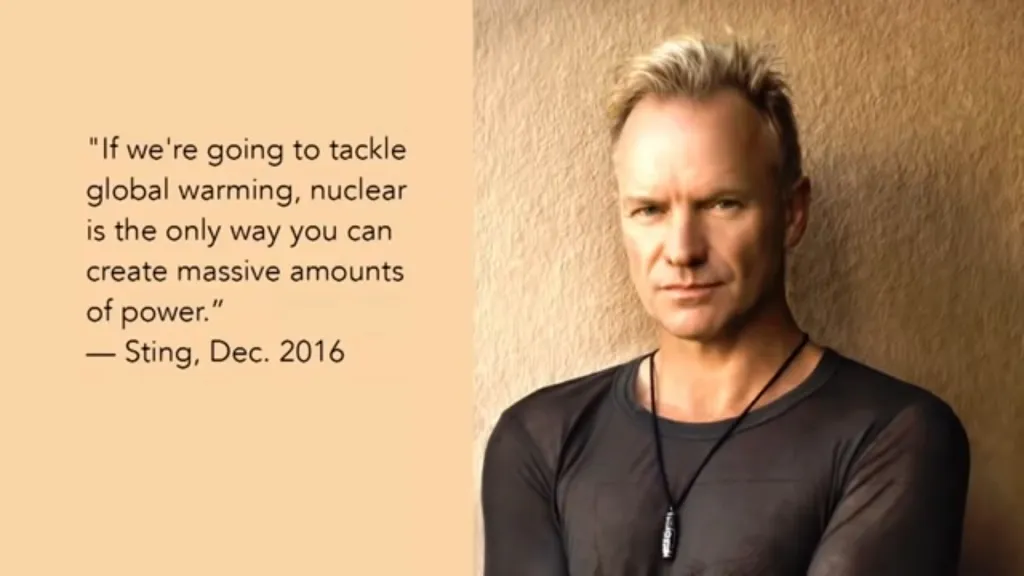
Sting on Nuclear Energy
Avoiding the Renewables Trap
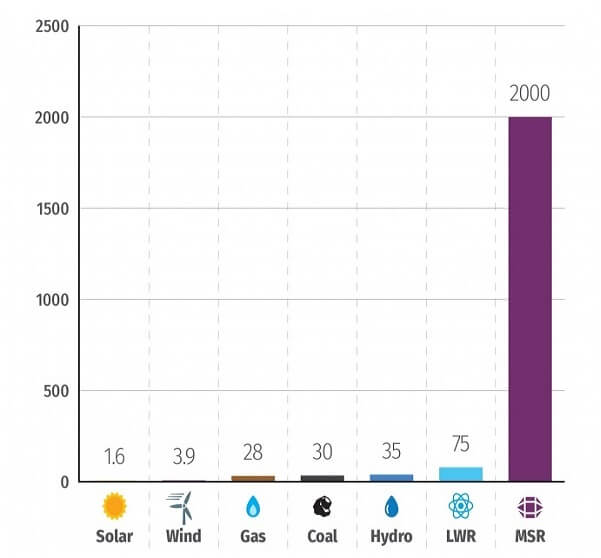
The Africa Renewable Energy Initiative planned to install 10 GW of wind and solar by 2020 (achieved) and 300 GW of wind and solar by 2030. But they are forgetting Germany’s failed 20 year experiment in wind and solar. In Germany, CO2 levels are unchanged and electricity prices have doubled. Germany is restarting coal fired power stations because their industry is failing on the weak intermittent energy from wind and solar. The reason is simple. When considering all factors, wind and solar are simply not viable. This is best illustrated by the Energy Return on Investment ratio, or EROI. This bar chart is developed from the Berlin Institute for Solid-State Nuclear Physics (Institut für Festkörper-Kernphysik) and available on the Australian government’s nuclear scientist’s website.
The Energy Return on Investment Ratio is a macro level indicator of the overall usefulness of the energy derived from any particular form. How many units of energy can be recovered for each unit of energy expended. The EROI of wind and solar (3.9 and 1.6 respectively) fails miserably when compared to coal (30), gas (28) and existing solid-fuel nuclear fission (75). But our focus is the literal purple elephant in the room – Liquid Fission Technology. It’s EROI is 2000 to 1! With such a significant obvious benefit, over all other forms of energy production, it is only a matter of time before the genie is out of the bottle.
Thus as the reality of low value return on wind and solar is realised, Liquid Fission Technology (and other small modular fission machines using traditional solid fuels) will gain traction to fill the growing requirements of Africa’s energy needs.
A New Paradigm of Industrial Growth
One can imagine a fleet of up to 5,000 small modular Liquid Fission machines each with a capacity of 100 MW installed strategically across Africa. Creating a decentralised, distributed power generation system. Some sites will be larger or smaller than others, driven by domestic electricity demands. With the power facilities having a fuelled lifespan exceeding 50 years, it is quite easy to see energy as no longer an issue across the African continent.
But it goes further. Whilst reliable 24/7 power from Liquid Fission machines provides ample energy for domestic needs, the technology supports industrial growth and development. 1 GW and larger power installations are able to drive industries reliant on both heat and power. Facilities of this size could lead to industrial parks such as the one here envisaged by government energy and industrial development planners in Turkiye.
A Positive Future
The people of Africa have a bright future ahead for them. With technologies tried and true from western spheres, the people of Africa can select and choose the most appropriate and most suitable means to improve their quality of life. For themselves and for their children. Liquid Fission energy technology is a strong contender for the energy mix of Africa.
Post created by Jeremiah Josey and the team at The Thorium Network
A Deadly Evacuation
Excerpts from the Report of the United Nations Scientific Committee on the Effects of Atomic Radiation (UNSCEAR) 7- 31 May, 2013 General Assembly Records.
Chapter III Scientific findings [Fukushima]
“1. The accident and the release of radioactive material into the environment.
On 11 March 2011, at 14:46 [2:46 pm] local time, a 9.0 magnitude earthquake occurred near Honshu, Japan, creating a devastating tsunami that left a trail of death and destruction in its wake.
The earthquake and subsequent tsunami, which flooded over 500 square kilometres of land, resulted in the loss of more than 20,000 lives.
The loss of off-site and on-site electrical power and compromised safety systems at the Fukushima Daiichi nuclear power station led to severe core damage to three of the six nuclear reactors on the site.
In this March 11, 2011 photo taken about 2 hours after a massive earthquake and tsunami occurred, Fukushima Dai-Ichi nuclear power plant in Okumamachi, is pictured. (AP Photo/Yomiuri Shimbun, Yasushi Kanno) JAPAN
The Government of Japan recommended the evacuation of about 78,000 people living within a 20-km (12 mile) radius of the power plant and the sheltering in their own homes of about 62,000 other people living between 20 and 30 km from the plant. However, the evacuations themselves also had repercussions for the people involved, including a number of evacuation-related deaths and the subsequent impact on mental and social well-being
Those “evacuation-related deaths” would eventually total 1,600, with 90% of them caused by Japan’s reliance on American radiation safety standards that are based on a fraud that began in the 1920’s. More on that in coming episodes.
That fraud, committed by a Nobel laureate and formalised by the U.S. in the 1950’s, became regulatory dogma that has greatly retarded the expansion of CO2-free nuclear power, accelerated Climate Change and caused the deaths of millions who, out of fear of radiation, avoided essential diagnostic methods and treatments, and at Fukushima caused hundreds of suicides by distraught and unstable people, primarily the elderly, who feared that they would never see their homes or businesses again.
The linear model has since been dropped by a number of international bodies specialising in radiation protection.
The daughter of an elderly woman who had hung herself lamented, “If she had not been forced to evacuate, she wouldn’t have killed herself.” (Chapter 7 of the book compares the deaths caused by using fossil fuels instead of emission-free nuclear power).
Children were not allowed to play outside, and topsoil was needlessly removed at great expense from farm fields that became, as a consequence, less fertile.
Hundreds of elderly people were hastily removed from nursing homes and hospitals, only to be scattered across the hardwood floors of gymnasiums, where many died from makeshift medical care, or sometimes none at all.
These deaths were preventable, just as Climate Change can be moderated if the industrialised nations replace the burning of carbon and the use of deadly, inefficient, carbon-reliant windmills and solar farms (chapters 9 and 10) with CO2-free nuclear power as rapidly as possible while developing technologies that support natural processes that can remove CO2 from our atmosphere. Windmills can’t do it. Neither can solar, not singly or combined with wind. For that, we will need an abundance of safe, efficient, CO2-free nuclear power. Nothing else will do.
Here is a podcast with George Erickson talking about Fukushima Daiichi:
Post created by Jeremiah Josey and the team at The Thorium Network
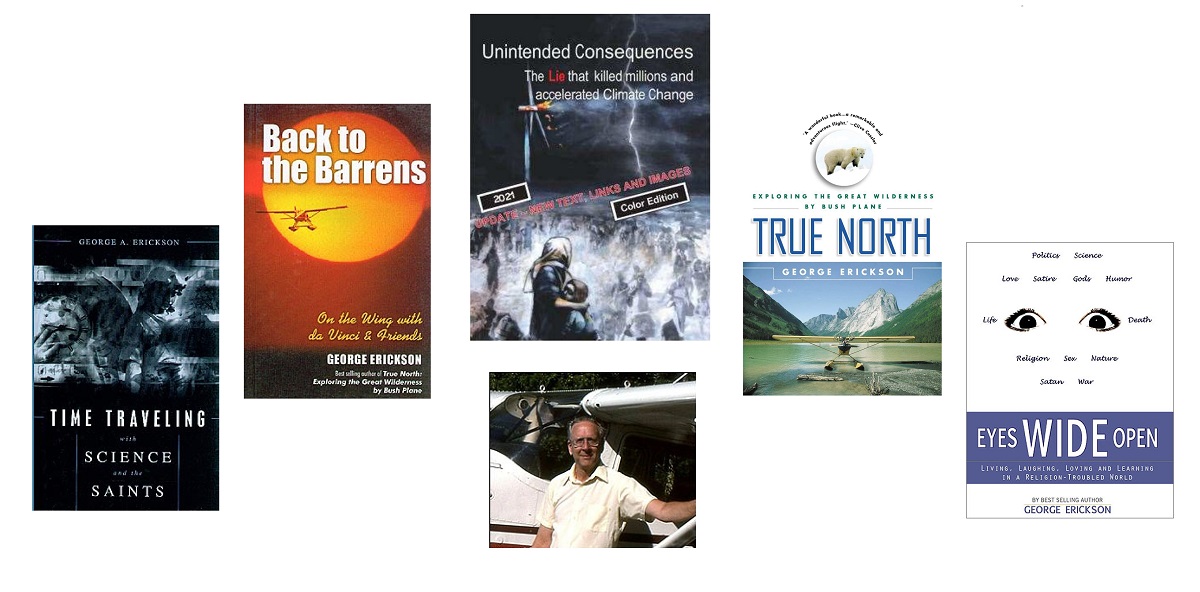
Unintended Consequences is intended to help open-minded readers learn the truth about the severity of Climate Change, the need for nuclear power – not “alternatives” like wind and solar – and to explain why our unwarranted fear of tiny amounts of radiation has caused millions of deaths and disabilities.
Those who challenge the firmly held beliefs of legislative bodies and powerful organisations like the Sierra Club, Greenpeace and their well-meaning but science-indifferent clones, soon learn that their arguments, no matter how logical or well documented, will often be brushed aside with a dismissive “That’s just your opinion.”
To counter that assertion, I, Dr. George Erickson, have included many links to supportive material from a wide range of professionals in the energy field: engineers, nuclear physicists, science journalists and specialists in nuclear medicine.
Dr. George Erickson in 2018 at TEAC8
Although inserting links to the work of so many experts within the text instead of footnoting them might seem intrusive, I’ve taken that risk because the health of our planet requires an informed public and science-literate legislators – unlike those who are supporting inefficient technologies that are damaging the environment they claim to revere.
“It is much easier to fool someone than it is to convince them that they have been fooled.” Mark Twain
Unfortunately, when I and my associates give climate change/energy presentations that support advanced nuclear power and criticise inefficient, environment-damaging, carbon- reliant wind and solar farms that we were conned into accepting, we frequently encounter disbelief, a problem that Mark Twain addressed: “It is much easier to fool someone than it is to convince them that they have been fooled.”
Post created by Jeremiah Josey and the team at The Thorium Network
This is the first episode taken from Dr. George Erickson‘s Unintended Consequences: The Lie that Killed Millions and accelerated Climate Change. Follow our media for a bite sized portion each week of Dr. Erickson’s book with additional images and references for easy information access. Follow our social media to read some of the best, some of the most concise words you’ll find on Climate Change and how Molten Salt Fission TechnologyTM with Thorium can fix it.
Over to you Dr. George Erickson…
Back in the sixties, when I was living in a small Minnesota farming community, my sons were taught to “duck and cover” beneath their desks in case of a nuclear war.
George Erickson – Why I care
We’d been warned about radiation and fallout, so I built a concrete block shelter in my basement that I hoped would shield my family for a week or two if events with Russia turned sour.
Time passed. The Cold War waned, and when concerns about nuclear power changed from making bombs to making electricity, my concerns about nuclear issues receded – until I attended a lecture on thorium near the turn of the century. Intrigued, I began to investigate thorium because of its many advantages over uranium for producing electricity
I had known about greenhouse gases, global warming and sea level rise, and I had read about Dr. Charles Keeling’s work with carbon dioxide on the slopes of Mauna Loa, but I hadn’t realized that expanding nuclear power, which creates no carbon dioxide (CO2) could be our most effective weapon for combating Climate Change, much of which is caused by burning coal, oil, wood and natural gas to supply electricity to an expanding world that exceeds 7 billion – a world that is finally beginning to consider the value of CO2-free, environmentally benign nuclear power.
Dr. Charles KeelingMauna Loa, Hawaii
One solution seemed obvious: replace the carbon-burning steam generators at every power plant with nuclear power plants. However, I quickly discovered that many powerful organizations oppose almost everything nuclear – some out of ignorance, many from fear, and some for profit, but I also found support from those who’d set their fears aside after discovering the impressive safety record and efficiency of CO2-free nuclear power. And so, with Climate Change becoming deadlier every year (assisted by former Pres. D. J. Trump, our anti-science Climate Change Denier in Chief), and because my grandchildren’s futures are at stake, I have decided to respond to those who fear our safest, most efficient, environmentally benign power technology by revealing its true record – including that of Chernobyl, which has caused fewer than 80 deaths, and of Fukushima Daiichi, where two workers drowned at the plant – and I’ll highlight some of the new plants that are even safer and more efficient than the hundreds we have relied on for 60 years.
But first, I must mention two discoveries that came as a huge surprise – the fact that our radiation safety standards are based on a fraud that became dogma not long after World War II [Ed. see later episodes for this explanation], and the existence of compelling evidence that low levels of background radiation can even improve our lives. I know that sounds crazy, but there is abundant science to back it up.
“An ecologist must be the doctor who sees the marks of death in a community that believes itself well and does not want to be told otherwise.” Aldo Leopold – 1943
The Green New Dealwill accelerate climate change and damage our environment unless it expands safe, highly efficient, resource-sipping, CO2-free nuclear power and stops funding inefficient, resource-gobbling environment-damaging wind and solar farms, Russia, South Korea, Turkey, Argentina, Poland, Sweden, Finland, India, China, the Czech Republic, Estonia, the Netherlands, France; Slovakia, Hungary, Romania, Gr. Britain, Belarus, Ukraine, the Emirates, Pakistan, Bangladesh and Egypt have approved or are building nuclear plants, and we [Ed. “we” = USA] should, too.
The belief that we can get all of our energy from wind, water and solar is exactly what Dr. James Hansen, former chief scientist at NASA, had in mind when he wrote, “We have two political parties; neither wants to face reality. Conservatives pretend that climate change is a hoax, and liberals propose solutions that are non-solutions.“
We must turn away from carbon. We must do better than this!
[Ed. Cartoon copyright Toles 2013, The Washington Post. Reprinted with permission of Universal Uclick.]
This is the end of the first episode taken from Dr. George Erickson’s Unintended Consequences: The Lie that Killed Millions and accelerated Climate Change. Each week we’ll be posting a bite sized portion of Dr. Erickson’s book with additional images and references for easy information access. So follow our social media to read some of the best, some of the most concise words you’ll find on Climate Change and how Molten Salt Fission TechnologyTM with Thorium can fix it.
Unintended Consequences Series – created by Jeremiah Josey and the team at The Thorium Network, 2 January 2022, updated 16 July 2023
Preface to Update – Dr. George Arthur Erickson passed away on July 14, 2023, at his home near Eveleth, Minnesota, at the age of 90. Out of our respect to his great contributions to advancing the adoption of Thorium energy – the key objective of our organisation – this series will remain largely intact. Changes will be made to account for him no longer being with us.
To start the new year we will be publishing episodes from the book “Unintended Consequences: The Lie that Killed Millions and accelerated Climate Change“.
Written by best selling science author Dr. George Erickson. Each week we be posting part of Dr. Erickson’s book onto our web page and social media channels in a bite size episode. There will be more than 40 episodes. Sign up for regular reminders of the next episode and spend the next 10 months learning from someone with first hand experience in the effects of climate change, and knowledgeable in the only real alternative we have for carbon free energy: safe, clean, green Liquid Fission Thorium EnergyTM, fuelled by Thorium.
Dr. Erickson is was the best-selling author of five pro-science books, a former bush pilot in Alaska and Canada, a retired dentist, a former vice president of the American Humanist Association, a member of the National Centre for Science Education and a member of the Thorium Energy Alliance.
Dr. Erickson exchanged climate change and energy emails with Dr. James Hansen, the former chief scientist at NASA (whom George Bush clashed frequently when the president tried to silence James on his climate change position). Dr. Hansen is quoted often in Dr. Erickson’s book, “Unintended Consequences: The Lie that Killed Millions and Accelerated Climate Change“.
In Unintended Consequences, Dr. Erickson exposes the lie that created our excessive and fraudulent radiation safety standards and the damage those regulations have caused. He expresses his dismay with “greens” in their profit of promoting low efficiency, intermittent supply, carbon reliant solar panels and bird and bat-killing, carbon-dependent windmills, yet oppose 90% efficiency, environmentally friendly, carbon free, super safe nuclear power.
Because of the increasing damage from climate change, Dr. Erickson made the latest update to his book update of this book FREE. You can buy the paperback off Amazon.
A prolific writer of climate change and energy op-eds, Dr. Erickson’s self funded his travel campaigns to give climate change and energy presentations at colleges, schools, universities, service clubs and affinity groups.
“Your writing is brilliant and so clear.” Dr. James Hansen, former chief climate scientist at NASA.
“By comparing the safety, reliability and emissions of nuclear reactors to carbon combustion and unreliable wind and solar, Dr. Erickson sends a message to people who love the earth – nuclear is the rational way forward.” Dr. Tim Maloney
“Unintended Consequences is excellent. I will recommend it widely.” Dr. Martin Goodman MD
“This great book reveals why the green movement is wrong on nuclear energy.” Mathijs Beckers
“Universal Consequences is rational thought for those seeking a sustainable planet.” Dr. Rod Coenen
After retiring near Virginia, Minnesota, United States of America, Dr. Erickson initiated and led a campaign to build a USD 1.2 million indoor tennis facility for his hometown. He helps coach the Virginia boys and girls tennis teams, funds scholarships at the Mesabi Range Community College and donates all of his book profits to educational charities. He is married and has two sons.
Coming up next week, Episode 1 – Why I care by Dr George Erickson of Unintended Consequences.
With so many nuclear reactors planned (a.k.a. fission energy machines), it’s an obvious outcome for the world in general: clean, green, safe energy production for the most populous region on earth. That means for Asia: clean air, clean water, and clean lives, with… low cost, safe energy. Production efficiency rates in the region will sore. Innovation will eclipse anything we’ve seen before. The environment will become a green wilderness again (remember too China reclaims over 2,000 square km of desert each year). This is the next revolution, after the Industrial, after the Information. It’s the Energy Revolution. And it’s very exciting to be part of it.
Agreements are what make the world go round. This emphasises the importance of clean concise documents and a team to make it happen. Since forming, The Thorium Network has signed many agreements, contracts, MOUs and NDAs. The agreements are with governments, mega corporations, specialist firms and individual experts. All related to our aim: The adoption of Thorium Molten Salt technology for Energy Production world wide.
Reach out to us for a conversation. About partnering, funding, joining our team or becoming one of our consultants. You’ll be interacting with our legal team.
Jeremiah Josey Founder and CEO The Thorium Network
“Technology, not taxes is the Australian Way to reduce emissions while protecting our economy and living standards.” Prime Minister Scott Morrison pledging Net Zero by 2050
But Mr. Morrison, it’s not just about reducing CO2. It’s also about Australia being a world leader.
China and Russia are building small modular reactors for themselves and for export to third world countries. They’re lowering their own carbon emissions and those in other countries, whilst reducing fossil fuel pollution that is killing millions particularly children under 5 years and also saving more lives by enabling desalination for clean drinking water and growing food.
Australia exports uranium and coal and say we are good citizens, on the right track to the solution for global warming. We are not being good world citizens when we don’t look at the big picture but only our self-interest.
Small, modular, transportable, Thorium molten salt burners could be this new technology that our Australian Government is relying on to create jobs, reduce carbon emissions and win the next election.
“Small Modular Reactors are the Future. Since 1970, nuclear has saved 60,000 million tonnes of CO2 emissions. Nuclear could deliver net zero, if only it was allowed to. Nuclear power will also solve water supply problems in a scalable manner.” Paul Kristensen Western Australian Owner/Principle- PK Science Consulting, nuclear scientist, and advocate.
Paul Kristensen Western Australian Owner/Principle- PK Science Consulting, nuclear scientist, and advocate
CURRENTLY the Rare Earth Elements (REE) in our mineral sands, which contain Thorium and uranium, cannot be used due to provisions in the Australia’s Environmental Protection and Biodiversity Conservation Act 1999. [AEP&BC Act] The Act is causing this potentially very valuable product to be disposed of as waste by unrecoverable burial.
“Only Australia, a true laggard and outlier, holds nuclear energy as illegal. In this, Australia is not just eccentric, but nuts.” Greg Sheridan, Foreign Editor, The Weekend Australian 10/11 July 2021.
Thorium is now being researched by over 30 countries. China is already operating a prototype reactor and building a commercial reactor to supply energy for a desert city.
Thorium molten salt burners can:- • provide safe, low-cost, carbon free, reliable base load energy replacing fossil fuels. • desalinate water for drinking and growing food. • use nuclear waste as fuel. • transport a reactor by truck or barge in a container to where needed. • produce much less waste which only needs storing for 300 years not thousands. • use a small earth footprint unlike solar, wind and hydro. • be rebooted after 60 years so do not have the expensive and difficult recycling of wind and solar. • be cooled without water so can be used in deserts. • not blow up or easily used to make bombs • be used to produce medical isotopes to save thousands of lives.
“Technology will have the answers to a decarbonised economy, particularly over time.” Scott Morrison
The Liberal goal is to create wealth and jobs in Australia and win the next elections both State and Federal in March 2022 and hopefully gain the respect of other countries.
Liz Penfold
Authored by Mrs Liz Penfold Former public representative for Flinders, South Australia. Undefeated in office from 1993 until retirement in 2010, with an approval rating always above 70%. Adviser to The Thorium Network on Australian Political Affairs. Liz on Wikipedia; Liz on Linkedin
Can a knife alone be dangerous? Who instilled in us the mindset of what is dangerous. What is wrong or right? Is this an inner belief or idea or is it rooted in our culture? Yes, I say that this knife, which in our opinion is a simple tool, may end someone’s life!
What about nuclear energy? Can this concept or rather a misconception be generalized to nuclear energy? I say yes! Without a doubt, everything in this world can show two sides, positive and negative. Nuclear energy is no exception. Actually, It is our way of thinking that distinguishes right from wrong. If we learn how to use something properly, then we will always use its positive potential.
Now, if we base our criteria on the proper use of anything, we will find out that the environmental problems caused by common fossil fuels that have formed in our minds as safe fuels will act as the same knife. In the validation, they will be in a lower position than renewable energies like nuclear energy and we will eventually find out which to choose between not enjoying healthy air or a misconception about nuclear energy.
Sometimes we need to solve a problem radically and temporary solutions will work in the short term but what about the long term?
So we can not categorically reject nuclear energy and approve fossil fuels because we have a logical reason to reject fossil fuels and that would be environmental pollution!…. We are now witnessing its destructive effects on our surroundings!
Sometimes we need to solve a problem radically and temporary solutions will work in the short term but what about the long term? What solution will we have? This is the relationship between the environment and clean energy.
Now we come to cultivate an idea … an idea that needs collective support and that is Thorium nuclear energy… By the laws of physics, without any military or destructive purposes as clean and alternative energy that can be produced for thousands of years, and most importantly Thorium molten salt machines are the safest type of technology available.
You may think, these are easy on paper but hard to do…but I say not impossible!
So we find that what matters is how we use the tools that we have, not just the nature of it. This is how the same simple knife can be beneficial in its way. Now you can see how the impossible can be made possible by changing the nature of a concept and flourishing it and that is why we are here and this is our main mission!
I love all the colours chosen for a gas that has none. There is no smell either. Pink, green, blue, grey, black, yellow, white, maroon… I’m making them up now, but it doesn’t matter. There is an odour coming from this “new hydrogen economy”. Hydrogen is not an “energy source”. It’s how we can transport energy. From where it’s made to where it’s consumed. The colours are a clever way of identifying the source of the energy before conversion into hydrogen. But be clear, hydrogen is not a “fuel” that replaces “fossil fuels”. Lithium is useless until energised in a Li-Ion battery. Hydrogen is useless until you make it, or rather separate it, from it’s most common bonded atomic partner – Oxygen. Then again I do enjoy a good drink of oxidised hydrogen. The most common form of hydrogen on earth – water – is not useless at all.
Hydrogen on the surface is “better” than hydrocarbons. It has twice the energy density. Fossil fuels, incidentally are stores of energy: you dig them up, or pump them out, and immediately convert them to heat. Remember that our most common need for energy is low cost heat. Hydrogen as a fuel is yet to find that low cost convertibility to a low priced, abundant fuel. It is easier to transport the energy via electrons, than lug around a much heavier proton with a electron attached to it.
For pipes and storage tanks, the metallurgy of hydrogen makes problems because it can embrittle many materials. It’s a very small molecule and creeps into all kinds of places. Hydrogen has a very wide explosive range: 4 to 74%, and will ignite with sunlight. It’s tricky stuff to work with.
I don’t see hydrogen becoming anything other than another energy distraction. Much the same way that ethanol was 20 years ago. But we are not adept at learning from our mistakes. There will be regions that will benefit for reasons other than are written here.
Hydrogen has a very wide explosive range: 4 to 74%, and will ignite with sunlight. It’s tricky stuff to work with.
Thorium Molten Salt Fission Energy technology making electricity is a viable proposition. The technology hurdles where identified and addressed more than 50 years ago. Yes, hydrogen production using Molten Salt Technology is a very viable option – where it is needed. The Energy Return on Investment (EROI) of energy from Molten Salt Fission Energy Technology is 30 times better than any oil equivalent and 512 times better than wind and solar. (Anyone remember fuel ethanol? The EROI is somewhere between 0.9 and 1.1 – pitiful).
Let those numbers sink in… That’s where you’ll find the real gold at the end of the rainbow.
Post by Jeremiah Josey and the team at The Thorium Network
So, are you up on your p’s & Q’s: Qtotal and Qplasma? Do you know the difference? If your taxes are being used on fusion energy efforts in your region then you better have a good talk to your representative about the details. Because as you’ll see in this video, even as recently as 2016, the head of the USD 65 billion ITER fusion project, Dr. Bigot, is telling little porky pies about the realty of their projects’ ultimate outcome. Why on earth would be be doing that? Oh, might have answered that in the previous sentence. It’s a big budget production.
Full credit to the efforts of all involved at ITER to create such an incredible feat of international collaborative scientific and engineering marvel. But will it get to the end once the cat is out of the bag (watch the video) and the mainstream realise they’ve been duped by clever scientific distinctions into funding a massive science experiment?
Also disappointing are the delays inevitably caused to other demonstrably viable technologies – like Molten Salt Fission – because of these deceptions. Tsk-tsk, Dr. Bigot.
Post note: ITER will be testing fuel “breeder blankets”, which may include a molten salt shielding and fuel production blanket of fluorine, lithium and beryllium (a “FLiBe” salt). The blanket is to produce the all important – but very, very rare – tritium fuel to make it all work. The Lithium needs to be Lithium-6. For Molten Salt Fission, Lithium-7 is necessary, because you do NOT want tritium production in Fission machines (in the thermal spectrum). We are very aware of that distinction and the implications for Lithium supplies around the world.
Ask us at SAFE Fission ConsultTM if you need help understanding all of this. We have experts from all sectors ready to help.
Whilst fusion is not our focus – ours is production of energy using Molten Salt Fission Energy Technology and Thorium – we’ve found it appropriate for a couple of focused articles – this one on ITER and one on JET – to highlight the inappropriate gap between the science and the spin. Both articles are be found here.
This spin on fusion distracts from real progress on carbon free power production for our societies. It diverts attention from real technologies. It confuses the public. It diverts public money – and a few duped private investors – who, given full knowledge, would provide their support to such projects more judiciously.
For more comprehensive study on the inadequacies of fusion for power production we refer you to the work of Steven B. Krivit and this site New Energy Times.
Authored by Jeremiah Josey and the team at The Thorium Network
Australia has committed to buying up to 8 small modular reactors*. It is conceivable to envisage similar technology rolling out across the country to produce SAFE, reliable, green energy. Thus, with a little imagination, one can envisage a burgeoning Thorium industry. And also eventual production of Safe clean fission energy from Molten Salt technologies. The imagination then expands further to the concept of a booming domestic vertical Rare Earths industry. With Boeing making UAVs in Toowoomba (Australia), how much of each aircraft could be supplied from ingenious, locally processed materials? Bringing it down to earth, how competitive would domestic EV and batteries industries become for export with local strategic supplies?
The mind boggles.
C’est la vie.
*Technically, these small modular reactors have a capacity of about 200MWt. They will probably be “9th generation” and hence have millions of safe operating hours behind them. Whilst the basis of the AUSUK decision is incorrect, the opportunities for correction open immensely.
Meanwhile, our consulting division, SAFE Fission Consult(TM), holds some of the brightest and experienced minds in the fission world. We are preparing countries for Safe Fission Energy:
Post by Jeremiah Josey and the team at The Thorium Network
This is a great piece of history. The late Professor Mike Driscoll of MIT, known for his work on fission breeding (where more fuel is produced than is consumed – go figure!) asked the question of the origins of the word “breeder” to Dr. Alvin Weinberg. This is Dr. Weinberg’s response with Dr. Eugene Wigner’s handwritten addition. 12 April 1976.
Post by Jeremiah Josey and the team at The Thorium Network
More than 50 years since the MSRE ended in Oak Ridge, Tennessee, USA, another starts up. This time in China. Whilst Oak Ridge’s machine was 8 MWt, China’s is 2MWt. This article by Gernot Kramper was published in the German Star online magazine on September 20, 2021. Well done China.