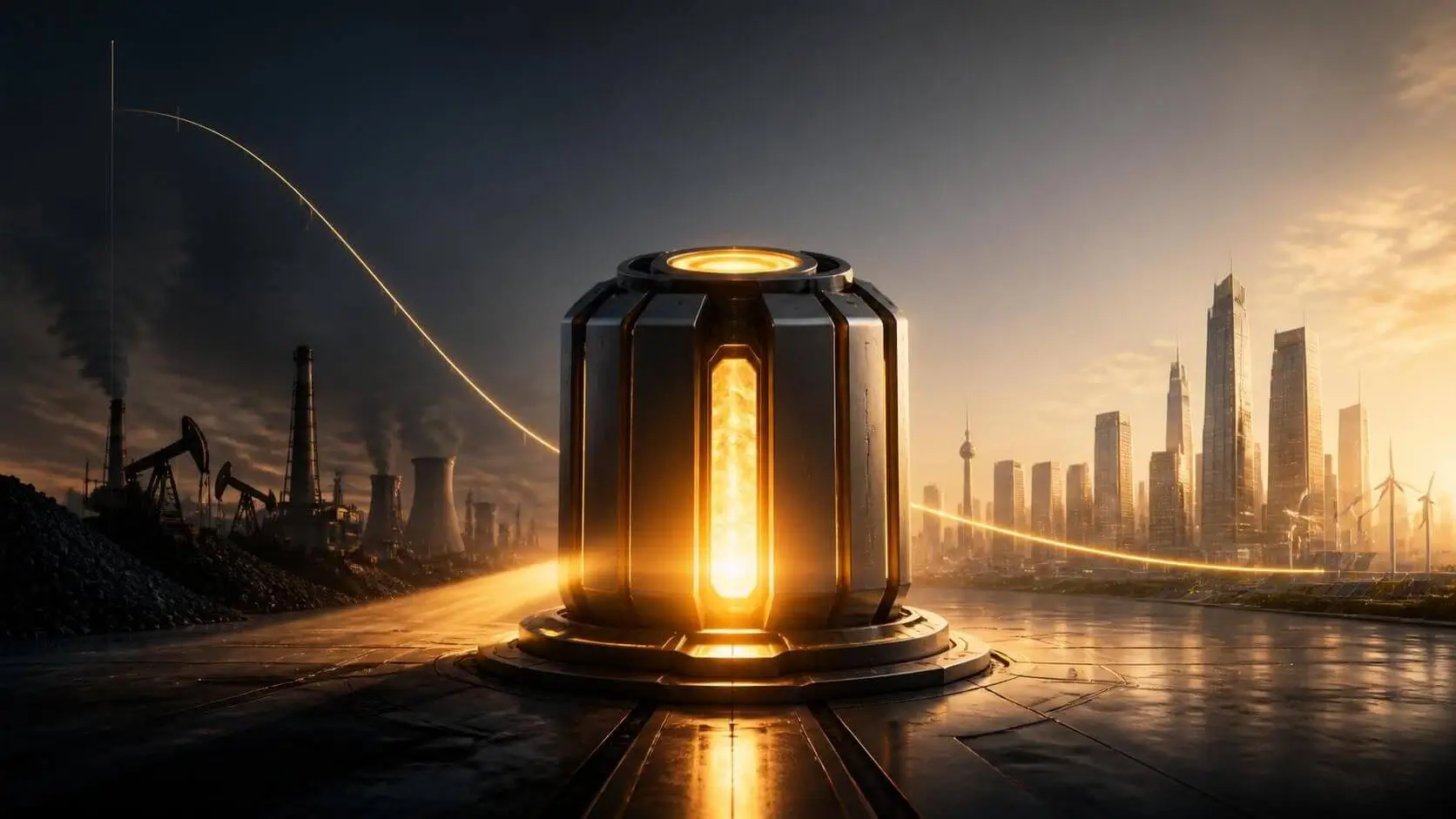
Part One: The Scenario
Imagine it is June 2036.
Turkey has deployed its first commercial Liquid Fission reactor in partnership with Japan. Cost: USD 800,000 per megawatt installed. India has announced plans for 40 GW of Thorium capacity by 2040. Brazil is fast-tracking deployment in the Amazon basin—not out of environmental virtue, but because it’s economically superior to hydroelectric expansion. China’s 700-engineer team has already brought total capacity to 12 GW, with cost curves dropping below USD 600,000 per megawatt.
The Gulf States—Saudi Arabia, UAE, Qatar, Bahrain, Kuwait—have quietly accelerated renewable and Liquid Fission investment simultaneously. They are hedging against fossil fuel obsolescence. The oil “will remain in the ground“, as famously forecast by a significant Saudi Royal family member 30 years ago.
Coal-dependent regions in Eastern Europe and Southeast Asia are announcing accelerated retirement plans. Not because of climate policy. Because the economics no longer work.
Uranium spot prices have collapsed. Solar manufacturers are facing overcapacity. Natural gas is becoming a stranded asset.
This is not science fiction. This is the future encoded in physics and economics. And it is already underway.
Part Two: Why This Is Inevitable
The superiority of Liquid Fission Thorium is not a matter of opinion. It is a matter of engineering.
One bulk carrier of Thorium fuel powers the world for one year. Thorium is as abundant as lead. The fuel cycle is closed—waste products decay to background radiation in centuries, not millennia. The reactor is inherently walk-away safe; it cannot melt down or explode, even under total failure. The energy density is extraordinary.
This technology was proven at Oak Ridge in 1969. It has been deployed successfully in Japan. It is being scaled now in Turkey. The physics is settled.
Why wasn’t it adopted decades ago? Because the fossil fuel industry spent seventy years promoting the Linear No-Threshold (LNT) radiation theory—a hypothesis rejected by leading radiobiologists but embedded in regulatory frameworks worldwide. Because uranium-based fission became politically entrenched. Because institutions resist admitting they were wrong.
But institutions cannot resist economics forever.
Cost curves matter. Solar photovoltaics fell from USD 5 per watt to USD 0.25 per watt in fifteen years through volume manufacturing and learning curves. Liquid Fission Thorium is experiencing the same trajectory. First-generation reactors are expensive. Second and third-generation units are dropping in cost with each deployment. The engineering is mature. The supply chains are forming. The regulatory pathways are opening.
China understands this. Japan understands this. Turkey understands this. The question is not whether Liquid Fission Thorium will dominate global electricity generation—physics and economics have already decided. The question is whether your nation, your investment, and your industry will be positioned for that transition.
Part Three: The Full Story
We have prepared a comprehensive timeline for serious readers: “The Thorium Reckoning.”
This is not a technical white paper. It is a narrative—a detailed speculative account that reads like a documentary film, weaving together:
- The fictional future with specific geopolitical and economic scenarios grounded in realistic timelines
- The technical reality that makes this future not just possible, but inevitable
- Investment implications, regulatory breakthroughs, and the strategic realignment that follows when energy becomes abundant
Complete with original conceptual imagery, cost curve analysis, and expert testimony from leading Thorium researchers and policy figures.
This is the story of how the world’s energy system transforms. And why fighting that transformation is fighting physics itself.
Access “The Thorium Reckoning” on Patreon
USD 5,000 (permanent access) or Patreon Membership (tiered monthly access at coffee-and-bagel prices)
Leave a Reply