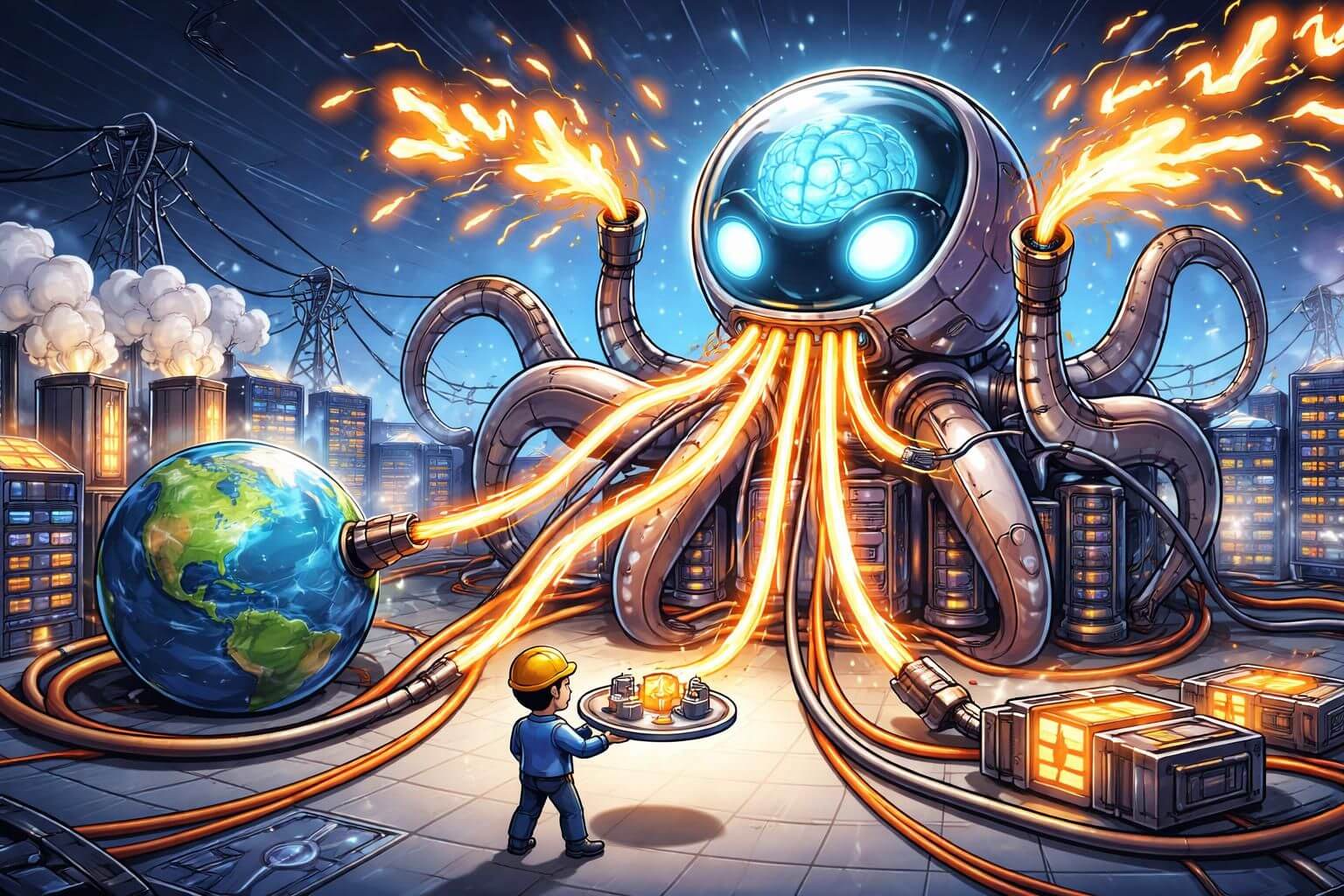
Artificial intelligence is often discussed as a software revolution. Physically, however, it is an electricity-and-infrastructure revolution. Every AI response requires computation in data centres, and increasingly capable systems require more memory, more processors, longer operating times, and more internal reasoning.
The central question is not whether one AI query uses a lot of energy. Most individual queries use very little. The question is whether billions of queries, autonomous agents, AI-generated media, robotics, scientific simulations, and industrial systems will operate continuously.
The answer could reshape global energy demand.
Two Useful Comparison Figures
Humanity currently consumes approximately 25 EJ per year in food energy. That is the energy metabolized by human bodies.
The world’s total energy consumption is approximately 600 EJ per year. This includes transport, buildings, industry, agriculture, electricity generation, and fuel use.
These give us two useful benchmarks:
- 25 EJ: the energy consumed by all human bodies
- 600 EJ: the energy consumed by human civilisation
AI is nowhere near either benchmark today, but its growth rate is much faster than the growth rate of human population or conventional energy demand.
The Central AI Energy Estimate
A reasonable middle estimate for AI energy consumption is:

These figures include the operational energy of AI servers and associated data-centre infrastructure. They should be understood as a central model rather than as precise measurements. Companies generally report total data-centre consumption rather than separating artificial intelligence from ordinary cloud computing, storage, and networking.
The 2030 estimate is consistent with projections showing that data-centre electricity demand will rise rapidly as AI-accelerated servers become the main source of growth.
From a Niche Technology to a Major Energy Load
In 2020, AI consumed approximately 0.06 EJ annually. At that point, large-scale machine learning was important, but AI systems were used mainly for recommendation engines, search, advertising, translation, image recognition, and early language models.
By 2026, AI energy consumption may be around 0.8 EJ annually. That is still small compared with total human energy use:
0.8 / 25 = 3.5%
AI would therefore consume only about 3% of the energy contained in human food consumption, and about:
0.8 / 600 = 0.13%
of our civilisation’s total energy consumption.
The significance is not its present share. The significance is the growth rate and the possibility that AI computation becomes embedded in nearly every digital and industrial process.
2030: AI Becomes a Substantial Industrial Load
By 2030, a central estimate of 2.5 EJ per year would place AI at:
2.5 / 25 = 10%
of human food energy, and:
2.5% / 600 = 0.42%
of total civilisation energy use.
At this stage, AI would still be a small fraction of global energy consumption, but it would be large enough to influence national electricity planning, data-centre construction, semiconductor manufacturing, transmission networks, and power-plant investment.
The energy would not be used only for chatbots. Major sources of demand would include:
- training increasingly large models;
- serving billions of daily interactions;
- internal reasoning and planning;
- autonomous software agents;
- video and three-dimensional content generation;
- scientific and engineering simulations;
- industrial control systems;
- robotics and autonomous vehicles.
The most important change is that AI systems may perform computation continuously, rather than only when a human is actively using a computer.
2050: AI Approaches the Energy of Human Metabolism
A central 2050 estimate of 18 EJ per year would make AI’s energy consumption approximately:
18 / 25 = 72%
of the energy consumed by all human bodies.
This does not mean AI would be as intelligent as humanity, nor that it would replace all human mental activity. It means that the machines performing AI computation could consume energy on a scale comparable with the food energy sustaining the human population.
Relative to civilisation’s total energy use:
18 / 600 = 3% (ignoring the growth of the 600 EJ number)
Even at 18 EJ, AI would remain only about 3% of current global energy consumption. AI could approach the energy scale of human metabolism while remaining far below the energy scale of civilisation.
Why Energy per Task is Not Enough
AI hardware is becoming more efficient. The amount of computation delivered per unit of energy will continue to improve through:
- smaller and more specialised models;
- quantisation and lower-precision arithmetic;
- better memory systems;
- improved cooling;
- more efficient chips;
- model sparsity;
- speculative decoding;
- better software and scheduling.
However, efficiency improvements do not necessarily reduce total energy consumption. When computation becomes cheaper, people and companies often use more of it.
A simple text request may require modest computation. An autonomous agent may perform hundreds of internal steps. A video model, scientific simulator, or robot may require vastly more computation than a short text response.
The central relationship is:
Total AI energy = number of tasks × energy per task
If energy per task falls by ten times while the number of tasks rises by one hundred times, total energy demand rises tenfold.
AI Will Not Necessarily Surpass Civilisation’s Energy Use
To exceed the energy consumption of civilization, AI would need to reach:
600 EJ per year (today’s annual demand)
That is approximately 33 times the central 2050 estimate of 18 EJ.
Such a future is possible only if the definition of AI expands well beyond data centres. It would likely require AI to control or perform a large share of:
- robotics;
- transportation;
- manufacturing;
- mining;
- construction;
- agriculture;
- energy production;
- synthetic biology;
- industrial simulation;
- machine-to-machine economic activity.
In other words, AI would need to become not merely a digital service but a major operating layer for the physical economy.
Do you think it will?
The Strategic Implication
The central forecast is not that AI will immediately consume more energy than humanity. It is unlikely.
The most likely trajectory is:
- 2020: AI is energetically insignificant at global scale.
- 2026: AI is approaching 1 EJ per year and becoming visible in electricity demand.
- 2030: AI reaches several EJ per year and becomes a major infrastructure sector.
- 2050: AI could consume energy comparable with a substantial fraction of human food metabolism.
- Beyond 2050: AI could become one of the largest categories of energy demand if autonomous systems, robotics, and machine-controlled industry expand dramatically.
The decisive issue is not whether AI is efficient in isolation. The decisive issue is whether efficiency gains are overwhelmed by the scale of deployment.
Human bodies consume approximately 25 EJ per year in food. Human civilisation consumes approximately 600 EJ per year in total. A central AI trajectory from 0.06 EJ in 2020 to 18 EJ in 2050 would not yet overtake civilisation, but it would transform AI from a software category into a major energy-consuming industry.
The AI revolution may ultimately be measured not only in models, parameters, or tokens, but in exajoules.
Post Script – How Much is 1 EJ
One 1 GW power station—of any type—operating continuously for a year produces approximately 0.032 EJ of energy. Supplying 1 EJ per year requires approximately 32 one-gigawatt power stations—or roughly 35–40 stations after allowing for maintenance and downtime.
That scale is well suited to a fleet of liquid-fission thorium burners: compact, continuously operating reactors deployed near the data centres and industrial facilities that need dependable, high-density power.

Leave a Reply