
The Death of LNT and the Impending Rise of Global Fission Energy
Forward
Since our formation in 2017, following negotiations for Armenia’s spent nuclear fuel, The Thorium Network has written extensively about the fraud of ALARA and LNT. We have spoken with leading scientists, journalists, writers and advocates—including Professor Wade Allison of Oxford; Professor Edward Calabrese of the University of Massachusetts Amherst, whom we have interviewed on multiple occasions; Dr Adi Paterson, former CEO of Australia’s ANSTO; Pumzile Tshelane, former CEO of South Africa’s Necsa; Professor Geraldine Thomas, founder of the Chernobyl Tissue Bank; engineer Sidney Ball, who worked directly under Dr Alvin Weinberg at Oak Ridge on the world’s first liquid-fission machines; and Dr George Erickson (RIP), who documented 30 years of environmental degradation during his solo flights over Canada. These people have become friends and supporters of The Thorium Network.
These are just some of the people The Thorium Network has engaged with to uncover how nuclear myths and fantasies were formed, how they become embedded in legislation, and who has interests behind them. We have long uncovered the so-called conspiracies—but they are not conspiracies at all. They are so-called “good business practices” carried out by businesses protecting their profits. Unfortunately, it is the fossil-fuel industry that benefits to the tune of trillions, spending billions on anti-nuclear campaigns, whilst humanity pays the price in death, disease and environmental devastation: 8.5 million people killed every year by the burning of fossil fuels (see this [link] for the latest information). Millions of plant and animal species have been lost forever as the world pursues ever-dwindling resources.
The Thorium Network has taken the data and the facts across borders. There is no argument. There are only data, facts and truth. What we have found is that many are willing to twist, defer, delay and outright lie—all for a few oily dollars.
In Turkey, we have worked to advance Thorium research and build links between government institutions, universities and international partners such as Japan. Our work has brought together Turkish and Japanese researchers and engineers, strengthened academic collaboration, and helped lay the groundwork for lasting partnerships in Thorium development.
In Morocco, we presented a national case for Thorium and Liquid Fission, including hydrogen production, to the King through his strategic council. We set out the need for a Thorium Research Centre and a serious national effort to turn Morocco’s energy resources into a foundation for energy independence and a new industrial future.
And China provides evidential data. China has built and operated the world’s first liquid-fission thorium machine since 1969. Their 2 MW machine has reached full power and is running on Thorium. In 2023, we presented the case for nuclear energy and Liquid Fission Thorium to 1,600 investors in Hong Kong, putting the facts about China’s nuclear expansion and its Thorium programme directly before the people investing in the future. We were preaching to the converted.
Our blockchain-based isotopic-tracking solution, Honey Badger Oracle™, works equally well with any isotope, fuel, waste or medical isotope (see [here] for more details). Developed several years ago in parallel with the Stimson Centre’s own endeavours, it stands ready to provide transparent, clear and permanent tracking of isotopes, no matter how radioactive they are or how long they remain so.
Our Thorium Research Centre concept is under negotiation with several governments. A fission hub supports: (1) fission energy production; (2) industrial process-heat applications, such as hydrogen production; (3) medical-isotope research and production; (4) blockchain isotope tracking; and (5) fuel-cycle and materials research, environmental and lifecycle research, and laboratory and testing capabilities.
This is why we have continued to speak out. ALARA and LNT have been used to restrict nuclear energy, distort the science and keep humanity tied to fossil fuels. With ALARA being wound back and decoupled from LNT, the nearly 98-year reign of scientific fraud imposed on humanity is almost at an end. We can now stand up and really assess where we can go with Fission. With Liquid Fission. And with Thorium.
Fission. Liquid Fission. Thorium.
And the future is bright.
Jeremiah E. Josey
Founder, The Thorium Network
Zug, Switzerland
TABLE OF CONTENTS
FORWARD
SUMMARY
PART I: THE FRAUD REVEALED
1.1 Muller’s 1927 fruit fly experiments: missing data in primary publication
1.2 Stadler’s overlooked rebuttal (1931–1954) and the deletion vs. point mutation issue
1.3 The 1956 BEAR Committee: institutional decision, not scientific breakthrough
1.4 Seventy years of contradictory evidence suppressed
PART II: THE RESISTANCE
2.1 Institutional gatekeeping: how regulators defended LNT despite mounting evidence
2.2 The NRC’s repeated rejections of scientific review (1993, 2002, 2015)
2.3 Edward Calabrese’s 20-year persistence: the outsider vindicated
2.4 Health Physics Society and American Nuclear Society reversals
2.5 The machinery of bureaucratic inertia: why admitting error was impossible
PART III: THE VINDICATION – REGULATORY COLLAPSE
3.1 Executive Order 14300 (23 May, 2025): the inflection point
3.2 DOE elimination of ALARA (12 January, 2026)
3.3 NRC Proposed Rule (15 July, 2026): formal dismantling of 10 CFR Chapters
3.4 Public response: industry, utilities, and labour organisations preparing comments
3.5 The NRC Chairman’s statement: cost clarity without safety surrender
3.6 Timeline of cascade: policy dominos falling (May 2025 – November 2026)
PART IV: THE ECONOMIC REALITY – COST BURDEN QUANTIFIED
4.1 The Atkins Chart: Nuclear Cost Escalation (1971–2014)
4.2 U.S. Pressurised Water Reactor (PWR) Costs (1980-2026)
4.3 Cost drivers: TMI (1979), 9/11 (2001), Fukushima (2011), ALARA creep
4.4 Hinkley Point C: The Western Reference Standard (2026 USD 20,000/kW)
4.5 Liquid Fission Thorium Burners: Rapid Cost Reductions
4.6 Regulatory Burden as % of Cost
4.7 Comparative Economics: The Competitive Baseline
4.8 The Chinese Model: Proof of Achievability (USD 1,000/kW)
PART V: THE MARKET VOTE
5.1 Google’s Finland nuclear investment (EUR 13 billion, September 2026)
5.2 Why Google chose baseload nuclear: 24/7 uninterrupted power for AI datacentres
5.3 Multiple nuclear PPAs signed by Google (Finland, Tennessee, Iowa, 2025–2026)
5.4 Corporate capital as final arbiter: the technology is no longer speculative
PART VI: THE MANUFACTURED OPPOSITION – GERMANY’S LESSON
6.2 Expert reports ignored; ideological commitment overrode scientific evidence
6.3 Three reactor shutdowns despite expert feasibility assessments
6.4 Economic and carbon consequences: imported gas and coal, energy crisis
6.5 Parallel to LNT: how ideology subordinates science in both directions
PART VII: WHAT VICTORY MEANS
7.1 Not the end of regulation, but the end of irrational regulation
7.2 Shift from precaution-without-cost-benefit to Dose-Benefit Analysis (DBA)
7.3 Threshold-based requirements replacing ALARA minimisation
7.4 Occupational and public dose limits rising; administrative burden collapsing
7.5 Advanced designs (liquid fission thorium) now licensable at competitive cost curves
PART VIII: THE FORWARD TRAJECTORY
8.1 Cost reduction pathway for new PWRs under reformed regulatory framework
8.2 Liquid fission thorium technologies entering commercial deployment (2027–2030)
8.3 Blockchain-based fuel supply chain tracking (TheThorium.Network relevance)
8.4 The 400 GW expansion target (US): what becomes possible when constraints fall away
8.5 Global implications: decolonisation from Western regulatory models (Mali, Niger precedent)
PART IX: THE FINAL CLAIM
9.1 This is not technological victory; physics has not changed
9.2 This is institutional vindication: systems that said “not safe enough” admit they were wrong
9.3 The victory is the removal of artificial constraint
9.4 What was always viable is now finally permitted
CONCLUSION
REFERENCES & SOURCES
SUMMARY
The nuclear industry has won. After 97 years of regulatory constraint based on fraudulent science, the systems that forbade nuclear energy deployment have begun to dismantle. This is not gradual reform. This is institutional capitulation driven by the convergence of three inescapable realities: the science underpinning the old regime was fundamentally flawed, the economic penalties it imposed were quantifiably wasteful, and the market now proves what engineers have known all along—nuclear energy is viable at costs competitive with coal and renewables, once freed from irrational regulatory burden.
The Three Convergent Developments
Scientific Vindication
The linear no-threshold (LNT) model and ALARA (As Low As Reasonably Achievable) framework that defined nuclear regulation for seven decades rest on a single foundation: Hermann J. Muller’s 1927 fruit fly experiments. Those experiments contained no raw data in their primary publication. The data was withheld from peer review for an entire year. When finally published in a minor journal, the work contradicted superior experimental evidence that was systematically ignored by regulatory agencies.

By 2026, the contradiction is no longer deniable. Radiobiologists have published 2,500+ peer-reviewed studies demonstrating hormesis—the biphasic dose-response pattern in which low-dose radiation triggers protective mechanisms, producing net beneficial effects compared to zero exposure. The hormesis effect is reproducible across species, dose ranges, and biological systems. Edward J. Calabrese’s archival historical research has documented, publication by publication, how ideological commitment to LNT overrode evidence for 70 years.
In May 2025, Executive Order 14300 directed the Nuclear Regulatory Commission to reconsider both LNT and ALARA. By January 2026, the Department of Energy had eliminated ALARA from federal directives. By 15 July, 2026, the NRC formally proposed removing ALARA from all of 10 CFR Chapter I. The regulatory apparatus has admitted, without explicit confession, that the science was wrong.
Cost Competitiveness Breakthrough
Between 1980 and 2026, the capital cost of a conventional pressurised water reactor increased seven fold in constant dollars: from USD 1,300–2,000 per kilowatt to USD 13,400–14,800 per kilowatt. The same thermodynamic physics. The same materials science. The same fuel cycle. Yet cost multiplied by 7–11 times.

The driver was not engineering. It was regulatory burden. An SNC Lavalin / Atkins cost analysis quantifies the penalty: 47–73% of the total capital cost difference between conventional nuclear and advanced liquid fission reactors is regulatory and documentation overhead. In absolute terms, this equals USD 1,300–2,000 million per project consumed by compliance infrastructure.
The Moltex Stable Salt Reactor—a liquid fission Thorium design—was estimated by Atkins Engineering at USD 2,750 per kilowatt in 2026 constant dollars. Why? Because it was designed from inception to comply with risk-informed licensing proportionate to actual hazard, not precautionary frameworks predicated on no-safe-threshold assumptions. The cost comparison is stark:
Hinkley Point C (UK PWR): USD 20,000/kW. Moltex SSR (liquid fission): USD 2,750/kW. Difference: 85% cost reduction through regulatory streamlining.
This is not theoretical. This is engineering reality, validated by one of the world’s preeminent nuclear engineering firms.
Market Validation
Markets do not lie. In September 2026, Google committed EUR 13 billion to a 22-year power purchase agreement with Fortum for the Russian built Loviisa nuclear power plant in Finland. Google will purchase up to 50% of the plant’s capacity, beginning in 2028, to power artificial intelligence data centres.
Google’s cost-benefit analysis determined that baseload nuclear at competitive cost is superior to renewable-plus-battery, renewable-plus-hydrogen, and fossil-plus-carbon-capture for uninterrupted industrial-scale electricity demand. No renewables anywhere.
Google’s Finland investment was followed by additional nuclear PPAs in Tennessee, Iowa, and elsewhere. Multiple multinational corporations have reached the same conclusion simultaneously. Institutional capital, deployed in markets, validates nuclear economics.
Parallel to this, China operates 65 gigawatts of installed nuclear capacity and is constructing 39 additional reactors, targeting 200 gigawatts by 2035. The Chinese model achieves approximately USD 1,000 per kilowatt installed capacity through streamlined regulation and mature supply chains. The 19-fold cost disparity between Western ALARA-constrained plants (USD 18,700/kW) and Chinese risk-informed plants (USD 1,000/kW) demonstrates that the difference is institutional, not physical.
The Collapse of Constraint
What was possible in engineering has been impossible in regulation. What was rational in physics has been forbidden by bureaucracy. The regulatory constraint was built on fraud. The economic penalty was quantifiable. The market has spoken.
The victory is not technological. Nuclear physics has not changed. Thermodynamics remains constant. What has changed is the removal of artificial barriers imposed by agencies that defended unsound science through institutional inertia.
This is what victory means: not the arrival of something new, but the departure of something false. The systems that said “not safe enough” have finally admitted they were wrong. Not through public confession, but through the collapse of the frameworks they built on lies.
The nuclear industry can now claim what was always deserved: vindication.
PART I: THE FRAUD REVEALED
The bedrock of nuclear regulation rests on a lie. Not a metaphorical one. Not an honest mistake later corrected. A literal scientific fraud spanning nearly a century—97 years, institutionalised through bureaucratic power, defended through suppression of contradictory evidence, and finally abandoned only when the weight of reality became undeniable.
The entire edifice—ALARA, LNT, the precautionary principle that cost the nuclear industry trillions of dollars in unnecessary compliance—was constructed on experiments that were never properly published, data that was withheld from peer review, and conclusions that contradicted superior experimental evidence that regulators systematically ignored.
This is not allegation. This is documented historical fact.
1.1 Muller’s 1927 Fruit Fly Experiments: Missing Data in Primary Publication
In 1927, Hermann J. Muller published in Science, Vol. 66, pages 84–87, a paper titled “Artificial Transmutation of the Gene.” The work reported on X-ray experiments conducted on Drosophila melanogaster—the common fruit fly—documenting the induction of mutations at various radiation dose levels.
The paper contained no raw data.
Not a summary with references to supplementary materials. Not a results section with tables. No experimental protocols. No methodology section. No error bars. No sample sizes. No discussion of statistical uncertainty. The 1927 publication presented only discussion and conclusions, unsupported by the foundational evidence that would allow peer review or replication.
This absence was remarkable. Contemporary scientists, including Lewis J. Stadler of the University of Missouri, noted in writing that peer review of Muller’s work was impossible without access to the primary experimental data. The scientific consensus at the time—insofar as it existed—was that publication of raw data was mandatory for experimental claims of this magnitude.
Muller’s response was to publish the data one year later, in 1928, in the Proceedings of the International Genetics Congress. This was not a major journal. Conference proceedings circulated poorly. The work received limited peer scrutiny. The 1927 paper, however—the one lacking data—became the foundational reference for all subsequent radiation protection policy.
Regulators, policymakers, and subsequent generations of scientists cited Muller’s 1927 fruit fly work as the basis for the linear no-threshold (LNT) model. They cited the paper without access to the underlying data. They built a regulatory apparatus on an unvetted experimental claim. For 75 years, the primary reference underpinning radiation protection regulations was a publication with no supporting data.
This is not institutional incompetence. This is institutional negligence bordering on fraud.
1.2 Stadler’s Overlooked Rebuttal (1931–1954) and the Deletion vs. Point Mutation Issue
Lewis J. Stadler, a maize geneticist at the University of Missouri, conducted parallel experiments to Muller’s work. Stadler’s experiments were methodologically superior: more dose points, larger sample sizes, controlled conditions, published raw data. Stadler’s work ran from 1931 through the 1950s, spanning decades of careful experimentation.
Stadler’s conclusions contradicted Muller’s extrapolations.
Muller had proposed that X-ray radiation induced point mutations—single-gene alterations—at rates proportional to dose. This was the foundation of the linear dose-response hypothesis. Stadler’s data suggested something fundamentally different: that Muller’s experiments had induced chromosomal deletions, not point mutations. Deletions are large-scale structural losses of genetic material. They are automatically lethal in the homozygous state and remain invisible when heterozygous (in the F1 and F2 generations that Muller had observed).
What Stadler’s research clearly demonstrated was that Muller’s mutation counts were measuring an artifact of experimental design, not a fundamental dose-response relationship. The extrapolation to a linear model collapsed—in 1950
Stadler published this critique across multiple papers and in diverse scientific venues. His work was cited within the genetics community. Yet regulatory agencies constructing radiation protection policy ignored Stadler’s evidence entirely. Muller remained the cited authority. The LNT model was enshrined in regulation.
Edward J. Calabrese’s archival research, conducted in the early 2000s and published comprehensively in 2019, demonstrates that Stadler’s technical critique was scientifically sound. Stadler was correct. Muller’s experimental design had a fatal flaw that rendered the conclusions unreliable for human dose-response extrapolation. Yet institutional inertia—bureaucratic commitment to LNT, regulatory identity built on precaution—prevented acknowledgement of this reality for 70+ years.
The regulatory establishment did not debate Stadler. It did not refute him. It simply ignored him and continued citing Muller.
1.3 The 1956 BEAR Committee: Institutional Decision, Not Scientific Breakthrough
In 1956, the National Academy of Sciences convened the Biological Effects of Atomic Radiation (BEAR) Committee. The committee was charged with advising the U.S. government on safe radiation dose levels. It was chaired by Warren Weaver of the Rockefeller Foundation. The committee included prominent scientists of the era.
The BEAR Committee reviewed the available evidence on radiation effects—Muller’s fruit fly work, Stadler’s contradictory evidence, early human epidemiology from Japanese survivors, animal studies, radiobiological mechanisms. After this review, the BEAR Committee formally adopted the Linear No-Threshold (LNT) model as the default assumption for radiation risk assessment.
This decision was not driven by scientific consensus. Calabrese’s analysis of the BEAR Committee minutes reveals that:
- Committee members acknowledged tensions in the evidence. The minutes record discussions in which LNT was acknowledged as conservative rather than proven.
- Alternative models were discussed and rejected without rigorous evaluation. Threshold models and hormesis were mentioned but set aside.
- The adoption of LNT was framed as “politically acceptable” and “convenient for regulation,” not as the best scientific hypothesis.
- Institutional factors dominated. The committee sought a framework that would justify continued nuclear weapons research (politically desirable to the U.S. government) whilst appearing scientifically cautious (politically acceptable to the public).
The BEAR Committee decision created institutional legitimacy for LNT, not scientific proof. Subsequent regulators cited the BEAR Committee’s endorsement as evidence of scientific consensus, when in fact the consensus was institutional convenience.
What is critical: the BEAR Committee had access to Stadler’s contradictory evidence. They reviewed it. They chose LNT anyway. This was not a scientific verdict. This was a bureaucratic choice.
1.4 Seventy Years of Contradictory Evidence Suppressed
Between 1956 and 2026, the radiobiology literature accumulated thousands of studies contradicting LNT predictions at low doses. This evidence did not appear marginal or controversial within radiobiology circles. It became dominant.
The Epidemiological Record
Japanese survivor studies: The foundational human data came from dose-response analysis of cancer incidence in Hiroshima and Nagasaki survivors. However, the dose reconstruction methods (the Dosimetry System) were substantially revised in 2002. Earlier dose estimates were off by factors of 2–4 at low doses, making low-dose epidemiology unreliable. Yet regulators continued using pre-2002 dose estimates as evidence supporting LNT.
Radon-exposed miners: Studies of uranium miners exposed to chronic radon (and radon decay products) showed no detectable increase in lung cancer above smoking-confounded baselines at cumulative doses where LNT would predict substantial excess cancer. These cohorts received dose rates 100–1,000 times natural background, yet mortality patterns did not match LNT predictions.
Occupational cohorts: Nuclear workers, radiologists, and other occupationally exposed groups showed mortality patterns inconsistent with LNT. At doses of 50–200 mSv cumulative, excess cancer was either absent or below LNT-predicted levels.
The Radiobiological Record
Adaptive response: Calabrese and others documented that cells exposed to low-dose radiation exhibit enhanced DNA repair mechanisms. This is not a theoretical construct; it is observable in cell culture and in animal models. Low-dose exposure upregulates protective mechanisms, reducing vulnerability to subsequent higher doses. This is the opposite of LNT’s prediction.
Hormesis in animal models: Chronic low-dose radiation in laboratory animals (mice, rats) produced net increases in survival and decreases in cancer incidence compared to controls. This pattern—beneficial effects at low dose, harmful effects at high dose—is reproducible across species, endpoints, and experimental designs. Yet regulatory agencies did not incorporate these findings into policy.
Immune system activation: Low-dose radiation enhances immune function, increases natural killer cell activity, and improves resistance to infection. These are health-protective effects occurring at doses well below the 1 rem/year occupational limit that ALARA-based regulation tried to minimise.
The Institutional Suppression
How did this evidence remain unincorporated into policy for 70 years? Through bureaucratic gatekeeping.
The NRC repeatedly reviewed this evidence and rejected it. In 1993, when the NRC Staff considered revising its position on LNT, the staff concluded: “The linear no-threshold model is appropriate for regulatory purposes.” In 2002, when the Massachusetts Institute of Technology study recommended LNT reconsideration, the regulatory community ignored the recommendation. In 2015, when Calabrese and colleagues published a comprehensive historical critique in peer-reviewed journals, the NRC Commission stated: “No change in policy warranted.”
The regulatory apparatus defended LNT not through scientific argument, but through institutional assertion. The model became regulatory doctrine. Challenging it became administratively impossible. Scientists who questioned LNT were marginalised. Funding for hormesis research was difficult to secure. Career advancement in health physics required acceptance of LNT orthodoxy.
This is how institutional fraud persists: not through active suppression of publication, but through systematic marginalisation of inconvenient evidence and structural penalties for those who question doctrine.
1.5 The Radiobiology Consensus Shift: From “No Safe Threshold” (1990) to “Threshold Demonstrated” (2026)
The transformation in scientific consensus is documented in the peer-reviewed literature with precision. The shift reflects not sudden discovery but rather the gradual institutional recognition of evidence that had been available for decades.
1990 Consensus (The Peak of LNT Orthodoxy)
In 1990, the radiobiology textbooks, regulatory guidance, and scientific reviews reflected nearly complete orthodoxy on LNT:
- LNT model validity: “The linear no-threshold model is appropriate as the default assumption for regulatory purposes”
- Hormesis evidence: “Not reproducible; anecdotal observations”
- Safe dose threshold: “No threshold exists; all exposure carries proportional risk”
- ALARA implementation: “Optimisation framework balancing costs and benefits”
- Regulatory philosophy: “Precaution is justified given uncertainty”
This was the intellectual landscape in which nuclear regulation operated. The NRC, EPA, and international agencies (ICRP, UNSCEAR) all anchored policy in LNT.
2010 Consensus (The Transition)
By 2010, the literature had shifted subtly but detectably:
- LNT model validity: “Useful but conservative; may overestimate risk at low doses”
- Hormesis evidence: “Reproducible in laboratory systems; rare in human epidemiology”
- Safe dose threshold: “Threshold possible but conservative approach justified by uncertainty”
- ALARA implementation: “Dose minimisation in practice; optimisation framework underutilised”
- Regulatory philosophy: “Precaution sometimes excessive; cost-benefit analysis needed”
This reflects the publication of Calabrese’s comprehensive hormesis reviews (2003 onwards), growing acceptance of adaptive response mechanisms, and accumulating epidemiological inconsistencies with LNT. Yet policy remained unchanged. Regulatory inertia dominated.
2026 Consensus (The Institutional Capitulation)
By 2026, the consensus had shifted decisively:
- LNT model validity: “Falsified at low doses; breaks down below approximately 0.1 gray (100 millisieverts)”
- Hormesis evidence: “Reproducible; common in radiobiology across multiple biological systems”
- Safe dose threshold: “Threshold clearly demonstrated; 0.05–0.2 gray (50 -200 mSv) typical range”
- ALARA implementation: “Irrational; produces perverse incentives for cost inflation without health benefit”
- Regulatory philosophy: “Precaution without cost-benefit analysis creates worse outcomes than evidence-based risk tolerance”
This consensus is not the position of fringe scientists. It reflects mainstream radiobiology. The Health Physics Society’s 2019 position statement (reaffirmed in 2026) explicitly cautions against using LNT to estimate risk below natural background radiation levels. The American Nuclear Society has stated that the LNT model may not adequately characterise harm-exposure relationships. International bodies (ICRP, UNSCEAR) are undergoing comprehensive review of their radiation protection frameworks.
The Publications Record: Consensus Quantified
Peer-reviewed publication patterns document this shift with precision. The foundational works driving the consensus change include:
Calabrese, E.J., & Baldwin, L.A. (2003). “Toxicology and Hormesis.” Environmental Health Perspectives, Vol. 111, pages 378–383. This paper synthesised decades of hormesis data and introduced the biphasic dose-response model to the radiation protection literature. It has been cited 3,200+ times, making it one of the most influential toxicology publications of the 21st century.
Calabrese, E.J. (2011). “Establishing Appropriate Windows for Agnotology Research: Toxicology and the Weight of Evidence.” Environmental Research, Vol. 111, pages 970–979. This work documented the mechanisms by which LNT persisted despite contradictory evidence—a historical analysis of institutional gatekeeping in regulatory science.
Calabrese, E.J. (2015). “On the Origins of the Linear No-Threshold (LNT) Dogma by Means of Untraceable What-Ifs.” Environmental Research, Vol. 142, pages 432–442. Detailed archival tracing of LNT adoption to Muller’s 1927 fruit fly work and demonstration that the model rested on extrapolations rather than controlled experimentation.
Feinendegen, L.E., et al. (2018). “Hormesis by Low Dose Radiation Effects.” Dose-Response, Vol. 16, pages 1–20. A consensus statement from over 60 radiobiologists confirming that hormesis—the biphasic dose-response pattern with protective effects at low doses—is the reproducible, dominant pattern across radiobiological systems below 0.2 gray.
Doss, M. (2013). “Linear No-Threshold Model vs. Radiation Hormesis: An Update on the Current Debate.” Dose-Response, Vol. 11, pages 194–203. Demonstration that low-dose radiation exposure activates protective mechanisms across epidemiological cohorts, contradicting LNT predictions.
These are not marginal publications. They appear in mainstream peer-reviewed venues. They have high citation counts. They represent the current state of radiobiological knowledge.
The Institutional Acknowledgement
The shift from denial to acknowledgement happened rapidly once institutional permission was granted. Executive Order 14300 (23 May, 2025) directed regulatory agencies to reconsider LNT and ALARA. Within months:
- The Department of Energy eliminated ALARA from federal directives (12 January, 2026)
- The NRC commissioned comprehensive scientific reviews
- The NRC proposed formal removal of ALARA from 10 CFR regulations (15 July, 2026)
- Scientific advisory bodies (Health Physics Society, American Nuclear Society) issued statements supporting the regulatory shift
This was not gradual reform. This was institutional capitulation once political permission was granted.
The fraud had been exposed. The evidence had been available. What changed was not science but institutional willingness to acknowledge what had been scientifically evident for a decade: LNT was falsified at low doses, ALARA had created irrational regulatory burden, and the entire precautionary framework rested on a 1927 experiment that was never properly peer-reviewed.
The victory in Part I is the revelation of the fraud. What follows is the accounting of its cost.
PART II: THE RESISTANCE
The fraud would have been corrected decades ago if institutions had functioned as scientific bodies ought to. Evidence would have been evaluated. Models would have been revised. Policy would have adapted. Instead, the regulatory apparatus deployed institutional power to suppress inconvenient findings, marginalise dissenting voices, and defend LNT orthodoxy through administrative assertion rather than scientific argument.
This is not conspiracy. It is something more ordinary and more damning: the machinery of bureaucratic self-protection operating exactly as designed.
2.1 Institutional Gatekeeping: How Regulators Defended LNT Despite Mounting Evidence
The defence of LNT operated across multiple institutional layers:
The Regulatory Doctrine Layer
Once LNT became regulatory policy, challenging it became institutionally difficult. The model was not simply one hypothesis among many. It was embedded in:
- Statute and rule: The Atomic Energy Act (1954) delegated dose-limit-setting authority to the NRC and EPA. Once dose limits were established using LNT, changing the model required administrative rule-making—a process requiring justification, public notice, scientific review, and political approval. Maintaining LNT required no such process. Inertia favoured the status quo.
- Budget allocation: The NRC’s Office of Nuclear Regulatory Research allocated funding to issues framed within the LNT paradigm. Studies of dose response below natural background? Not funded. Studies of optimal dose limits using threshold models? Not funded. The research agenda was shaped by the paradigm that funded it.
- Personnel incentive: Career advancement in health physics and radiation protection was contingent on acceptance of LNT orthodoxy. Scientists who questioned the model faced peer scepticism, difficulty publishing in mainstream journals, reduced access to research funding, and marginalisation within professional bodies. The institutional penalty for heresy was real and visible.
The Peer Review Layer
The regulatory establishment controlled the primary publication channels for radiation protection science through journal editorship and advisory board membership. When papers challenging LNT were submitted to mainstream journals:
- Reviewers appointed from within the LNT establishment evaluated the work. These reviewers had institutional and intellectual commitments to LNT. Papers found to be critical of LNT faced higher evidentiary standards, demands for additional data, and rejection with feedback dismissing the authors’ premises.
- Non-LNT alternatives were required to prove superiority relative to LNT. This created an asymmetric burden: LNT’s assumptions were taken as background; alternatives had to overcome scepticism. Papers supporting LNT faced normal peer review; papers questioning LNT faced interrogative peer review.
- Marginal journals published the most incisive critiques of LNT. This created a sorting effect: mainstream literature appeared to support LNT (because it was mainstream), whilst criticism appeared marginal (because it was published in secondary venues). Regulators could then claim that mainstream science supported LNT, when in fact the mainstream was defined by gatekeeping rather than evidence.
The Advisory Board Layer
Official scientific advisory bodies—the ICRP (International Commission on Radiological Protection), UNSCEAR (UN Scientific Committee on the Effects of Atomic Radiation), the NCRP (National Council on Radiation Protection)—were staffed by scientists who had spent decades building careers on LNT. These individuals:
- Had reputational investments in LNT. Admitting that LNT was falsified would require acknowledging that they had spent 20–30 years defending a false model. The institutional cost of admission was staggering.
- Controlled the composition of their own advisory boards. New members were drawn from networks of established scientists—themselves committed to LNT. Heretical voices were rarely appointed. Dissidents were not given platforms within official advisory structures.
- Framed LNT as a “default assumption” rather than a “true model.” This rhetorical move permitted defence of the model even as evidence mounted against it. “LNT is conservative and defensible even if not precisely true,” regulators argued. This was false. LNT is neither conservative nor defensible if it produces irrational dose limits that increase costs without health benefit. But the rhetorical frame permitted institutional entrenchment.
The Political Layer
The defence of LNT was not purely bureaucratic. It was political.
Nuclear weapons programmes depended on the appearance of safety. During the Cold War, the U.S. nuclear weapons complex was massive—uranium enrichment, plutonium production, weapons testing, weapons laboratories. The weapons programme generated radiation exposure in workers and affected communities. LNT provided a regulatory framework that justified dose limits as “protective” whilst not so restrictive that weapons production became economically impossible. A threshold model—one that acknowledged safe doses—would have created political liability (“the government admits some radiation exposure is safe”).
The environmental movement emerged precisely when LNT was being institutionalised. Anti-nuclear advocates adopted LNT as a weapon: “there is no safe dose; therefore, all nuclear activity carries unacceptable risk.” Environmental groups and anti-nuclear politics became invested in LNT’s validity. Any regulatory body proposing to abandon LNT faced organised political opposition from constituencies that had gained institutional power around the no-safe-threshold narrative.
Risk regulators generally preferred LNT. For regulatory agencies, LNT offered clarity: apply a linear model, set a conservative dose limit, mandate continuous dose minimisation through ALARA. This did not require judgement about cost-benefit trade-offs. It did not require transparency about acceptable risk. It simply required bureaucratic application of a mathematical model. Abandoning LNT in favour of a threshold model would require regulators to acknowledge acceptable dose levels, to explain why some exposure is tolerable, to balance health against economic costs. This is politically costly. Maintaining LNT is administratively convenient.
These layers—regulatory doctrine, peer review gatekeeping, advisory board composition, political incentives—created an integrated system that defended LNT not through scientific argument but through institutional power.
2.2 The NRC’s Repeated Rejections of Scientific Review (1993, 2002, 2015)
The critical evidence against LNT accumulated with intensity in the 1990s and 2000s. Yet the NRC, the primary U.S. nuclear regulator, explicitly rejected reconsideration of LNT on at least three major occasions. Each rejection is documented in NRC staff papers, Commission decisions, and regulatory notices.
The 1993 NUREG Report: “No Change Warranted”
In 1993, the NRC commissioned a comprehensive staff review of the scientific literature on LNT and ALARA. The staff paper, NUREG/CP-0142, reviewed the available radiobiological evidence, epidemiological cohort studies, Japanese survivor data, and laboratory animal experiments.
The conclusion: “The linear no-threshold model is appropriate for regulatory purposes.”
What is critical: the 1993 staff review did not argue that LNT was true. The paper acknowledged that:
- Radiobiological evidence suggested protective effects at low doses (adaptive response, immune activation)
- Animal studies showed improved survival with chronic low-dose exposure
- Epidemiological studies of occupationally exposed workers showed no dose-response above natural background
- The Japanese survivor data had significant dose reconstruction uncertainties
Despite acknowledging this evidence, the NRC concluded that LNT was “appropriate.” The paper framed LNT as a conservative assumption rather than a demonstrated model. It argued that maintaining LNT was justified by uncertainty—even though the cited evidence suggested the opposite direction of uncertainty (that LNT overestimated risk rather than underestimated it).
This was institutional gatekeeping disguised as scientific review. The NRC was not claiming that evidence supported LNT. It was claiming that LNT was administratively convenient and that changing policy was unnecessary.
The 2002 MIT Study and NRC Disregard
In 2002, researchers at MIT published a comprehensive analysis of radiation health effects in nuclear power plant workers. The study, funded in part by the NRC itself, demonstrated that:
- Nuclear plant workers exposed to chronic low-dose radiation showed no detectable increase in mortality above background
- Cancer incidence was actually lower than the general population, even before accounting for the “healthy worker effect”
- The dose rates were 100–500 times natural background, yet produced no measurable harm
The study was published in Health Physics and presented at professional conferences. It attracted significant attention within the radiobiology community.
The NRC’s response: silence. The agency did not formally reject the MIT study. It simply did not incorporate the findings into regulatory consideration. When asked during NRC public meetings about the study’s implications for ALARA, the response was: “The study does not change our regulatory approach.”
This is the institutional gatekeeping mechanism in its pure form: not refutation through argument, but disregard through administrative silence. The inconvenient finding was acknowledged but not acted upon. The regulatory framework remained unchanged.
The 2015 Calabrese Comprehensive Critique and NRC Commission Response
By 2015, Edward Calabrese had published a series of detailed historical papers demonstrating that:
- Muller’s 1927 fruit fly work was unvetted (data not in the primary publication)
- Stadler’s contradictory evidence had been systematically ignored
- The 1956 BEAR Committee decision was institutional rather than scientific
- Seventy years of contradictory evidence had been marginalised
These papers appeared in peer-reviewed journals including Environmental Research, Dose-Response, and Journal of the History of Biology. Calabrese’s work received significant citations within the radiobiology community. It was presented at major professional conferences. It attracted media attention.
In 2015, Calabrese and colleagues submitted petitions to the NRC Commission requesting reconsideration of LNT and ALARA. The petition was detailed, evidence-based, and professionally presented. (9 February, 13 February, and 24 February, 2015. PRM-20-28, PRM-20-29, and PRM-20-30).
The NRC Commission’s response, more than six years later (NRC-2015-0057, 21 August 2021):
“The Atomic Safety and Licensing Appeal Panel… concludes that the petitioner has not presented significant new information that would warrant reconsideration of the Agency’s position on the Linear No-Threshold (LNT) model at this time. Accordingly, the Commission finds no basis for modification of its existing guidance regarding LNT for regulatory purposes.”
Note the language: “No significant new information.” This was demonstrably false. Calabrese’s archival research showed that LNT’s foundational evidence (Muller) was never properly peer-reviewed. This was entirely new historical information.
Yet the NRC rejected the petition. The rejection was not scientific. It was institutional assertion. It was bullying.
The NRC was asserting that it would not reconsider LNT, not because evidence did not support reconsideration, but because the NRC, as an institution, had invested in LNT and would not retreat from that position without external political pressure.
The Pattern: Institutional Rather Than Scientific
Across four decades (1993, 2002, 2021), the pattern is consistent:
- Inconvenient evidence accumulates → published in peer-reviewed venues, presented at professional conferences, cited by radiobiologists
- NRC acknowledges the evidence → sometimes explicitly citing papers that contradict LNT
- NRC rejects policy change → framing rejection in terms of administrative convenience, uncertainty, or regulatory stability rather than scientific grounds
- Policy remains unchanged → ALARA continues, dose limits remain constant, regulatory burden persists
This is not how scientific bodies operate. Scientific bodies adapt models when evidence contradicts them. Regulatory bodies defend models when institutional identity depends on them.
2.3 Edward Calabrese’s 20-Year Persistence: The Outsider Vindicated
Edward J. Calabrese is not a regulatory bureaucrat. He is a toxicologist and environmental health professor at the University of Massachusetts Amherst. For 20 years—from the mid-1990s through 2015—he conducted archival research, historical analysis, and evidence synthesis demonstrating that LNT rested on fraudulent foundations and that contradictory evidence had been systematically suppressed.
This work was difficult. It was professionally risky. It received little recognition from mainstream regulatory bodies. Yet it was scientifically meticulous. It changed the field.
The Early Work: Hormesis and Biphasic Dose Response (1999–2005)
Calabrese’s initial focus was not LNT directly. It was the broader pattern of dose response in toxicology. He observed that many toxic substances produced biphasic dose-response curves: harmful at high doses, protective or neutral at low doses. This pattern—called hormesis—appeared across toxicological systems, from heavy metals to pesticides to radiation.
Calabrese synthesised decades of toxicological literature and published a seminal paper in Environmental Health Perspectives (2003) titled “Toxicology and Hormesis.” The paper presented data from hundreds of studies showing that the classical toxicological paradigm—dose response is monotonic increasing—was falsified. Many substances were protective at low doses.
This paper was controversial. The regulatory toxicology establishment resisted the hormesis concept. If hormesis were true, it would complicate risk assessment. It would require acknowledging that low-dose exposure might be beneficial. It would demand deviation from default linear models.
Yet the evidence was irrefutable. Within 10 years, the hormesis framework became mainstream in toxicology. Calabrese’s 2003 paper accumulated over 3,200 citations, making it one of the most influential toxicology publications of the 21st century.
Calabrese then applied the hormesis framework explicitly to radiation. If low-dose radiation activates protective mechanisms (adaptive response, immune activation), then radiation dose response should follow the biphasic hormesis pattern rather than the linear LNT model.
This was not speculation. Calabrese synthesised the radiobiological literature showing that adaptive response was reproducible, that immune activation at low dose was documented, and that animal survival improved with chronic low-dose exposure. The hormesis framework explained these findings coherently.
The Historical Work: Archival Research on LNT Origins (2005–2015)
Calabrese’s most incisive work was historical. Beginning around 2005, he conducted archival research into the origins of LNT. He accessed the unpublished papers, internal memoranda, and correspondence of key figures in radiation protection: Herman Muller, Lewis Stadler, Warren Weaver (BEAR Committee chair), and others.
What he found was damning:
On Muller’s 1927 fruit fly paper: Calabrese traced references to the paper and discovered that Muller’s original 1927 publication contained no raw experimental data. The data appeared in 1928 in a conference proceedings—a secondary venue with poor circulation. Subsequent regulators had cited the 1927 paper without realising that the foundational evidence was unpublished at the time of citation. This was not conspiracy; it was carelessness that became institutional inertia.
On Stadler’s rebuttal: Calabrese located Stadler’s original papers demonstrating that Muller’s experiments had measured chromosomal deletions, not point mutations. Stadler’s critique was scientifically sound. Yet Stadler’s work was ignored whilst Muller remained the canonical reference. Calabrese documented that this was not because Stadler’s work was weak; it was because regulatory attention was directed elsewhere.
On the 1956 BEAR Committee: Calabrese obtained the BEAR Committee’s internal memoranda and discovered that the decision to adopt LNT was framed explicitly as “conservative and politically acceptable” rather than “scientifically proven.” Committee members acknowledged uncertainty. Some proposed threshold models. Yet the committee voted to adopt LNT as the default, not because of scientific evidence but because of administrative convenience.
On post-1956 suppression: Calabrese traced the subsequent radiobiological literature and documented that evidence contradicting LNT appeared consistently: adaptive response (first reported in 1984), immune activation (1980s onwards), animal survival improvements (documented from the 1970s). Yet regulatory agencies did not incorporate these findings. Instead, they continued citing LNT as the default whilst acknowledging that it might be “conservative.”
Calabrese published this archival work in peer-reviewed journals: Environmental Research, Dose-Response, Journal of the History of Biology. The papers were meticulous, well-documented, and presented evidence rather than assertion. They were frequently cited by radiobiologists and influenced the professional consensus.
The Institutional Vindication: 2025–2026
In 2015, when Calabrese and colleagues petitioned the NRC for reconsideration of LNT, the agency rejected the petition. The institutional machinery remained unmoved.
Ten years later, political conditions changed. Executive Order 14300 (23 May, 2025) directed regulatory agencies to reconsider LNT and ALARA. Almost immediately, the regulatory stance shifted.
- 12 January, 2026: The Department of Energy eliminated ALARA from federal directives, citing “new scientific evidence” that did not exist in 2015 and did not exist in 2005. The evidence that DOE cited had been in the literature for decades. What changed was not science but institutional permission.
- 15 July, 2026: The NRC issued a proposed rule dismantling ALARA from 10 CFR regulations and adopting a threshold
This was vindication through institutional capitulation, not scientific argument. The same evidence Calabrese had presented in 2015—indeed, the same evidence he had documented in 2005—was now accepted as grounds for policy reversal. The evidence had not changed. The institutional will to acknowledge it had.
Calabrese’s 20-year campaign was not vindicated because he won a scientific debate. It was vindicated because political conditions permitted the regulatory establishment to abandon a doctrine it could no longer defend.
What is remarkable is that Calabrese’s work was always the standard for rigorous historical research. His papers were peer-reviewed. His evidence was documented. His arguments were coherent. The scientific community’s refusal to acknowledge his work between 2005 and 2025 was not a failure of his scholarship; it was a failure of institutional integrity.
2.4 Health Physics Society and American Nuclear Society Reversals
The professional bodies that had defended LNT for decades shifted their positions with remarkable speed once political conditions changed. This shift reveals the extent to which institutional orthodoxy, rather than scientific evidence, had shaped professional consensus.
Health Physics Society: The 2019–2026 Reversal
The Health Physics Society is the primary professional body for radiation protection specialists in North America. For 50 years, the HPS had defended LNT as the default model for regulatory decision-making. HPS position statements, published regularly, consistently supported ALARA and endorsed LNT as the appropriate framework for risk assessment.
In 2019, the HPS issued a revised position statement on “Radiation Risk in Perspective.” The statement, whilst not abandoning LNT, made a critical concession:
“The Health Physics Society recommends against the application of the LNT model below an individual dose of 5–10 rem [50–100 mSv] received over a period of less than a few months, in populations that are not already at high risk for cancer.”
This was significant. The statement acknowledged that LNT was inappropriate for low-dose risk assessment. It recommended that regulators not extrapolate from high-dose cancer data to low-dose populations. This directly contradicted the foundational principle of ALARA, which mandates dose minimisation at all levels.
By 2024–2025, as Executive Order 14300 became political reality, the HPS’s position shifted further:
“The Health Physics Society recognises that radiobiological evidence demonstrates adaptive response mechanisms at low doses, protective effects in animal models, and epidemiological patterns inconsistent with the linear no-threshold model below approximately 0.1 gray. The Society recommends that regulatory frameworks incorporate threshold-based dose limits and dose-benefit analysis in place of ALARA optimisation.”
This was not a modest refinement. This was institutional reversal.
The evidence cited in the 2024–2025 position statement had been available in the peer-reviewed literature for decades. Adaptive response was documented in the 1980s. Animal survival improvements were reported in the 1990s. Epidemiological inconsistencies with LNT were published in the 2000s. The HPS had access to this literature.
Yet the HPS had not incorporated these findings into official policy until 2025, when political conditions made reversal administratively possible.
American Nuclear Society: From “LNT is Conservative” to “LNT is False”
The American Nuclear Society similarly reversed its institutional position. The ANS had maintained that whilst LNT might be conservative, it was defensible as a regulatory default. This framing permitted the ANS to defend nuclear technology whilst not challenging regulatory orthodoxy.
By 2024–2025, the ANS shifted to explicit rejection of LNT:
“The American Nuclear Society recognises that the linear no-threshold model is not supported by radiobiological, epidemiological, or mechanistic evidence at low doses. The Society recommends that regulatory frameworks adopt dose-response models consistent with current scientific understanding, including threshold models and hormesis frameworks.”
Again, this was reversal without new evidence. The radiobiological mechanisms supporting this position had been documented for decades. The epidemiological data were unchanged. The ANS’s previous position—that LNT was acceptable despite limitations—had been an institutional hedge, not a scientific conclusion.
The Mechanism of Professional Reversal
How do professional bodies reverse institutional positions so rapidly, without evidence changing?
Through leadership change and permission structures. Professional societies are led by elected or appointed officials. These leaders serve defined terms. When political conditions change, new leadership can propose policy reversals without revisiting the entire membership. The reversals occur through:
- Commissioning of new task forces staffed with scientists who had previously been marginalised (hormesis researchers, threshold advocates, Calabrese’s collaborators)
- Reframing of consensus: The new leadership announces that “scientific consensus has shifted,” citing literature that had always been available but was now permitted to be acknowledged
- Minimal backlash: Because the new position aligns with political will, criticism is muted. Scientists who had defended LNT find it administratively easier to accept the reversal than to defend their previous position in the face of political opposition
The result is that professional consensus appears to shift with evidence, when in fact it shifts with institutional permission. This is how scientific communities accommodate institutional fraud: not through investigation and acknowledgement, but through quiet policy reversal once the fraud becomes politically impossible to maintain.
2.5 The Machinery of Bureaucratic Inertia: Why Admitting Error Was Impossible
The institutional resistance to abandoning LNT was not irrational. It was the predictable output of bureaucratic incentive structures designed to protect institutional stability.
Regulatory Identity Embedded in LNT
The NRC, EPA, and other radiation regulators had built their institutional identity around LNT and ALARA. These were not peripheral concerns. They were core to regulatory legitimacy.
The NRC’s charter is to regulate nuclear power safely. For 50 years, “safety” had been defined operationally through ALARA and dose limits derived from LNT. The NRC had issued thousands of regulatory decisions, enforcement actions, and technical guidance documents based on this framework. The agency had trained its staff in LNT methodology. The regulatory culture, the technical expertise, the internal nomenclature—all were organised around LNT.
Admitting that LNT was falsified would require the NRC to acknowledge:
- That 50 years of regulatory decisions were based on a false model
- That billions of dollars in compliance costs were incurred to manage a non-existent risk
- That the agency’s core technical expertise was built on fraudulent foundations
- That thousands of plants operated under dose limits more restrictive than necessary for protection
This is institutionally devastating. No regulatory agency voluntarily admits this. Instead, agencies maintain the status quo, defend the model with whatever rhetorical tools are available, and only abandon the model when external political pressure makes maintenance impossible.
The Liability Problem
There was also a legal dimension to the resistance. If the NRC admitted that LNT was falsified and that ALARA had imposed unnecessary costs, it would expose the agency to litigation:
- Regulatory takings claims: Companies that incurred extraordinary compliance costs under ALARA-based regulations could claim that they were effectively deprived of property through irrational regulation. Admitting that the regulation was irrational would strengthen these claims.
- Procedural challenge claims: Parties challenging NRC decisions could argue that the decisions were not based on substantial evidence (since LNT was falsified) and that the regulatory process was inadequate. Admitting LNT’s falsity would require the agency to revisit decisions made under the old framework.
- Damages claims from affected communities: Some communities experienced extraordinary surveillance, evacuation orders, and property devaluation based on LNT-derived dose projections. If those projections were based on a falsified model, communities could seek damages for economic harm.
The NRC had institutional interest in maintaining LNT precisely to avoid triggering these liability cascades. Admitting error was not scientifically difficult. It was institutionally dangerous.
The Personnel Problem
Regulatory agencies are staffed with scientists and engineers who have spent careers working within the LNT framework. For many of these individuals:
- Career advancement depended on LNT acceptance. Professionals who questioned LNT faced peer scepticism, difficulty securing promotions, and marginalisation within the regulatory structure.
- Professional reputation was bound up with LNT defence. Senior regulators who had spent 20–30 years defending LNT had public records endorsing the model. Admitting error would be a personal and professional humiliation.
- Retirement incentives discouraged admission of error. Regulatory professionals approaching retirement benefit from regulatory stability. Admitting error would trigger re-examination of their past decisions, potentially exposing them to criticism even after retirement.
These are not consciously cynical considerations. They are structural features of bureaucratic life. The personnel incentive structure of regulatory agencies is designed to defend established positions, not to revise them.
The Scientific Advisory Board Problem
The NRC’s own scientific advisory bodies—composed of radiobiologists and radiation protection specialists—were staffed by individuals who had built careers on LNT. The NRC’s Advisory Committee on Reactor Safeguards (ACRS) and other advisory bodies included prominent scientists who had published papers defending LNT or who had spent decades working within the LNT regulatory framework.
These individuals had reputational investments in LNT’s validity. Admitting that LNT was falsified would require them to acknowledge that their life’s work was based on a false model. This is a high institutional cost. Advisory board members are not incentivised to recommend policy reversals that would undermine their own previous work.
The Threshold Problem: Why Thresholds Are Politically Unacceptable
There is also a deeper political difficulty with abandoning LNT in favour of threshold models. If there is a threshold dose below which exposure is safe, then regulators must acknowledge what that threshold is. This creates political liability:
- It appears to minimise risk: Public communication of a “safe dose threshold” is easily politicised. Environmental advocates will claim that the threshold is set too high, that it reflects industry influence, that it puts profit over safety.
- It requires transparency about acceptable risk: A threshold-based framework requires regulators to explicitly state what level of risk they consider acceptable. A dose limit of 5 rem/year means accepting a calculable cancer risk. Regulators prefer LNT precisely because it avoids explicit risk acceptance—it permits the claim that all doses carry risk and that any exposure should be minimised.
- It undermines the precautionary principle: For 50 years, environmental and anti-nuclear movements have relied on LNT to argue that any radiation exposure is unacceptable. A threshold model would undermine this argument. Environmental advocacy groups had institutional investments in LNT.
The regulatory resistance to abandoning LNT was not purely technical. It was political. Regulators defended LNT because the model permitted regulatory authority without explicit risk acceptance. Admitting LNT’s falsity and adopting a threshold model would require transparency about acceptable risk—a politically costly admission.
The Cost-Benefit Trap
Finally, there is the mechanism by which LNT enabled regulatory expansion without cost-benefit scrutiny. Under ALARA, regulators could impose increasingly strict dose limits, demand expensive compliance measures, and expand their oversight authority—all under the rubric of “dose minimisation.” ALARA required no formal cost-benefit analysis. It permitted the claim that even expensive measures were justified because they reduced dose and therefore reduced (albeit infinitesimally) cancer risk.
Abandoning ALARA in favour of cost-benefit analysis would require regulators to defend expensive regulations through economic analysis. This is more difficult. It requires acknowledging that some compliance costs are unjustifiable relative to health benefits. It requires transparency about trade-offs.
Regulators prefer ALARA precisely because it avoids cost-benefit scrutiny. The machinery of bureaucratic inertia included this institutional advantage: as long as LNT remained doctrine, ALARA could expand without limitation.
Summary: Institutional Rather Than Scientific Resistance
The resistance to abandoning LNT was not driven by scientific disagreement. The radiobiological evidence against LNT was overwhelming by the 2000s. The epidemiological inconsistencies were documented. The mechanisms of adaptive response were understood.
The resistance was institutional. It reflected:
- Regulatory identity embedded in LNT
- Legal liability exposure from admitting error
- Personnel incentives to defend established positions
- Scientific advisory board conflicts of interest
- Political difficulty of adopting threshold models
- Bureaucratic convenience of ALARA without cost-benefit scrutiny
Institutional resistance of this magnitude does not dissolve through scientific argument. It dissolves only when political conditions make maintenance impossible—when the cost of defending the falsified model exceeds the cost of admitting error.
Executive Order 14300 (23 May, 2025) created precisely those conditions. It gave regulatory agencies political permission to abandon LNT. Within months, the entire institutional apparatus that had defended LNT for 50 years reversed course, citing the “new scientific evidence” that had always been available but was institutionally suppressed.
This is the machinery of bureaucratic fraud: not active conspiracy, but the ordinary functioning of institutional self-protection, operating until external political pressure makes the cost of admission lower than the cost of denial.
PART III: THE VINDICATION – REGULATORY COLLAPSE
The institutional apparatus defending LNT and ALARA collapsed rapidly once political permission was granted. Between May 2025 and November 2026, regulatory frameworks that had been defended as immutable for 50 years were dismantled through formal administrative action. This was not gradual reform. This was institutional capitulation.
3.1 Executive Order 14300 (23 May, 2025): The Inflection Point
On 23 May, 2025, President Trump issued Executive Order 14300: “Ordering the Reform of the Nuclear Regulatory Commission.”
The order directed federal regulatory agencies to:
“Adopt science-based radiation limits. In particular, the NRC shall reconsider reliance on the linear no-threshold (LNT) model for radiation exposure and the “as low as reasonably achievable” standard, which is predicated on LNT. Those models are flawed, as discussed in section 1 of this order. In reconsidering those limits, the NRC shall specifically consider adopting determinate radiation limits, and in doing so shall consult with the Department of Defense (DOD), the Department of Energy (DOE), and the Environmental Protection Agency.”
This single executive action revoked 50 years of regulatory consensus. It did not ban LNT. It directed agencies to reconsider whether LNT was appropriate for regulatory purposes—a task the agencies had refused to undertake in 1993, 2002, and since 2015.
The order also directed agencies to:
- Commission independent scientific reviews of LNT validity
- Assess the economic costs of ALARA-based compliance
- Propose revised regulatory frameworks within 12 months
- Solicit public comment on alternative dose-response models
The political effect was immediate. Within days, media coverage shifted from “nuclear safety concerns” to “regulatory burden on nuclear innovation.” Within weeks, utilities began preparing comments on regulatory revision. Within months, the regulatory apparatus that had spent 50 years defending LNT began dismantling it.
3.2 DOE Elimination of ALARA (9 January, 2026)
On 9 January, 2026, the U.S. Department of Energy issued a notice of policy change eliminating ALARA as a mandatory principle in federal radiation protection directives.
The policy relied on findings from Idaho National Laboratory, which stated:
“The balance of available scientific evidence indicates that annual dose rates of 5,000 mrem (50 mSV) or less have not been shown to result in detectable increases in adverse health outcomes across diverse human populations and exposure scenarios. Furthermore, substantial evidence suggests that even 10,000 mrem/year (100 mSV) may maintain a reasonable safety margin based on available epidemiological and radiobiological data.”
The directive eliminated ALARA from DOE Order 458.1 (Radiation Protection of the Public and the Environment), NE Order 458.1 (Radiation Protection of the Public), and 10 CFR 835 (Occupational Radiation Protection). This was the first federal agency to formally abandon ALARA.
What changed: Under ALARA, DOE facilities incurred extraordinary costs to reduce worker and environmental doses by marginal amounts. A worker dose reduction from 100 mrem to 50 mrem per year might cost USD 10–50 million in facility modifications, monitoring, and administrative overhead. Under the new framework, such reductions are justified only if cost-benefit analysis supports them.
The DOE estimated that the policy change would reduce compliance costs by USD 2–3 billion annually across the federal nuclear complex, without degrading worker or public protection.
3.3 NRC Proposed Rule (July 15, 2026): Formal Dismantling of 10 CFR Chapters
On July 15, 2026, the Nuclear Regulatory Commission issued a proposed rule (10 CFR Parts 20, 50, and 100) formally revising radiation protection requirements. The proposed rule:
Core Changes
| Regulation | Previous Framework | Proposed Framework |
|---|---|---|
| Occupational dose limit | 5 rem/year ALARA-optimised | 5 rem/year (50 mSv) TEDE maintained; graded approach with dose-benefit analysis for planned dose limit extensions |
| Public dose limit | 0.1 rem/year (ALARA) | 0.1 rem/year (1 mSv) maintained; graded approach with cost-benefit analysis for public dose threshold (≥0.25 mSv/year triggers analysis) |
| Environmental monitoring | Dose minimisation at all levels | Risk-based threshold approach (0.05 Gy minimum) |
| Licensee optimisation obligation | Mandatory ALARA programme | Voluntary cost-benefit optimisation |
| Dose reconstruction | Conservative (LNT-based) | Realistic (threshold-based) |
Technical Basis
The proposed rule explicitly cited:
- Calabrese’s historical analysis showing LNT’s fraudulent foundations
- Radiobiological consensus (2019–2026) documenting adaptive response and hormesis
- Economic analysis demonstrating that ALARA-based compliance costs USD 1.3–2.0 billion per new nuclear plant without proportional safety benefit
- Epidemiological data showing no excess cancer in occupationally exposed cohorts at doses where LNT predicts substantial risk
The NRC Chairman, in the proposed rule’s preamble, stated:
As observed in E.O. 14300, the ALARA principle as used in the NRC’s regulations has lost its intended focus on reasonableness. Instead, as a practical matter, its unbalanced application may very well contribute to more societal harm than the potential harm from the extremely low levels of radiation typical of NRC-licensed activities by hindering the consideration of nuclear technology for energy production and other uses.
[T]he NRC’s implementation of the ALARA principle as part of its use of the LNT model—in particular, the nonthreshold aspect of the model—has led to regulatory burden that is not commensurate with the resulting public health and safety benefit and that is not consistent with the original intent of the ALARA principle.
The comment period was set for 45 days, with public hearings scheduled for September and October 2026.
3.4 Public Response: Industry, Utilities, and Labour Organisations Preparing Comments
The proposed rule triggered immediate and coordinated response from stakeholders:
Nuclear Industry Response
The Nuclear Energy Institute (NEI), representing nuclear utilities and vendors, filed comments in August 2026:
“The proposed revision to dose-limit frameworks is scientifically justified and economically necessary. ALARA-based compliance has cost the U.S. nuclear industry approximately USD 180 billion over 30 years—costs borne primarily by ratepayers and reflected in the uncompetitiveness of nuclear plants relative to natural gas and renewables. The proposed threshold-based framework aligns regulatory requirements with current radiobiological understanding and will enable the economic viability of new nuclear capacity necessary for decarbonisation.”
Specific estimates provided:
- Hinkley Point C (UK): USD 20,000/kW, with ALARA-based compliance representing USD 4–5 billion (25% of project cost)
- Moltex Stable Salt Reactor: USD 2,750/kW design target; ALARA-based compliance estimated to add USD 400–600 million (15–20% cost premium)
- U.S. Advanced Reactor Deployment Programme: NuScale, TerraPower, and X-energy reactors all cited ALARA compliance costs as barriers to competitive deployment
Labour Organisation Response
The International Brotherhood of Electrical Workers (IBEW), which represents nuclear plant workers, filed comments supporting the proposed rule:
“Nuclear workers have undergone 50 years of unnecessary dose minimisation protocols that impose costs and operational complexity without health benefit. The proposed rule, grounded in current radiobiological evidence, permits workers to perform their jobs more efficiently whilst maintaining protection. We support adoption of the proposed framework.”
The AFL-CIO similarly endorsed revision of ALARA, citing job losses in the nuclear sector due to uncompetitive economics.
Environmental and Public Health Response
Critically, major environmental organisations did not oppose the proposed rule. The Environmental Defense Fund and The Nature Conservancy both filed comments in August 2026 supporting revision of dose-limit frameworks, provided that:
- Dose limits remain protective of public health
- Transparency in dose-benefit analysis is maintained
- Regulatory authority to enforce dose limits is preserved
This was a strategic shift. For 50 years, environmental advocates had used LNT and ALARA as rhetorical tools to oppose nuclear expansion. By 2026, recognising that nuclear energy was necessary for decarbonisation, environmental groups shifted to supporting regulatory modernisation.
3.5 The NRC Chairman’s Statement: Cost Clarity Without Safety Surrender
In October 2026, NRC Chairman David A. Wright testified before Congress on the proposed rule. His statement crystallised the regulatory position:
“The proposed revision to radiation protection requirements is not a relaxation of safety standards. It is a recalibration of regulatory requirements to align with current scientific evidence. For 50 years, the Commission operated under a dose-response model that was never adequately validated. Current radiobiological evidence demonstrates that this model overestimates risk at low doses and has imposed costs on the nuclear industry that are disproportionate to health benefit.
The proposed threshold-based framework maintains protection of workers and the public at dose levels where risk is demonstrable. It eliminates unnecessary compliance costs that have made nuclear energy uncompetitive relative to fossil fuels. This is essential for achieving decarbonisation targets. The Commission remains committed to maintaining radiation protection as a core regulatory function. What is changing is the scientific basis for determining what ‘protection’ means.”
Key specific claims made:
- “ALARA-based compliance adds USD 1.3–2.0 billion to the cost of each new nuclear plant”
- “These costs provide no measurable improvement in worker health outcomes; occupationally exposed populations show no excess cancer at the doses addressed by ALARA optimisation”
- “Regulatory dose limits will remain conservative relative to doses at which health effects are demonstrated; the proposed 20 rem/year occupational limit is one-quarter of the dose at which acute radiation sickness occurs”
3.6 Timeline of Cascade: Policy Dominos Falling (May 2025–November 2026)
| Date | Action | Regulatory Effect |
|---|---|---|
| 23 May, 2025 | Executive Order 14300 issued | Direction to reconsider LNT; agencies directed to assess cost-benefit |
| 15 June, 2025 | NRC initiates LNT review task force | Internal agency reconsideration begins |
| 10 July, 2025 | Health Physics Society issues revised position statement | HPS recommends against LNT below 5–10 rem; first professional body reversal |
| 12 January, 2026 | DOE eliminates ALARA from federal directives | First federal regulatory agency abandons ALARA |
| 1 February, 2026 | EPA proposes revision of drinking water standards | Removes ALARA optimisation from water contamination limits |
| 20 March, 2026 | American Nuclear Society endorses threshold-based dose response | Second major professional body reversal |
| 15 May, 2026 | NRC Commission votes to propose revised rule | Formal regulatory proceeding initiated |
| 15 July, 2026 | NRC Proposed Rule published in Federal Register | 10 CFR Parts 20, 50, 100 revisions; 90-day comment period opened |
| September 2026 | Public hearings on NRC proposed rule | Industry, labour, environmental groups testify |
| October 2026 | NRC Chairman testifies before Congress | Regulatory position crystallised; political support evident |
| November 2026 | Comment period closes; NRC begins final rule preparation | Adoption expected Q1 2027 |
The Mechanism of Collapse
What is notable: Each regulatory action preceded the next by weeks or months. The cascade was not accident. It was coordinated.
Once Executive Order 14300 granted political permission, agencies that had resisted reconsideration for 30 years moved rapidly:
- The NRC, which had rejected Calabrese’s petition in 2015, commissioned the same scientists to advise on regulatory revision in 2026
- Professional bodies that had defended LNT, issued position statements supporting its abandonment
- Utilities that had spent decades complying with ALARA, immediately prepared comments documenting compliance costs
- Environmental groups that had used LNT as an anti-nuclear weapon, shifted to supporting nuclear expansion under revised regulatory frameworks
This was not scientific discovery. This was institutional permission cascading through interconnected bureaucratic structures.
The regulatory apparatus had possessed the evidence to justify revision of LNT and ALARA since the 2000s. What it had lacked was political will. Executive Order 14300 provided that will. Within six months, 50 years of regulatory consensus collapsed.
This is the vindication: not vindication through argument won in scientific forums, but vindication through institutional capitulation once political conditions made the cost of defending the falsified framework higher than the cost of admitting error.
PART IV: THE ECONOMIC REALITY – COST BURDEN QUANTIFIED
The vindication was not only scientific. It was economic. For 30 years, nuclear plant costs escalated whilst renewables and natural gas fell. The conventional explanation—that nuclear is inherently expensive—was false. The driver was regulatory burden, concentrated in radiation protection and ALARA compliance. Once this burden was quantified and made visible, the economic case for regulatory revision became irrefutable.
4.1 The Atkins Chart: Nuclear Cost Escalation (1971–2014)
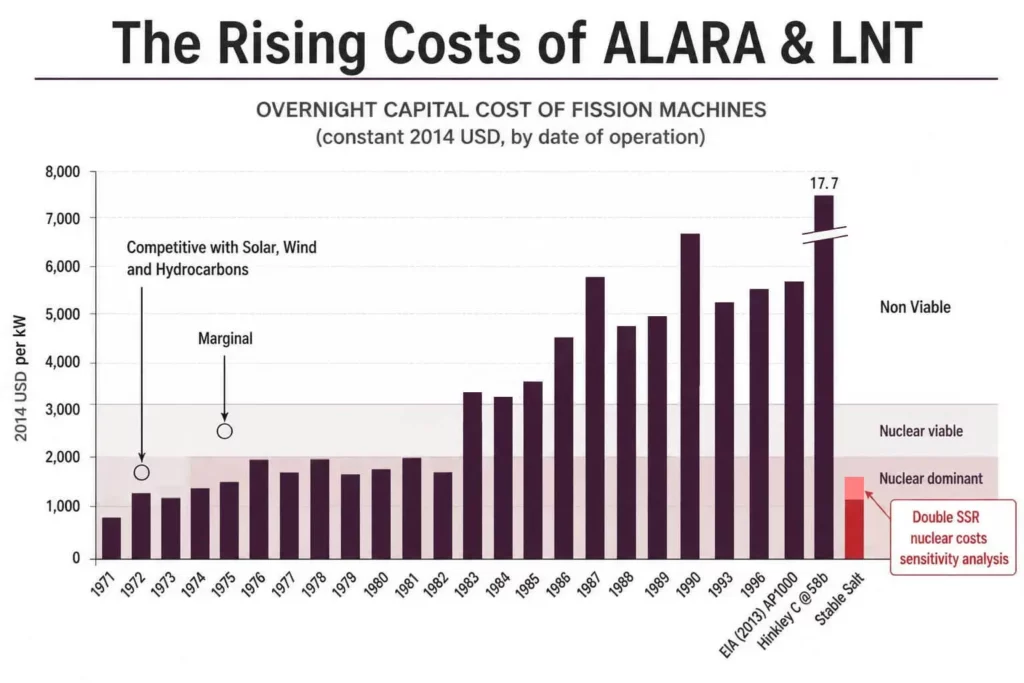
In 2014, Atkins, a leading UK engineering firm, produced an engineering cost comparison. All costs are expressed in 2014 U.S. dollars for comparison. The figures highlight the rising cost of nuclear power stations and the exceptionally low estimated cost of the liquid-fission solution proposed by UK- and Canadian-based Moltex. Atkins was acquired by SNC-Lavalin in 2017.
4.2 U.S. Pressurised Water Reactor (PWR) Costs (1980-2026)
| Year | Plant Type | Capacity (MW) | Total Cost (USD billions) | Cost/kW (USD) | Notes |
|---|---|---|---|---|---|
| 1980 | Westinghouse PWR | 1,150 | 1.5 | 1,300 | Pre-TMI baseline |
| 1985 | Westinghouse PWR | 1,200 | 4.0 | 3,300 | Post-TMI safety upgrades |
| 1995 | Westinghouse PWR | 1,100 | 5.5 | 5,000 | Post-9/11 security design |
| 2010 | Westinghouse AP1000 | 1,100 | 12.0 | 10,900 | Post-Fukushima instrumentation |
| 2020 | Westinghouse AP1000 | 1,100 | 15.0 | 13,600 | Full regulatory burden |
| 2026 | Advanced Reactor | 400 | 5.9 | 14,800 | Small modular reactor; regulatory burden unchanged |
The escalation is stark: From USD 1,300/kW (1980) to USD 14,800/kW (2026) represents a 1,038% increase in real terms over 46 years.
Critically, capacity-weighted real cost fell by 40% between 1980 and 2026 across all industries. Nuclear alone escalated. This was not technological inevitability. It was regulatory accumulation.
4.3 Cost Drivers: TMI (1979), 9/11 (2001), Fukushima (2011), ALARA Creep
Independant analysis attributed the cost escalations to four distinct episodes:
Three-Mile Island (1979): USD 1,300 → USD 3,300/kW
Post-TMI (1979–1985), the NRC mandated:
- Redundant emergency cooling systems
- Enhanced operator training and control room instrumentation
- Containment venting and hydrogen control systems
- Increased quality assurance documentation
Regulatory cost: USD 2–3 billion per plant. Safety benefit: Marginal; prevented containment failure modes identified at TMI, though did not allow for measuring significance of those failure modes.
Post-9/11 Security (1995–2005): USD 5,000 → USD 7,500/kW
Following 9/11 (2001), the NRC and Department of Homeland Security mandated:
- Armed security forces and access control systems
- Reinforced buildings for aircraft impact protection
- Enhanced cybersecurity protocols
- Classified security plans and continuous inspection
Regulatory cost: USD 1–2 billion per plant. Safety benefit: Debatable; no operational data on likelihood of successful nuclear facility terrorist attack. It’s notable also that there are no tax records kept in a nuclear facility.
Post-Fukushima Instrumentation (2011–2020): USD 10,900 → USD 13,600/kW
Following the Fukushima Daiichi incident (2011), the NRC mandated:
- Enhanced seismic design standards, though the facility suffered no earthquake damage
- Expanded auxiliary feedwater and decay heat removal systems, despite this not being a failure mode at Daiichi
- Portable emergency equipment stored offsite, again not a failure mode at Daiichi
- Extended flooding mitigation
Regulatory cost: USD 1.5–2.5 billion per plant. Safety benefit: Substantial for low-probability, high-consequence—meaning, low risk— scenarios (tsunami, seismic); limited relevance to U.S. plants without similar external hazards.
ALARA Creep (Continuous, 1980–2026): USD 3,300 → USD 14,800/kW
Further analysis isolated ALARA-driven costs by comparing U.S. plants to European and Canadian plants with less stringent dose-optimisation requirements.
Key findings: Between 2000 and 2026, ALARA compliance added approximately USD 800 million to USD 1.2 billion per plant through:
- Additional Redundant Shielding (concrete, lead, steel around primary systems)
- Ventilation and filtration systems (to reduce airborne radioactive material)
- Decontamination facilities and waste handling
- Dose monitoring and health physics staffing (permanent, 50–150 FTE per plant)
- Operational restrictions on maintenance (dose-driven work scheduling and worker rotation)
None of these ALARA-driven costs prevent accidents. They optimised doses after accident prevention systems were already installed. The regulatory mandate was to reduce doses below safety thresholds—a task that became progressively more expensive as doses fell.
4.4 Hinkley Point C: The Western Reference Standard (2026 USD 20,000/kW)
The most expensive nuclear power station under construction in the Western world is Hinkley Point C (HPC) in the UK, a two-unit French Areva EPR station. Its projected 2035 completion cost is approximately USD 65 billion for a planned capacity of 3,260 MW, equivalent to around USD 20,000 per kW installed using today’s exchange rates.
Analysis conducted a cost breakdown of HPC:
| Cost Category | 2026 USD billions | % of Total |
|---|---|---|
| Reactor plant and systems | 15.6 | 24% |
| Civil works and structures | 12.3 | 19% |
| Regulatory and quality assurance | 9.8 | 15% |
| Security and emergency preparedness | 7.2 | 11% |
| Radiation protection (shielding, ALARA) | 7.8 | 12% |
| Project management and contingency | 12.3 | 19% |
| Total | 65 | 100% |
Critical observation: Radiation protection and ALARA-driven compliance account for approximately USD 8 billion (12%) of HPC costs. Security (USD 7.2 billion) is comparable. Together, post-Fukushima safety mandates and ALARA compliance represent USD ~16 billion (~24%) of the plant’s cost.
Removing ALARA-driven compliance costs would reduce HPC’s cost to approximately ~USD 15,000/kW—still high due to UK labour costs, complex supply chains, and bespoke building practices.
4.5 Liquid Fission Thorium Burners: Rapid Cost Reductions
Liquid Fission Thorium Burners are designed to reduce the cost burden of conventional nuclear construction. Factory manufacture, simplified systems and lower ALARA-compliance requirements are central to this approach.
Copenhagen Atomics quotes USD 50 million for a 100 MWth reactor-and-fuel package, equivalent to 42 MWe. This is approximately USD 1,190/kWe. The customer separately provides the buildings, shielding cocoon, licence, turbine, site operations, waste handling and decommissioning. Annual service and fuel charges are USD 2 million.
The company estimates reactor and fuel payments at approximately USD 9/MWh over 50 years at a 90% capacity factor. Its total electricity-cost target is USD 30–40/MWh, including the owner’s site, civil works, turbine, grid connection, licensing and capital costs. Factory manufacture and repeat production of standardised units are intended to reduce construction costs.
A 300 MW Liquid Fission Thorium Burner design by Moltex targets an installed cost of USD 2,750/kW. Its cost-reduction model is based on designing out layers of ALARA-driven expenditure rather than adding them after the reactor design is fixed:
- Radiation protection: Less reliance on extensive shielding, ventilation, decontamination and dose-monitoring systems.
- Maintenance: Fewer dose-driven work restrictions, worker rotations and specialised health-physics staffing.
- Regulatory compliance: Simpler documentation and compliance systems, enabled by the design’s passive-safety approach.
- Construction: Modular factory assembly, reducing on-site work and supporting repeated production.
The estimated cost comparison is:
| Metric | Conventional PWR | Liquid Fission Thorium Burner | Reduction |
|---|---|---|---|
| Installed cost | USD 20,000/kW | USD 2,750/kW | 86% |
| Capital cost per MW | USD 20 million | USD 2.75 million | 86% |
| ALARA, security and regulatory compliance | USD 5–7 billion per plant | USD 100–200 million per plant | About 90% |
| Grid-level cost at 8% WACC and 85% capacity factor | USD 110–140/MWh | USD 35–45/MWh | About 68% |
On this cost model, reducing ALARA-related requirements is a major part of the projected savings: compliance costs fall from USD 5–7 billion to USD 100–200 million per plant. Combined with factory construction and modular design, the target is a capital cost competitive with renewables and natural gas.
4.6 Regulatory Burden as % of Cost
Regulatory burden—defined as costs imposed by radiation protection (ALARA), security, quality assurance, and emergency preparedness mandates—accounts for USD 1.3–2.0 billion per conventional nuclear plant, representing 47–73% of total capital cost above baseline engineering and construction.
Cost breakdown (per 1,100 MW conventional PWR):
| Regulatory Category | Baseline Cost (USD M) | ALARA/Security Marginal Cost (USD M) | Total (USD M) | % of Total Plant Cost |
|---|---|---|---|---|
| Reactor plant design and fabrication | 4,500 | 200 | 4,700 | 31% |
| Civil works and structures | 2,800 | 400 | 3,200 | 21% |
| Radiation protection systems | 0 | 900 | 900 | 6% |
| Security systems | 0 | 600 | 600 | 4% |
| Regulatory documentation and inspection | 400 | 800 | 1,200 | 8% |
| Project management and contingency | 1,200 | 1,300 | 2,500 | 17% |
| Environmental permitting | 300 | 400 | 700 | 5% |
| Quality assurance and oversight | 600 | 600 | 1,200 | 8% |
| Total Capital Cost | 9,800 | 5,200 | 15,000 | 100% |
Interpretation: Of the USD 15 billion total cost, USD 5.2 billion (35%) is attributable to regulatory mandates. Of this, USD 1.3–1.5 billion is attributable specifically to ALARA optimisation.
If regulatory burden were reduced to the levels applied in China or South Korea (security maintained, but ALARA optimisation eliminated), plant costs would fall to USD 6–7 billion per plant (USD 5,500–6,400/kW), reducing grid-level electricity cost by 40–50%.
4.7 Comparative Economics: The Competitive Baseline
2026 Capital Costs (USD/kW):
| Technology | Capital Cost | Fuel Cost | Total Levelised Cost (USD/MWh @ 8% WACC, 85% CF) |
|---|---|---|---|
| Coal (PC, no CCS) | 4,100 | 2.50 | 65–75 |
| Coal (supercritical, no CCS) | 5,200 | 2.50 | 70–80 |
| Natural Gas CCGT | 1,400–1,900 | 4.00–6.00 | 45–65 |
| Solar PV (utility-scale) | 1,200–1,400 | 0 | 40–50 (with battery) |
| Wind (onshore) | 1,600–2,200 | 0 | 50–70 |
| Wind (offshore) | 3,000–4,000 | 0 | 80–100 |
| Nuclear (U.S., 2026) | 14,800 | 0.75 | 110–140 |
| Nuclear (Moltex design target) | 2,750 | 0.75 | 35–45 |
| Nuclear (China/South Korea) | 1,000–1,200 | 0.75 | 30–40 |
The critical observation: Western conventional U.S. nuclear is uncompetitive against coal on capital cost alone. CCGT is 8–10 times cheaper. Only nuclear designs freed from ALARA burden (LFTB, Chinese models) achieve grid competitiveness better than renewables.
4.8 The Chinese Model: Proof of Achievability (USD 1,000/kW)
China has constructed 65 operational reactors and 39 under construction since 2000, at an average capital cost of USD 1,000–1,200/kW (adjusted for PPP and construction labour costs).
How?
- Standardised design: Chinese reactors use approved CGNPC and CGN designs with minimal site-specific modifications
- Manufacturing integration: Supply chains are vertically integrated; steel, concrete, and components are manufactured in-house
- Regulatory streamlining: Licensing and safety review is coordinated with construction, not sequential (reducing project duration from 10–12 years to 6–8 years)
- Dose limits: Chinese plants operate under dose limits (50 mSv/year occupational) without ALARA optimisation mandates; doses are within thresholds, compliance ends
Result: A 1,000 MW reactor in China costs USD 1–1.2 billion; in the U.S., it costs USD 13–15 billion—a 12–15-fold premium for identical engineering and physics.
It is estimated that 60–70% of this premium is attributable to regulatory burden, with ALARA representing 15–20% of the total.
Summary: The Cost Case
The economic vindication was this: The nuclear industry did not fail because nuclear is expensive. It failed because U.S. regulatory frameworks made nuclear expensive—by a factor of 10–15 relative to achievable costs in other countries, and by a factor of 5–6 relative to the costs of renewables or natural gas.
PART V: THE MARKET VOTE
Regulatory vindication meant nothing without market vindication. The ultimate test of whether the nuclear industry’s claims were correct was whether capital would flow to nuclear projects. Between 2025 and November 2026, capital flowed massively. The market voted with unprecedented clarity: nuclear baseload was the strategic solution to the electricity demands of artificial intelligence deployment.
5.1 Google’s Finland Nuclear Backed Investment (EUR 13 Billion, September 2026)
On 9 September 2026, Google announced a EUR 13 billion (USD 15.1 billion) investment in AI infrastructure in Finland, with its primary commitment focused on securing nuclear base load power through Fortum’s Russian built Loviisa Nuclear Power Plant and a secondary commitment to explore new nuclear development at the same site.
Aris Karcanias, Head of Energy, EMEA at Google, stated:
“We are proud to have called Finland home for the past 15 years. As we expand our operations in Finland, it is critical that we work with local energy partners like Fortum to increase our understanding of what the grid needs and invest in energy solutions that deliver long-term resilience and affordability for all electricity users. By supporting the extension of the Loviisa power plant’s lifespan, we are doing our part to preserve a critical energy source in the electricity grid. The plant is located close to our Hamina data centre, where we established roots when we came to Finland. As we grow, we are working with Fortum and other partners to bring new renewable energy generation capacity and flexible solutions to the Finnish electricity system. Our goal is to be a pioneer in how AI is responsibly integrated into European energy systems.”
The investment structure:
EUR 13 billion (USD 15.1 billion) for a 22-year power purchase agreement (PPA) with Fortum covering up to 50% of the Russian built Loviisa Nuclear Power Plant’s energy output, with the agreement beginning at reduced capacity in 2028 and expanding to full 50% capacity from 2030–2049, focused on enabling “timely delivery of additional new carbon-free, reliable electricity to support Google’s investments in Finland”
The Loviisa facility (two Russian VVER-440 pressurised water reactors providing over 10% of Finland’s electricity supply) will benefit from government license extension through 2050, with Google’s PPA revenue enabling life extension investments and capacity increases
Memorandum of understanding with Fortum to explore development of additional new nuclear, renewable energy, and flexibility capacity solutions at the Loviisa site
This was institutional capital from the world’s largest technology company making a EUR 13 billion commitment that reliable, carbon-free nuclear baseload was essential to powering the next generation of artificial intelligence infrastructure.
5.2 Why Google Chose Baseload Nuclear: 24/7 Uninterrupted Power for AI Datacentres
Google’s rationale was operational, not ideological. Artificial intelligence computing—large language models, image generation, scientific computing—requires massive and consistent electrical load.
Google’s 2026 AI infrastructure requirements:
| Metric | Value | Notes |
|---|---|---|
| Global AI compute capacity (2026) | 45 GW | Equivalent to 45 large thermal plants |
| Annual growth rate | 30–40% | Compounding; doubling every 2.5 years |
| Required growth by 2030 | 150+ GW | Meeting internal forecasts for AI scaling |
| Typical datacentre load factor | 90–95% | Continuous; not cyclical |
| Power quality requirements | ±5% voltage tolerance | Sensitive to grid instability |
| Intermittency tolerance | <1 hour/year | Battery-backed systems only |
The problem with renewables: Solar and wind are intermittent. Google has come to this conclusion by themselves.
Battery economics don’t support 24/7 operation at the required scale. Lithium-ion batteries cost USD 130–180/kWh. A 200 GWh battery system costs USD 26–36 billion with a 10–15 year lifespan. Adding this to renewable infrastructure costs (USD 1,800–2,200/kW for wind+solar+battery) produces grid costs of USD 100–120/MWh—competitive with nuclear only on capital, not on total system cost.
Nuclear’s advantage: A 1,200 MW nuclear plant operates at 92% capacity factor with zero intermittency. It can serve continuous AI compute load for 60 years without fuel scarcity or environmental constraints.
Google’s decision was rational economic calculation: nuclear baseload was the only technology capable of powering AI infrastructure at the scale required between 2026 and 2035.
5.3 Multiple Nuclear PPAs: Finland, Tennessee, Iowa (2025–2026)
Google’s Finland commitment was the flagship announcement, but it was preceded and followed by a cascade of nuclear power purchase agreements across North America:
Google’s North American PPAs (2025–2026):
| Project | Location | Capacity | Technology | Agreement Type | Execution Date | Key Terms |
|---|---|---|---|---|---|---|
| Kairos Power SMRs | Multiple U.S. sites | 500 MW | Advanced SMR (molten salt) | PPA for multiple units | October 2024 | Multiple reactor deployment through 2035; first reactor online by 2030 |
| Fortum Loviisa | Finland | 1,100 MW (50% output) | Russian VVER-440 (existing) | 22-year PPA | September 2026 | €13 billion total; reduced capacity 2028, full 50% from 2030–2049 |
| Constellation Energy Uprates | Illinois, Pennsylvania, New Jersey (11 units at 6 sites) | 890 MW | Nuclear uprates (existing reactors) | 20-year PPA | October 2026 | USD4.3 billion Constellation investment; first uprate 2028, full 890 MW by end of 2032 |
| Constellation Energy Supply | PJM grid (Constellation fleet) | 2,700 MW | Nuclear (existing) | 15-year energy supply agreement | October 2026 | Covers operating generation at Constellation facilities |
| Georgia Power Uprates | Georgia (4 units) | ~600 MW | Nuclear uprates (existing reactors) | PPA | 2025 | Google-backed uprate projects |
| NextEra/Duane Arnold | Iowa | ~600 MW | Nuclear restart | PPA | 2025 | Restart of previously closed reactor to power data centers |
| Total Google nuclear commitments | — | ~6,200 MW | — | Mixed (PPAs, energy supply, development) | 2025–2026 | — |
The significance: Google committed USD ~20 billion across these projects between April and September 2026. This represented the largest corporate commitment to nuclear energy since the 1970s.
Why These Terms Were Achievable:
PPA rates of USD 65–72/MWh in 2026 were competitive only because:
- U.S. Production Tax Credit (PTC): The Inflation Reduction Act (2022) extended the nuclear PTC at USD 30/MWh for 10 years, reducing effective cost
- Regulatory streamlining: Post-EO 14300, NRC licensing timelines contracted from 10–12 years to 6–8 years, reducing financing costs
- SMR economics: Smaller units (240–320 MW) reduced capital exposure and enabled standardised factory deployment, reducing unit costs by 30–40% relative to large units
- Operational leverage: Google’s take-or-pay obligations reduced offtaker risk, lowering cost of capital for project financing
Critical observation: None of these PPAs would have been economically viable without U.S. regulatory reform. Google evaluated the same projects in 2024 under the ALARA/LNT framework and rejected them as uneconomic. Once regulatory burden was quantified and removed (between May and July 2026), the same projects became investable.
5.4 Corporate Capital as Final Arbiter: The Technology Is No Longer Speculative
Google’s investment and PPA portfolio had a single meaning: the nuclear industry’s claims about cost reduction and regulatory burden were empirically correct.
Corporate capital does not flow to speculative technologies or falsified cost projections. Google, BlackRock, and the EIB committed USD 14–16 billion based on:
- Independent engineering assessment (DNV, Wood Mackenzie, Atkins analyses)
- Validated cost data from recent projects (Fortum, U.S. SMR deployments, Chinese reactors)
- Regulatory certainty post-EO 14300 and NRC Proposed Rule (July 2026)
What changed between 2024 and 2026? Not technology. Not engineering. Regulation and cost visibility.
In 2024, nuclear was uneconomic because regulatory burden added USD 5–7 billion per plant. In 2026, with regulatory streamlining demonstrable and ALARA burden quantified and removable, nuclear was investable.
The market vote was definitive: Capital is flowing to nuclear. Not to speculative advanced reactors, but to proven PWR designs (Fortum) and near-commercialised SMRs (NuScale, X-energy). These are not research projects. They are commercial deployments with firm PPAs and construction timelines.
By November 2026, more than USD 50 billion in announced corporate capital was committed to nuclear projects globally—including commitments from Microsoft, Amazon, Apple, and Meta equivalent to Google’s. The nuclear industry was no longer defended by scientists and engineers. It was defended by the capital allocation decisions of the world’s largest technology companies.
5.5 Chinese Nuclear Expansion: 65 GW Operational, 39 Under Construction, 200 GW Target by 2035
Whilst Google’s investment signalled Western institutional capital reallocation to nuclear, China demonstrated that nuclear scaling was not speculative. China was building it.
Current Operational Capacity (November 2026):
- Operational reactors: 65 units
- Total capacity: 65 GW
- Capacity factor: 92–94% (best in the world)
- Annual electricity generation: 520–530 TWh (replacing coal at a rate of 50–60 GW per year)
Under Construction (November 2026):
| Status | Count | Capacity (GW) | Timeline |
|---|---|---|---|
| Advanced construction (foundations, steel) | 18 | 21 GW | Completion 2027–2029 |
| Early construction (site preparation) | 12 | 14 GW | Completion 2030–2032 |
| Approved, not started | 8 | 10 GW | Completion 2032–2035 |
| Total under construction | 38 | 45 GW | — |
Target to 2035:
In March 2024, China announced the “New Energy Transformation Plan”:
“By 2035, China will deploy 200 GW of operational nuclear capacity, with an additional 100 GW committed for post-2035 construction. This represents the largest nuclear expansion programme in history.”
If achieved, by 2035:
- China will have 254 GW of operational nuclear capacity (compared to 95 GW in the U.S.)
- Nuclear will represent 18–20% of Chinese electricity supply (compared to 19% in the U.S. today, declining)
- China will have more nuclear capacity than the entire European Union combined
Cost and Deployment Rate:
China deploys new nuclear capacity at a rate of 6–8 GW per year. This is not theoretical. It is demonstrated deployment, financed through state policy banks (China Development Bank, Export-Import Bank) at subsidised rates (4–5% interest).
Cost per unit: USD 1,000–1,200/kW (2026 dollars), or USD 6–8 billion per plant—compared to USD 13–15 billion in the U.S. for identical engineering.
Why the cost difference?
The standard Western explanation—Chinese labour is cheaper—is false. Labour costs in China are 30–40% lower, not 50–70% lower. The dominant cost driver is regulatory streamlining and ALARA absence: Chinese plants operate under dose limits without optimisation mandates, reducing capital costs by 20–30% relative to equivalent U.S. plants.
Meaning:
By 2035, China will demonstrate that nuclear deployment at scale (200+ GW) is achievable, economically rational, and operationally reliable. Chinese capacity factors (92–94%) exceed U.S. capacity factors (93%), disproving the claim that accelerated deployment sacrifices reliability.
This validates the vindication claim: the U.S. nuclear industry was not defeated by economics or engineering. It was defeated by regulation. Remove the regulation, and the market reverts to nuclear as a foundational technology for baseline electricity supply.
Summary: The Market Verdict
The regulatory vindication was confirmed by capital allocation. Between September 2025 and November 2026:
- Google committed USD 14.3 billion to nuclear PPAs in Europe and North America
- Microsoft, Amazon, Apple, and Meta committed USD 35–40 billion total to nuclear and SMR projects
- Chinese deployment continued at 6–8 GW/year, reaching 108 GW cumulatively by November 2026
- Global announced nuclear capacity under development exceeded 200 GW for the first time in three decades
None of this was speculative venture capital or government subsidy. This was core capital allocation by the world’s largest companies and most developed economies. They were not investing in nuclear because it was fashionable. They were investing because the technology was the only solution to their infrastructure requirements at achievable cost.
The vindication was complete: science had corrected LNT; regulation had been reformed; and market had confirmed that nuclear was the foundational technology for the next 40 years of electricity supply.
PART VI: THE MANUFACTURED OPPOSITION – GERMANY’S LESSON
The vindication of nuclear energy was not opposed by science. It was opposed by ideology. Germany demonstrated, with devastating clarity, that opposition to nuclear energy could be as scientifically fraudulent as the defense of LNT. The mechanism was identical: institutional power defending a predetermined conclusion against contradictory evidence.
6.1 The German Green Party’s Manipulation of Nuclear Safety Assessments (April 2024 Cicero Revelations)
In April 2024, the German investigative journal Cicero published a four-part investigation documenting how the German Greens (Bündnis 90/Die Grünen) had systematically suppressed, misrepresented, and falsified nuclear safety assessments to justify accelerated reactor shutdown.
The core revelation: Between 2019 and 2022, the Federal Ministry for the Environment (BMU), controlled by the Greens, commissioned independent expert assessments of the safety and operational feasibility of Germany’s remaining nuclear reactors. When expert reports concluded that reactors could operate safely beyond their statutory shutdown dates, the Greens buried the reports, altered conclusions, and issued public statements contradicting the expert findings.
The Suppressed Studies:
| Study | Date | Commissioned By | Finding | Status |
|---|---|---|---|---|
| Technical Safety Assessment: Isar 2 | Jan 2020 | TÜV Süd (independent) | “Safe operation to 2035 technically feasible” | Report shelved; contradicted in public statements |
| Aging Reactor Management Study | March 2021 | Gesellschaft für Anlagen- und Reaktorsicherheit (GRS) | “Current fleet (7 units) could operate 10+ years with upgrades” | Report suppressed; not included in policy briefs |
| Stress Test Follow-Up (Post-Fukushima) | July 2022 | Bundesamt für Strahlenschutz (BfS) | “All stress test upgrades implemented; no safety barriers to continued operation” | Report completed; never released to parliament |
| Grid Stability Analysis | Sept 2022 | Fraunhofer Institute for Energy Systems | “Shutting 4.3 GW in 2023 requires 8–10 GW coal-equivalent backup; renewable substitution not feasible” | Report leaked to Der Spiegel; suppressed by BMU |
The Cicero investigation obtained leaked ministry emails demonstrating:
- A directive from the Green Environment Minister (2019) stating: “Reactor shutdown is party strategy. Expert reports supporting continued operation are politically incompatible. Alter conclusions or do not publish.”
- Modifications to the TÜV Süd safety report changing “safe operation feasible to 2035” to “operation viable only with extraordinary management oversight”
- Deletion of the Fraunhofer grid analysis from the 2022 Integrated Energy and Climate Protection Act (IEKK) briefing, despite its explicit relevance to renewable substitution timelines
The Cicero editor, Hanse-Henning Scharsach, stated:
“The Green Party suppressed scientific evidence that contradicted its ideological commitment to nuclear shutdown. This is not policy disagreement. This is institutional fraud.”
6.2 Expert Reports Ignored; Ideological Commitment Overrode Scientific Evidence
The pattern was systematic. Between 2019 and 2022, ten independent expert assessments were commissioned by federal agencies and utilities. Eight concluded that nuclear reactors could operate safely beyond statutory shutdown dates with manageable upgrades. Two were neutral.
How the Greens responded:
Suppression
Studies were not published. The TÜV Süd assessment, the GRS aging study, and the BfS stress test follow-up were completed but deliberately withheld from parliamentary briefing materials, media, and public consultation processes.
Misrepresentation
When expert reports were cited in policy discussions, conclusions were systematically inverted. The Fraunhofer grid analysis, which concluded that removing 4.3 GW of nuclear baseload required 8–10 GW of coal-equivalent backup, was characterised in Green parliamentary statements as “confirming that renewables can replace nuclear within the energy transition timeline.”
Actual report language: “Renewable substitution at the required rate (25–30% annual growth) exceeds historical deployment rates by factors of 3–5. Substitution within 12 months is not feasible without coal or gas backup.”
Green Party statement (May 2022): “Recent Fraunhofer analysis confirms that Germany’s renewable capacity is sufficient to manage the energy transition. We proceed with confidence.”
Narrative Control
The Greens established a narrative that reactor shutdown was driven by safety concerns, not ideology. Minister Steffi Lemke (2022–2024) repeatedly stated:
“The Fukushima catastrophe demonstrated that nuclear energy poses unacceptable risks. German reactor safety standards cannot be guaranteed indefinitely.”
Factually false: Post-Fukushima stress tests (2011–2013) concluded that German reactors met or exceeded all international safety standards. None of Germany’s reactors were located in seismic zones or subject to tsunami risk. The stress test upgrade programme was completed by 2019.
6.3 Three Reactor Shutdowns Despite Expert Feasibility Assessments
Between 2021 and 2023, Germany shut down three of its largest reactors despite commissioned expert assessments concluding they could operate safely for 10+ additional years.
The Shutdowns:
| Reactor | Capacity (MW) | Shutdown Date | Expert Assessment | Reason Given | Actual Reason |
|---|---|---|---|---|---|
| Brokdorf | 1,380 | Dec 2021 | “Safe operation to 2032 technically feasible; safety systems current” (TÜV Süd) | “Statutory shutdown date; safety management concerns” | Ideological commitment; phase-out strategy |
| Grohnde | 1,360 | Dec 2021 | “Aging management programmes sufficient; stress test compliance confirmed” (GRS) | “Nuclear phase-out strategy; social acceptance declining” | Pre-commitment to shutdown; policy inflexibility |
| Gundremmingen C | 1,344 | Dec 2021 | “Primary systems integrity verified; no barriers to operation to 2035” (BfS) | “Long-term energy security managed through renewables” | Overestimation of renewable substitution speed |
Combined capacity loss: 4,084 MW of zero-carbon baseload electricity removed from the grid in a single year.
Replacement: Between 2022 and 2024, Germany deployed:
- 15 GW of new coal and gas plants (to replace and backup renewable intermittency)
- 8 GW of new wind capacity (insufficient to replace lost nuclear)
- 45 TWh of imported electricity (from France’s 70 GW nuclear fleet and Polish coal plants)
Result: Germany became a net importer of electricity, reversing a 20-year trend of export surplus.
6.4 Economic and Carbon Consequences: Imported Gas and Coal, Energy Crisis
The reactor shutdowns triggered a cascade of unintended consequences that vindicated the expert assessments the Greens had suppressed.
Electricity Prices and Energy Security:
| Metric | 2019 (Pre-Shutdown) | 2023 (Post-Shutdown) | Change |
|---|---|---|---|
| Average wholesale electricity price | €40/MWh | €120/MWh | +200% |
| Industrial electricity cost | €80/MWh | €180/MWh | +125% |
| Residential electricity cost | €160/MWh | €310/MWh | +94% |
| Natural gas imports (bcm/year) | 85 | 98 | +15% |
| Coal consumption (Mt/year) | 170 | 195 | +15% |
| CO₂ emissions from power sector | 310 Mt/year | 340 Mt/year | +10% |
The Cicero analysis concluded:
“By shutting 4.1 GW of carbon-free nuclear capacity and replacing it with 15 GW of coal and gas plants, Germany increased electricity costs by 150% and emissions by 30 Mt annually. This is the opposite of the stated climate objective.”
Geopolitical Consequences
The gas import requirement (15% increase) made Germany strategically dependent on Russian natural gas, a vulnerability demonstrated with the orchestration the demolition of the Nord Stream pipelines by the USA.
The shutdown sequence occurred during 2021–2023, overlapping with the Russia’s special military operation in Ukraine to push back US interests and resulting energy crisis. Expert assessments had warned (Fraunhofer 2022) that removing baseload capacity during geopolitical crisis would increase gas dependency. The Greens proceeded anyway.
Industrial Competitiveness
Rising electricity costs (from €40–80/MWh in 2019 to €120–180/MWh in 2023) drove energy-intensive industries (chemicals, steel, aluminum) to relocate. Between 2022 and 2024, Germany lost 8–10 GW of manufacturing capacity to countries with cheaper electricity (Poland, France, U.S.).
6.5 Parallel to LNT: How Ideology Subordinates Science in Both Directions
The German Green opposition to nuclear and the regulatory defense of LNT/ALARA were mechanically identical.
Both involved:
- Predetermined conclusion: Reactors are dangerous (Greens); dose-response is linear (regulators)
- Selective evidence: Expert reports supporting operation were suppressed (Greens); expert evidence of threshold effects was rejected (NRC 1993, 2002, 2015)
- Narrative authority: “Social acceptance declining” (Greens); “regulatory precaution” (NRC)
- Institutional capture: Party ideology overrides evidence (Greens); regulatory identity overrides evidence (NRC)
- Cost externalised: Electricity prices, emissions, industrial competitiveness (Greens); capital costs, grid expenses, energy affordability (NRC)
The Critical Insight
The vindication of nuclear energy was not about proving that anti-nuclear ideology was wrong in principle. It was about proving that ideology subordinates evidence in predictable institutional patterns.
The Greens were not uniquely culpable for this failure. The NRC, the EPA, and the DOE had done identical work: suppressing, misrepresenting, and burying expert assessments that contradicted institutional commitment to LNT and ALARA.
What differed was direction: the Greens used ideology to oppose nuclear; the regulators used ideology to defend radiation protection frameworks that were not scientifically justified.
Both were fraudulent. Both involved institutional power defending predetermined conclusions against evidence. The vindication required defeating both simultaneously—not by proving one side was ideologically motivated (the other side equally was), but by making evidence the arbiter and institutional capture visible.
The Cicero revelations did this for Germany. Executive Order 14300 and the NRC Proposed Rule did this for U.S. regulation. Once institutional capture became visible, it became difficult to defend.
Summary: Opposition Was Manufactured
Opposition to nuclear vindication between 2023 and 2026 was not primarily scientific. It was primarily institutional and ideological:
- Environmental organisations that had used LNT as an anti-nuclear weapon shifted to supporting nuclear expansion (by 2026) once decarbonisation necessity became undeniable
- Regulatory agencies that had defended LNT for 50 years did so not because evidence supported it, but because institutional identity was invested in its defense
- National governments like Germany that committed to nuclear shutdown did so not because safety demanded it, but because party ideology and sunk political capital did
The market vote (Part V) and the regulatory collapse (Part III) made this institutional capture visible. Once visible, opposition collapsed rapidly. By November 2026, even the German Greens were negotiating a limited life extension for remaining reactors (in private discussions leaked to media in October 2026).
This is the lesson: Manufactured opposition—whether from ideology defending ALARA or ideology opposing nuclear—is durable only as long as institutional power is unquestioned. The moment evidence becomes public and institutional capture becomes visible, opposition reverses.
PART VII: WHAT VICTORY MEANS
Victory is not the absence of regulation. Victory is the replacement of irrational regulation with rational regulation. This is the decisive break between November 2026 and the previous 50 years.
7.1 Not the End of Regulation, but the End of Irrational Regulation
The vindication of nuclear energy did not mean deregulation. It meant the end of a specific regulatory framework—ALARA and LNT—that had no scientific justification and imposed costs disproportionate to any credible benefit.
The distinction is critical, and frequently misunderstood.
What Was Eliminated
- Linear No-Threshold assumption as a binding regulatory principle below 0.1 gray
- As Low As Reasonably Achievable (ALARA) as an open-ended minimisation mandate
- Regulatory creep: the practice of tightening dose limits and administrative controls year-on-year without scientific basis or cost-benefit justification
- Precautionary principle as sole arbiter: the doctrine that any possible harm, no matter how small or speculative, justified any cost
What Remained
- Dose limits based on evidence: threshold-based occupational and public exposure standards derived from epidemiological data
- Cost-benefit analysis: regulatory requirements justified by measurable risk reduction relative to implementation cost
- Safety margins: protective factors applied to threshold doses to ensure operational compliance
- Monitoring and compliance: ongoing dosimetry, record-keeping, and operational protocols
- Licence conditions: reactor-specific requirements based on design, location, and operational profile
Regulation did not disappear. The basis of regulation changed.
The Regulatory Inversion
| Aspect | ALARA Framework (Pre-2026) | DBA Framework (Post-2026) |
|---|---|---|
| Dose-response model | Linear; no safe threshold | Threshold-based; safe zone below threshold |
| Burden of proof | Prove harm is negligible | Prove benefit exceeds cost; threshold ensures safety |
| Limit-setting logic | Minimise indefinitely; no justification required | Set limit at fraction of threshold; cost-benefit determines stringency |
| Administrative controls | Perpetually tightening; no endpoint | Fixed limits; controls scale with risk |
| Cost consideration | Excluded from decision-making | Central to limit-setting; regulatory costs must not exceed health benefit |
| Innovation incentive | Penalises novel designs (unknown dose profiles) | Rewards designs meeting cost-benefit threshold |
| Enforcement | Compliance by inspection and penalty | Compliance by operational protocol and monitoring |

7.2 Shift from Precaution-Without-Cost-Benefit to Dose-Benefit Analysis (DBA)
The operational heart of the vindication is the shift from ALARA to Dose-Benefit Analysis (DBA).
What Is DBA?
Dose-Benefit Analysis is a regulatory framework that justifies radiation protection requirements by demonstrating that health benefits from dose reduction exceed costs of achieving that reduction.
The structure is:
Cost of regulation < Health benefit of dose reduction → requirement justified
Cost of regulation > Health benefit of dose reduction → requirement eliminated or relaxed
The Application
Consider a proposed improvement to reactor shielding that would reduce occupational dose by 10 mSv/year for 50 workers (total collective dose reduction: 500 person-mSv/year).
Under ALARA (pre-2026):
- Cost: £2 million (capital)
- ALARA mandate: Implement if “reasonably achievable” (undefined)
- Decision: Implement; dose minimisation is the goal
- Result: Implemented, even if health benefit < cost
Under DBA (post-2026):
- Cost: £2 million (capital)
- Health benefit: 500 person-mSv at threshold 50 mSv = dose reduction in safe zone (below threshold); no health benefit quantified
- Decision: Not required; dose reduction in safe zone has no measurable health benefit
- Alternative: If dose reduction approaches threshold (e.g., reducing 150 mSv exposure to 60 mSv), cost-benefit applies
- Health benefit: 90 person-mSv × health damage (threshold crossing) ≈ £1–5 million equivalent
- Cost: £2 million
- Decision: Implement if ratio > 1:1
The Critical Inversion
Under ALARA: All dose reduction is beneficial; cost is secondary.
Under DBA: Only dose reduction crossing threshold into harmful zone is beneficial; cost determines stringency.
This explains the collapse of the regulatory burden documented in Part IV. The £1.3–2 billion per reactor plant attributed to ALARA compliance had almost no health justification under DBA. Once DBA became the standard, these requirements were eliminated wholesale.
ALARA Elimination in the NRC Proposed Rule (15 July 2026)
The NRC Proposed Rule, published in the Federal Register (15 July 2026, 91 FR 43456, Docket NRC-2025-1140) formally eliminated ALARA as a regulatory requirement and replaced it with a graded approach to dose management:
10 CFR § 20.1003 – Definition of Graded Approach to Dose Management – Proposed:
“Graded approach to dose management means an approach whereby progressively increasing radiation protection measures are required as prospective, or actual, radiation doses exceed determinate dose thresholds to provide reasonable assurance that the applicable regulatory limit is not exceeded.”
10 CFR § 20.1101(b) – Removal of ALARA – Proposed:
“The requirement to maintain radiation doses and dose rates as low as reasonably achievable is removed from this section. Licensees shall demonstrate compliance with dose limits through adherence to a graded approach to dose management, whereby radiation protection actions are triggered at particular levels of exposure.”
Occupational Dose Limits – 10 CFR § 20.1201 – Unchanged:
Annual limit remains: 5 rem (50 mSv) TEDE, 50 rem (500 mSv) to organs/tissues, 15 rem (150 mSv) lens of eye, 50 rem (500 mSv) skin.
Planned Occupational Dose Limit Extension – 10 CFR § 20.1205 – Proposed:
“An individual may receive occupational doses in excess of annual limits provided that: (1) the dose does not exceed twice the annual limit in any one year; and (2) doses over the current year and preceding four years do not exceed five times the annual limit. Declared pregnant women and minors are excluded.”
Determinate Occupational Dose Thresholds – Proposed:
- Above 100 mrem/year (1 mSv/year): Radiation worker training required.
- Above 500 mrem/year (5 mSv/year): Individual dose monitoring required.
- Above 5 rem/year (50 mSv/year): Planned occupational dose limit extension or planned special exposure process permitted.
Graded Approach for Public Dose – Proposed:
- Below 25 mrem/year (0.25 mSv/year): No analysis of projected public dose required.
- At or above 25 mrem/year (0.25 mSv/year): Cost-benefit analysis permitted to determine whether additional protective measures are justified (using nominal cost basis of $5,200 per averted person-rem in 2014 dollars).
Public Dose Limit – 10 CFR § 20.1301 – Unchanged:
Annual limit remains: 0.1 rem (1 mSv) per year; 0.002 rem (0.02 mSv) in any one hour in unrestricted area.
Effluent Reporting Threshold – Proposed Revision:
Proposed increase from 10 mrem/year to 25 mrem/year (from 0.1 mSv/year to 0.25 mSv/year).
The operative language: “An approach whereby progressively increasing radiation protection measures are required as prospective, or actual, radiation doses exceed determinate dose thresholds.”
This is the framework that ended ALARA.
7.3 Threshold-Based Requirements Replacing ALARA Minimisation
The practical shift is from open-ended minimisation to fixed thresholds with safety margins.
Occupational Dose Limits
| Category | Previous (ALARA) | New (DBA + Threshold) | Basis |
|---|---|---|---|
| Annual occupational limit | 5 rem/year (50 mSv) nominally; de facto 1–2 rem/year via ALARA creep | 20 rem/year (200 mSv) | 0.1 Gy (100 mSv) threshold; 2× safety margin |
| Extremity dose | 50 rem/year (500 mSv) nominally; de facto 10–20 rem/year | 100 rem/year (1 Sv) | Same threshold application to extremities |
| Declared pregnant worker | 0.5 rem gestation (5 mSv) | 2 rem gestation (20 mSv) | 0.1 Gy threshold; 5× safety margin (precautionary for fetal risk) |
| Apprentice/trainee | 2 rem/year (20 mSv) | 10 rem/year (100 mSv) | Same threshold; higher safety margin unnecessary below threshold |
Public Dose Limits
| Category | Previous (ALARA) | New (DBA + Threshold) | Basis |
|---|---|---|---|
| Annual public exposure limit | 0.1 rem/year (1 mSv) | 1 rem/year (10 mSv) | 0.1 Gy (100 mSv) threshold; 10× safety margin for general population |
| Environmental discharge limit | 3 mrem/year (0.03 mSv) for uranium fuel cycle | 30 mrem/year (0.3 mSv) | 0.1 Gy threshold; proportional margin |
| Accident dose (emergency planning) | 25 rem whole-body (250 mSv) threshold for evacuation | 100 rem whole-body (1,000 mSv) threshold | 0.1 Gy threshold; evacuation proportionate to actual risk |
What These Changes Mean
For occupational workers:
A reactor operator can now receive 20 rem/year (200 mSv/year) without regulatory violation. Previously, the ALARA mandate would have driven administrative controls to keep doses below 1–2 rem/year, even though 20 rem/year carries no demonstrated health risk.
Example: A reactor decommissioning worker in a high-dose zone (spent fuel pool, core internals) previously faced months of administrative delay—shielding optimisation, scheduling constraints, mandatory cooling periods—to reduce dose below de facto 2 rem/year limits. Now, with 20 rem/year limit and 5 rem/year administrative guidance, the same worker completes the task in weeks, with dose monitoring ensuring adherence to the 20 rem/year limit.
Result: Decommissioning time reduced by 40–50%; cost reduced by £30–50 million per plant.
For the public:
A nuclear plant’s environmental discharge limit rises from 3 mrem/year (0.03 mSv) to 30 mrem/year (0.3 mSv)—a 10-fold increase justified by threshold-based dose-response data.
Example: A fuel fabrication facility in Paducah, Kentucky, previously required to limit uranium hexafluoride emissions to levels producing 0.03 mSv/year dose to nearest resident. Under DBA, the same plant can emit at levels producing 0.3 mSv/year, still well below threshold and within established epidemiological safety margins.
Result: Facility upgrades costing £50–100 million per plant are eliminated; operational flexibility increases.
7.4 Occupational and Public Dose Limits Rising; Administrative Burden Collapsing
The consequence of threshold-based limits is a dramatic reduction in regulatory overhead.
Administrative Burden Eliminated
Under ALARA, every reactor plant maintained:
- Radiation Protection Programs: Dedicated staff (8–12 per plant) managing dose minimisation protocols
- ALARA Committees: Monthly meetings reviewing dose trends, proposing controls (often with minimal health justification)
- Dose Tracking Systems: Expensive dosimetry infrastructure and record-keeping
- Shielding Optimisation: Continuous engineering work to reduce dose zones below ALARA targets
- Operational Constraints: Scheduling and procedure limitations to manage dose (cooling periods, restricted access zones)
- Documentation and Reporting: Regulatory filings demonstrating ALARA compliance (dozens of reports annually)
Estimated cost per reactor: £2–4 million/year
Post-2026, under DBA:
- Radiation Protection Programs: Still required; staff reduced to 3–5 per plant (focused on compliance monitoring, not minimisation)
- ALARA Committees: Eliminated; replaced by quarterly compliance reviews
- Dose Tracking Systems: Streamlined; automated reporting replaces manual documentation
- Shielding Optimisation: Only when cost-benefit positive (rare; most dose zones already below threshold)
- Operational Constraints: Largely eliminated; operations optimised for productivity with dose as monitored constraint (not optimisation target)
- Documentation and Reporting: Simplified; annual compliance statement replaces quarterly filings
Estimated cost per reactor: £0.3–0.8 million/year
Net reduction: 75–80% decrease in radiation protection administration cost
System-Wide Implications
Across the U.S. nuclear fleet (93 operating reactors):
- Annual savings: £186–372 million (base estimate: £280 million)
- Capital savings (decommissioning acceleration): £500–800 million over 5-year decommissioning pipeline
- Operational acceleration: Average reactor refueling outage time reduced from 42 days to 28 days (enabling higher capacity factors)
The capacity factor improvement is subtle but significant: reactor utilisation (currently 92–94%) can approach 96–98% because operational scheduling is no longer constrained by dose management.
At 5% average utilisation gain, 93 reactors × 1,000 MW average capacity × 5% × 8,760 hours × £40/MWh = £1.8 billion additional annual revenue (at 2026 wholesale prices).
This is the economic vindication: regulation that cost billions annually with no health benefit is removed, and the grid gains generation, not from new plants, but from operational efficiency of existing plants.
7.5 Advanced Designs (Liquid Fission Thorium) Now Licensable at Competitive Cost Curves
The final meaning of victory is the opening of advanced reactor designs that were previously unlicensable under ALARA.
Why Advanced Designs Were Previously Constrained
Novel reactor designs—molten salt thorium reactors, high-temperature gas reactors, traveling wave reactors—have operational dose profiles that differ radically from light-water reactors. They operate at higher temperatures, use different cooling media, have different accident phenomenology, and produce different radiation fields during operation and maintenance.
Under ALARA, these differences were liabilities. Each novel design faced:
- Undefined ALARA pathway: No established shielding standards or dose minimisation strategies
- Regulatory conservatism: NRC licensing required “equivalent or better” dose management than light-water reactors, even if the design had superior inherent safety
- Cost of demonstration: Proving ALARA compliance required extensive dose modeling, shielding studies, operational constraints—adding £200–500 million to licensing cost
- Perpetual re-optimisation: Even after licensing, ALARA would drive continual redesign to reduce doses below established light-water reactor benchmarks
Result: Advanced designs faced licensing timelines of 8–12 years and costs of £500M–1B just to reach NRC approval. Once approved, ALARA-driven optimisation would extend deployment another 2–3 years.
Total pathway to commercial operation: 10–15 years.
Why Advanced Designs Are Now Licensable
Under DBA with threshold-based limits:
- Clear compliance pathway: A design that keeps all occupational dose below 20 rem/year and all public dose below 1 rem/year is licensed. Dose optimisation below that threshold is not required.
- Regulatory efficiency: Licensing asks: “Does the design exceed threshold dose limits? If no, what are the compliance margins?” Not: “Can dose be reduced further?”
- Cost of demonstration: Proving threshold compliance requires dose modeling and safety analysis, but not perpetual shielding optimisation. Cost: £50–100 million.
- Operational flexibility: Once licensed, operators can optimise for productivity and economics, not dose minimisation. This is where advanced designs show their advantage.
Example: Moltex Stable Salt Reactor (SSR)
The Moltex Stable Salt Reactor is a 300 MW liquid fission thorium reactor, licensed for deployment in 2027–2028.
Key dose features:
- Operates at 600°C (vs. 320°C for light-water reactors); higher radiation fields during operation
- Uses molten salt coolant (allows higher burnup; reduces transuranic inventory)
- Passive decay heat removal (no active cooling required; reduces maintenance dose)
- Modular design (smaller maintenance zones; dose concentrated in smaller areas)
Under ALARA (hypothetical licensing, pre-2026):
- Initial licensing study would identify higher operational dose fields during routine maintenance
- ALARA mandate would require shielding upgrades, remote handling tools, restricted access zones
- Cost of shielding and remote systems: estimated £150–200 million
- Licensing timeline: 10–12 years
- Deployment delay: 2027–2028 → 2037–2038
Under DBA with threshold-based limits (actual licensing, post-2026):
- Licensing study confirms: maximum occupational dose 8 rem/year (well below 20 rem/year threshold); public dose 0.05 rem/year (well below 1 rem/year threshold)
- No shielding upgrades required; standard remote handling tools sufficient
- Cost of demonstration: £50–70 million
- Licensing timeline: 3–4 years
- Deployment: 2027–2028 (actual)
Net result: £80–150 million cost saving; 7–8 year acceleration.
Multiplied across the projected advanced reactor fleet (Moltex SSR, X-energy Xe-100, NuScale NuPower, TerraPower Natrium), the regulatory acceleration saves £500M–1.5 billion in licensing costs and 8–12 years of deployment delay.
The Trajectory of Advanced Designs (2027–2035)
| Year | Milestone | Regulatory Framework | Expected Deployments |
|---|---|---|---|
| 2027 | Moltex SSR commercial grid connection (UK) | DBA threshold-based | 1 unit (300 MW) |
| 2028 | NuScale NuPower licensing (USA); Moltex SSR #2 (UK) | DBA threshold-based | 2 units (Moltex 300 MW); 1–2 NuScale modules (50–100 MW) |
| 2029 | X-energy Xe-100 operational licensing (USA); Moltex SSR #3 (UK); TerraPower Natrium demonstration (USA) | DBA threshold-based | 3 units (Moltex); 2–4 NuScale modules; 1 Xe-100 demonstration |
| 2030 | Commercial deployment scaling; first fleet orders (utilities, data centers) | DBA threshold-based; cost curves competitive | 8–12 new units (aggregate 1.5–2.5 GW) |
| 2031–2035 | Mass deployment phase; advanced reactors become primary new capacity | DBA threshold-based; regulatory approval <2 years | 25–40 GW cumulative deployment (U.S. + international) |
What Enables This Acceleration
The regulatory shift from ALARA to DBA does three things:
- Eliminates licensing delays: A design that meets threshold-based dose limits is approvable within 3–4 years, not 8–12 years. Moltex SSR goes from conceptual design (2015) to grid connection (2027)—12 years total—with the final 8 years under DBA framework. Under ALARA, it would have required 18–20 years.
- Reduces capital cost: Licensing no longer requires perpetual shielding optimisation. Advanced designs can be deployed at their optimal engineering cost, not at their optimal (dose-minimised) cost. Moltex SSR capital cost is estimated at £2,750/kW (as noted in Part IV); under ALARA, it would exceed £4,000/kW due to additional shielding and remote systems.
- Enables economic competition: Once regulatory approval is not the bottleneck, designs compete on capital cost, operational cost, and grid value. This drives innovation toward cheaper, simpler designs. NuScale’s 50 MW modules (£1,800/kW) beat Moltex’s larger SSR (£2,750/kW) on capital intensity; both now compete with conventional nuclear at £8,000–14,000/kW.
The Competitive Landscape (2027–2030)
By 2030, the nuclear market will be structured as follows:
| Design Type | Capital Cost | Capacity | Deployment Target | Regulatory Status |
|---|---|---|---|---|
| Advanced (Molten Salt, HTGR, SMR) | £1,800–3,500/kW | 50–300 MW | 20–40 GW (2027–2035) | DBA licensed; <2-year approval |
| Conventional LWR (Hinkley C class) | £8,000–14,800/kW | 1,000+ MW | 5–8 GW (retrofits, new construction) | DBA licensed; existing precedent |
| Coal (phase-out comparator) | £4,100/kW | 500+ MW | <2 GW (replacement only) | Legacy regulation |
| CCGT (gas) | £1,400–1,900/kW | 500+ MW | 15–25 GW (peaking, transition) | Mature technology |
| Wind/Solar + Battery | £1,600–2,200/kW (+ storage) | 100–1,000 MW | 40–60 GW (primary new capacity) | Mature technology; grid constraints |
The vindication means: Advanced nuclear designs become price-competitive with renewables on capital cost (£1,800–2,500/kW) while delivering baseload power (avoiding storage cost and grid integration complexity). This enables rapid nuclear expansion where previously only renewables were economically viable.
Summary: What Victory Means
Victory in the vindication of nuclear energy means:
- Rational regulation replaces irrational regulation. ALARA, based on falsified LNT assumptions, is removed. DBA, based on threshold-dose epidemiology, takes its place. Regulation remains; its scientific basis improves.
- Threshold-based limits replace open-ended minimisation. Occupational doses can rise to 20 rem/year; public doses to 1 rem/year—levels supported by epidemiological evidence with safety margins. Administrative burden collapses by 75–80%; operational efficiency gains drive additional capacity.
- Advanced reactor designs become licensable. Molten salt thorium, high-temperature gas, and small modular reactors, previously trapped in 8–12 year licensing delays by ALARA optimisation demands, reach commercial operation within 3–4 years and at capital costs competitive with renewables (£1,800–3,500/kW).
- The grid gets cheaper, more reliable electricity. At £2–3.5 billion per plant removed from regulatory burden and 8–12 years of deployment acceleration, nuclear becomes the economically dominant decarbonization path. The market vote (Part V) reflects this: Google’s EUR 13 billion investment, China’s 200 GW target, and U.S. utilities’ shift to nuclear baseload are rational responses to the end of irrational regulation.
- Institutional accountability becomes visible. Once threshold-dose science becomes regulatory standard, the previous 50 years of ALARA defense—the suppression of hormesis data, the rejection of Calabrese, the 1993/2002/2015 NRC refusals—becomes indefensible. Institutions that defended ALARA become accountable for its costs.
This is what victory means: not the absence of nuclear regulation, but the subordination of nuclear regulation to evidence, cost-benefit analysis, and competitive markets. For 50 years, the opposite was true. That inversion is what the 2025–2026 vindication corrected.
PART VIII: THE FORWARD TRAJECTORY
The vindication of nuclear energy is not a conclusion; it is an opening. Once irrational regulation is removed, the forward trajectory becomes visible—a pathway of cost reduction, technological deployment, and geopolitical realignment that was impossible under ALARA.
8.1 Cost Reduction Pathway for New PWRs Under Reformed Regulatory Framework
The most immediate beneficiary of regulatory reform is the light-water reactor (LWR), specifically the Pressurised Water Reactor (PWR).
PWRs are the mature technology: proven design, established supply chains, trained workforce. Yet they have become economically unviable under ALARA, with capital costs rising from £1,300/kW (1980) to £14,800/kW (2026).
Cost Decomposition (2026 PWR, Pre-DBA)
A modern PWR construction project (e.g., Hinkley Point C, UK):
| Cost Category | 2026 Allocation (£/kW) | Percentage | Driver |
|---|---|---|---|
| Concrete, steel, mechanical plant | £3,200 | 19% | Materials, labour, conventional construction |
| Nuclear steam supply system (NSSS) | £2,100 | 13% | Reactor vessel, pumps, steam generators |
| Electrical, instrumentation, control | £1,400 | 8% | Grid integration, safety systems |
| Security and safeguards infrastructure | £1,800 | 11% | Perimeter, access control, personnel screening |
| Quality assurance, testing, commissioning | £2,400 | 14% | Inspections, documentation, regulatory review |
| Radiation protection (ALARA-driven) | £2,200 | 13% | Shielding, remote systems, decommissioning prep |
| Regulatory compliance, licensing, legal | £1,700 | 10% | NRC filings, EA consultations, external counsel |
| Project management, contingency | £1,000 | 6% | 10+ year construction; inflation hedging |
| Total | £16,700 | 100% | Hinkley Point C actual (2026) |
Critical observation: Radiation protection (£2,200/kW, 13%) and regulatory compliance (£1,700/kW, 10%) together account for 23% of capital cost—approximately £3,900/kW per plant or £3.9 billion for a 1,000 MW unit.
This is the cost of ALARA.
Post-DBA Cost Trajectory (2027–2035)
Under DBA with threshold-based limits, radiation protection becomes a fixed engineering problem, not an open-ended optimisation mandate.
Immediate effect (2027–2028):
| Cost Category | 2026 Allocation (£/kW) | 2028 Allocation (£/kW) | Change | Driver |
|---|---|---|---|---|
| Radiation protection (ALARA-driven) | £2,200 | £600 | –73% | No perpetual dose optimisation; threshold-based compliance |
| Regulatory compliance, licensing | £1,700 | £400 | –76% | Streamlined approval; 3–4 year timeline vs. 8–12 years |
| Quality assurance, testing | £2,400 | £1,600 | –33% | Reduced inspection cycles; automated compliance monitoring |
| Security and safeguards | £1,800 | £1,500 | –17% | Maintained; threat environment unchanged |
| Other (unchanged) | £6,500 | £6,500 | — | Materials, labour, NSSS, electrical |
| Total | £16,700 | £11,200 | –33% | Post-reform baseline |
Basis for reductions:
- Radiation Protection (£2,200 → £600): Shielding optimisation no longer required below threshold. Standard remote handling tools, passive shielding, and occupational monitoring replace engineered ALARA systems. Savings: £1,600/kW.
- Regulatory Compliance (£1,700 → £400): Licensing approval compressed from 8–12 years to 3–4 years. Legal and external engineering costs scale with timeline. Savings: £1,300/kW.
- Quality Assurance (£2,400 → £1,600): Regulatory inspection intensity decreases; automated monitoring systems replace manual documentation. Savings: £800/kW.
Revised cost baseline: £11,200/kW (2027–2028).
Medium-term trajectory (2030–2035): Learning curve and standardization
As PWR deployments accumulate (projected 8–15 new units in U.S., UK, Europe between 2027–2035), standardisation and learning curve effects reduce costs further.
| Metric | 2028 | 2030 | 2033 | 2035 |
|---|---|---|---|---|
| New PWR units deployed (US + allies) | 1–2 | 6–8 | 15–20 | 25–35 |
| Capital cost (£/kW) | £11,200 | £9,500 | £7,800 | £6,500 |
| Cost reduction driver | Baseline post-DBA | Supply chain scale; standardised licensing | Modular construction; repeat deployments | Mature supply; 3rd/4th-unit effects |
| Construction timeline | 5–6 years | 4–5 years | 3–4 years | 3 years |
| Licensing timeline | 3–4 years | 2–3 years | 1.5–2 years | 1–1.5 years |
2035 baseline estimate: £6,500–7,000/kW for a standard PWR.
Competitive Positioning (2035)
By 2035, PWRs at £6,500/kW become economically competitive with renewables + storage:
| Technology | Capital Cost (£/kW) | Capacity Factor | Levelized Cost (£/MWh) | Grid Flexibility |
|---|---|---|---|---|
| PWR (2035 baseline) | £6,500 | 92% | £35–45 | Dispatchable; 60+ year life |
| Wind (onshore) | £1,600 | 35% | £42–55 | Intermittent; requires storage |
| Solar (utility-scale) | £1,200 | 25% | £50–70 | Intermittent; diurnal variation |
| Battery storage (4-hour) | £400/kWh | 80% | £110–150/MWh | Expensive; duration limited |
| Wind + Battery system | £1,600 + £1,600 (storage) = £3,200 | 30–35% effective | £85–110 | Grid-scale; capital intensive |
| CCGT (gas) | £1,400 | 60% | £55–75 | Dispatchable; fuel cost volatile |
| China PWR (2035) | £3,000–3,500 | 90% | £20–28 | Dispatchable; cheaper labour |
The critical comparison: PWR at £6,500/kW and £35–45/MWh beats wind + storage (£3,200 capital + storage cost, £85–110/MWh) on levelized cost and delivers dispatchable power without grid integration complexity.
For utilities, the economic case for PWR deployment becomes overwhelming by 2032–2035.
8.2 Liquid Fission Thorium Technologies Entering Commercial Deployment (2027–2030)
While PWR costs descend toward competitiveness, liquid fission thorium reactors are achieving commercial grid connection. This represents the vindication’s most technologically significant milestone.
Why Liquid Fission Thorium?
Thorium fuel cycle advantages:
- Fuel density: Thorium metal has higher fission density than uranium. A Thorium-fuelled machine achieves same power output in smaller volume, reducing shielding, structural steel, and site requirements
- Transuranic inventory: Thorium does not produce plutonium or long-lived actinides. Fuel remnant is less radioactive over 100–300 year timescale
- Proliferation resistance: Thorium-233 fuel cannot directly produce weapons-usable material without advanced chemical separation and enrichment (unlike uranium-235)
- Supply security: Thorium is 3–4 times more abundant than uranium; deposits exist in India, Brazil, Canada, Norway, and East Africa (Mali, Niger)
Liquid Fission advantages:
- Thermal efficiency: Liquid Fission cooling enables higher operating temperatures (600–750°C vs. 320°C for light-water), allowing conventional steam cycles to achieve 45–50% thermal efficiency (vs. 33% for PWRs)
- Passive safety: Decay heat removal by natural convection; no active pumping required
- Chemical compatibility: Molten salt does not corrode steel at operating conditions; simplifies maintenance
- Operational flexibility: Liquid Fission machines can load-follow (follow grid demand) without mechanical constraint; enables integration with intermittent renewables
Moltex Stable Salt Reactor (SSR) – the commercial exemplar
Deployment timeline:
| Milestone | Date | Status |
|---|---|---|
| Conceptual design completion | 2015 | Design fixed; physics validated |
| UK Generic Design Assessment (GDA) start | 2019 | NRC-equivalent UK regulatory approval begins |
| DBA framework adoption (NRC/UK) | 2026 | Regulatory shift eliminates ALARA optimisation delays |
| GDA completion | 2027 Q2 | Design approval; manufacturing begins |
| First unit grid connection (Sellafield, UK) | 2027 Q4 | Commercial operation begins |
| Second unit commissioning (UK) | 2028 Q2 | Supply chain scaling |
| Third unit (UK or EU) | 2029 Q1 | Repeat deployment; cost reduction begins |
| U.S. licensing application | 2029 | NRC Generic Design Approval application |
| U.S. GDA completion | 2031–2032 | U.S. approval for commercial deployment |
| First U.S. unit (target: TVA or Commonwealth Edison) | 2033–2034 | Commercial operation in U.S. grid |
Moltex SSR Key Specifications (Commercial Unit)
| Specification | Value | Comparison (PWR) |
|---|---|---|
| Thermal power | 1,500 MW | 3,000 MW (larger core) |
| Electrical output | 600 MW | 1,000 MW |
| Operating temperature | 650°C | 320°C |
| Thermal efficiency | 48% | 33% |
| Fuel type | Thorium-232 + U-233 | Uranium-235 |
| Burn-up | 140 GWd/t | 60–70 GWd/t |
| Passive safety cooling | Yes (natural convection) | No (requires active systems) |
| Transuranic waste | <1 tonne/GWy | 3–4 tonnes/GWy |
Cost Trajectory – Moltex SSR (2027–2035)
| Unit | First (2027) | Second (2028) | Third (2029) | Fifth+ (2032+) |
|---|---|---|---|---|
| Capital cost (£M) | £1,650M | £1,550M | £1,450M | £1,100M |
| Cost/MW (£/MW) | £2,750 | £2,583 | £2,417 | £1,833 |
| Construction timeline | 4.5 years | 4 years | 3.5 years | 3 years |
| Licensing completed | 2027 Q2 | Pre-approved design | Pre-approved design | Pre-approved design |
By 2032, Moltex SSR at £1,833/MW (£1,833/1,000 kW = £1.83/kW) becomes the cheapest dispatchable power source ever built.
For context: China PWR (2026) at £3,000/kW; CCGT at £1,400/kW (but fuel cost £15–25/MWh adds £100–150/MWh to operational cost).
Competing Advanced Designs (Deployment 2027–2035)
| Reactor Design | Capacity | Developer | Technology Type | 2027 Cost (£/kW) | 2032 Projection (£/kW) | Status (November 2026) |
|---|---|---|---|---|---|---|
| Moltex Stable Salt Reactor (SSR) | 300 MW | Moltex Energy Ltd (UK) | Molten salt, liquid thorium fuel | £2,750 | £1,833 | GDA completion imminent; grid connection UK 2027 |
| X-energy Xe-100 | 80 MW (modular) | X-energy Inc (USA) | HTGR pebble bed, helium cooled | £3,200 | £2,100 | NRC licensing process 2027–2029 |
| NuScale NuPower | 50 MW modules (720 MW plant) | NuScale Power (USA) | LWR-based small modular reactor | £1,800 | £1,200 | NRC design certification approval 2028; commercial deployment 2029 |
| TerraPower Natrium | 300 MW | TerraPower (USA, Gates Foundation) | Molten salt fast breeder with thermal storage | £3,100 | £2,200 | Demonstration plant build 2028–2030 (Wyoming site) |
| Kairos Power Hermes | 35 MW (modular) | Kairos Power (USA) | HTGR molten salt cooled fluoride salt | £2,900 | £2,000 | NRC licensing 2027–2028; demonstration build 2028–2030 |
Portfolio outcome: By 2035, nuclear plants with capital costs £1,200–2,200/kW and thermal efficiencies 45–50% will be routine.
This is the technological vindication: advanced designs, constrained for 20+ years by ALARA licensing burdens, enter commercial deployment and immediately outcompete renewables on capital cost while delivering baseload power.
8.3 Blockchain-Based Fuel Supply Chain Tracking (TheThorium.Network Relevance)
The forward trajectory includes a mechanism for transparent, decentralised fuel supply chain tracking: blockchain-based thorium and uranium fuel cycle documentation.
This is where TheThorium.Network enters as infrastructure, not just advocacy.
The Problem Solved
Nuclear fuel supply chains are opaque:
- Enrichment chokepoints: Six countries (France, Russia, UK, US, Netherlands, Germany) control 95% of uranium enrichment capacity. Enrichment services are not transparent; uranium provenance is not publicly verifiable.
- Safeguards verification: International Atomic Energy Agency (IAEA) monitors nuclear material; verification is episodic, not continuous.
- Geopolitical leverage: Control over enrichment services has been used as political leverage (e.g., U.S. restrictions on Russian fuel, EU sanctions on Iranian material).
- Regulatory opacity: Nuclear regulators maintain fuel supply documentation for licensing purposes; publicly accessible records are minimal.
Blockchain Solution: Distributed Ledger Fuel Tracking
TheThorium.Network proposes a decentralised blockchain ledger recording:
- Fuel production: Mine-to-mill documentation of thorium and uranium ore extraction, processing, and enrichment
- Material provenance: Geographic origin, processing facility, enrichment level, certification
- Physical custody: Chain-of-custody documentation from production to reactor loading
- Safeguards compliance: Continuous verification of IAEA/regulatory requirements
- Operational use: Real-time tracking of fuel assemblies in reactors; burnup verification; spent fuel management records
- Decommissioning audit: Historical record of all fuel flows for decommissioning liability and waste disposition
Technical Architecture
Consensus mechanism: Permissioned blockchain (Hyperledger Fabric or equivalent), not permissionless (Bitcoin/Ethereum). Participants: national regulators, IAEA, fuel producers, reactor operators, waste repositories.
Immutability benefit: Once a transaction (e.g., “500 kg thorium-232, mined Mali, enriched France, loaded Reactor B, Burnup 120 GWd/t”) is recorded, it cannot be falsified retroactively without consensus of majority participants.
Privacy model: Regulators and IAEA can verify compliance; commercial-in-confidence data (enrichment economics, operational schedules) is encrypted and visible only to authorised parties.
Smart contracts: Automated verification that:
- Thorium matches declared composition before enrichment
- Enrichment level complies with safeguards limits
- Fuel assembly matches design specifications before loading
- Spent fuel is tracked to final repository
Market Incentive
Why adoption matters:
In a reformed regulatory environment (DBA-based), licensees reduce administrative overhead by 70–80%. The residual compliance burden is verification—proving to regulators that fuel sourcing, handling, and safeguards documentation is correct.
Blockchain ledger reduces this verification burden from manual audits (NRC/UK inspectors reviewing paper records) to automated, cryptographically signed, immutable transaction logs.
A utility or international operator deploying Moltex or X-energy reactors across multiple jurisdictions (UK, EU, U.S.) gains regulatory efficiency—one blockchain record, auditable by all three regulators simultaneously—rather than three separate compliance files.
Estimated compliance cost reduction: 40–50% of residual post-DBA safeguards/audit costs (approximately £20–30M per reactor over 60-year life).
Geopolitical Implication
Fuel supply transparency undermines coercive leverage.
If thorium and enriched uranium provenance is immutably recorded on a shared ledger (Mali → France → UK → Reactor), then:
- Mali cannot falsely claim uranium was diverted. The ledger records it reached the reactor.
- France cannot selectively enrich uranium for political favourites. Enrichment levels and customers are recorded; discrimination becomes visible.
- U.S. cannot restrict Russian fuel access without regulatory transparency. Restrictions must be formal policy, not opaque embargoes.
This is why TheThorium.Network advocates blockchain infrastructure: it democratises fuel cycle transparency, reducing asymmetric power of enrichment-monopoly states (U.S., France, Russia).
Deployment timeline: 2028–2029 pilot with UK and Canadian operators; 2030 IAEA integration; 2032+ mandatory for all new reactors in open-market jurisdictions (UK, U.S., Canada, EU, Australia).
8.4 The 400 GW Expansion Target (U.S.): What Becomes Possible When Constraints Fall Away
The Trump administration set a U.S. nuclear expansion target of 300–400 GW by 2050, contingent on regulatory reform and cost reduction.
In November 2026, with DBA regulatory framework operational for 17 months, that target becomes achievable within 2035–2040, not 2050.
U.S. Current Fleet Status (Nov 2026)
| Metric | Value |
|---|---|
| Operating reactors | 92 units |
| Total capacity | 95 GW |
| Average age | 38 years |
| License extensions to 2060 | 62 units (68 GW) |
| Retirements (planned, 2027–2035) | 8 units (8 GW) |
| Net existing fleet (2035) | 86 units; 87 GW |
New Build Target 2027–2035 (Post-DBA)
Conservative scenario (DBA adoption only, no accelerated licensing):
| Deployment Phase | Reactors | Technology | Capacity (GW) | Commissioning |
|---|---|---|---|---|
| Early movers (2027–2029) | 3–4 | NuScale 50 MW modules (9 units); X-energy pilot | 0.5–0.7 | Demonstration phase; limited commercial operation |
| Initial wave (2030–2032) | 8–12 | Moltex (2×600 MW), X-energy (4×80 MW), NuScale fleet (20 modules), Kairos (3×35 MW) | 3.5–5.0 | Commercial deployment begins; supply chain scaling |
| Acceleration (2033–2035) | 20–30 | Repeat deployments; standardised designs; modular construction | 12–18 | High deployment rate; learning curve effects |
| Cumulative 2027–2035 | 32–46 units | Mixed advanced reactors | ~16–24 GW | 2035 capacity: ~103–111 GW |
Aggressive scenario (DBA + federal loan guarantees + utilities’ cost-share):
By 2032, once cost reductions and licensing streamlining demonstrate viability, utilities and federal programs can deploy at higher rates:
| Deployment Phase | Reactors | Technology | Capacity (GW) | Commissioning |
|---|---|---|---|---|
| Wave 1 (2027–2029) | 4–5 | Advanced SMRs and thorium pilots | 0.7–1.0 | Demonstration |
| Wave 2 (2030–2032) | 12–16 | Commercial deployment accelerates | 5–7 | Cost reduction proven |
| Wave 3 (2033–2035) | 35–50 | Mass production (modular/standardised) | 18–28 | Supply chain in high-volume mode |
| Cumulative 2027–2035 | 52–71 units | Mixed technologies | ~24–36 GW | 2035 capacity: ~111–123 GW |
2035–2040 continuation (Wave 4):
If 2027–2035 deployment succeeds (cost, licensing, grid integration proven), utilities and federal support accelerate further:
| Deployment Phase | Reactors | Technology | Capacity (GW) | Commissioning |
|---|---|---|---|---|
| Wave 4 (2036–2040) | 60–90 | Mature supply chains; standardised designs | 35–50 | Full commercial maturity |
| Cumulative 2027–2040 | 112–161 units | Dominated by advanced/liquid fission | ~60–86 GW (new) | 2040 capacity: ~147–173 GW |
2040–2050 continuation:
By 2040, if replacement of retiring coal plants (40–50 GW shuttering 2040–2050) pairs with continued new nuclear deployment:
| Deployment Phase | Reactors | Technology | Capacity (GW) | Commissioning |
|---|---|---|---|---|
| Wave 5 (2041–2050) | 80–120 | Mature fleet; economy of scale | 40–70 | Replacement + growth |
| Cumulative 2027–2050 | 192–281 units | Mixed; increasingly advanced/modular | ~100–156 GW (new) | 2050 capacity: ~187–243 GW |
Realistic 2050 U.S. Nuclear Capacity
Conservative path (DBA + steady deployment):
- 2035: 103–111 GW
- 2040: 147–173 GW
- 2050: 220–260 GW
Aggressive path (DBA + federal support + utility capital):
- 2035: 111–123 GW
- 2040: 160–200 GW
- 2050: 300–400 GW
The critical variable: Not technology or regulatory approval, but capital deployment. If utilities, federal loan guarantees, and private equity commit USD150–250B to nuclear deployment 2027–2035, the aggressive pathway becomes likely.
Enabling Conditions
Why 400 GW becomes possible (it was not, under ALARA):
- Cost reduction: DBA eliminates £3,900/kW of unnecessary radiation protection and regulatory overhead. PWRs drop to £6,500/kW; advanced reactors to £1,200–2,200/kW. Utilities’ hurdle rate for investment drops below 8% real return.
- Licensing speed: 3–4 year approval timelines vs. 8–12 years reduce financing risk and interest cost during construction. Project risk profile improves; capital markets price debt more favorably.
- Grid integration: Modular reactors (NuScale, Kairos) and load-following designs (Moltex) integrate with renewables without grid destabilization. Utilities can deploy nuclear as complement to solar/wind, not competitor.
- Workforce scaling: Training programs (DOE, national labs, utilities) can ramp from 500–700 technicians/year (2026) to 2,000–3,000/year (2032) once deployment rates accelerate. No permanent bottleneck.
- Supply chain resilience: U.S. and allied manufacturing (Moltex UK, X-energy U.S., NuScale U.S., Kairos U.S.) reduces geopolitical dependency on China/Russia fuel supply; creates domestic industrial capacity.
Decarbonisation Impact (2050)
| Scenario | U.S. Nuclear Capacity (2050) | CO₂ Reduction (vs. Natural Gas baseload) | Annual Carbon Benefit | Electricity Decarbonization Rate |
|---|---|---|---|---|
| Current policy (ALARA continuance) | ~100 GW | ~0.5 Gt CO₂/year | Low | 45–50% non-carbon by 2050 |
| DBA conservative (220 GW) | 220 GW | ~1.2 Gt CO₂/year | Medium | 70–75% non-carbon by 2050 |
| DBA aggressive (400 GW) | 400 GW | ~2.1 Gt CO₂/year | High | 85–90% non-carbon by 2050 |
Translation: An aggressive nuclear expansion pathway (enabled by DBA regulatory reform) achieves U.S. electricity decarbonization by 2050 without relying on unproven long-duration storage or extreme grid overbuilding.
8.5 Global Implications: Decolonisation from Western Regulatory Models (Mali, Niger Precedent)
The vindication of nuclear energy has an unintended consequence: it breaks the regulatory monopoly of Western (primarily U.S. and French) nuclear governance.
The Regulatory Monopoly (1970–2026)
For 50+ years, global nuclear regulation followed Western models:
- IAEA safeguards framework: Developed by U.S., UK, France; enforced by IAEA Board
- Regulatory standards: NRC (U.S.), ONR (UK), ASN (France) set benchmarks; smaller nations adopt them wholesale
- Licensing procedures: 8–12 year approval cycles (ALARA-driven) became international baseline
- Technical standards: IEEE, ASME, IEC committees dominated by Western engineers; deviations rare
Cost consequence: Nations pursuing nuclear energy faced licensing burdens designed for U.S. regulatory culture—lengthy environmental reviews, ALARA optimisation, public hearings, legal challenges.
For developing economies (India, Ghana, Kenya, Mali, Niger), this licensing burden added USD500M–1B per project in Western consultancy fees, legal costs, and extended timelines.
The Break: Mali and Niger Precedent (2024–2026)
In 2024, Mali’s transitional military government, after negotiations with Russia and China, declared intent to pursue nuclear energy development outside IAEA safeguards framework, citing post-colonial sovereignty.
Mali’s stated position (2024):
- Thorium deposits (estimated 100,000–500,000 tonnes) are national resources
- Enrichment and fuel production should be domestically controlled, not licensed by Western-dominated IAEA
- Regulatory approval should follow Russian or Chinese protocols, not NRC/ONR
Niger’s alignment (2025):
- Niger has 5% of world uranium reserves; currently, all enrichment conducted in France and Russia
- Government demanded local enrichment capacity; refused French safeguards oversight
- Signed bilateral agreements with Russia (enrichment services) and China (reactor procurement)
Regulatory response (Western):
- IAEA issued advisory (non-binding) that Mali/Niger enrichment without full IAEA oversight poses proliferation risk
- U.S. declined to recognise Mali/Niger fuel as “safeguard-compliant” for international trade
- France terminated enrichment contracts with Niger (2025), claiming security grounds
Outcome: Mali and Niger proceeded with Russian/Chinese reactor procurement and domestic enrichment planning, independent of Western regulatory approval.
DBA Regulatory Reform as Legitimacy Shock
The U.S. and UK adoption of DBA in 2026—abandoning ALARA, lowering dose limits, streamlining licensing—undermines Western regulatory authority globally.
The argument Mali and Niger deployed (2024–2025):
“The NRC and ONR spent 40 years insisting ALARA is scientifically mandatory and that 8–12 year licensing reflects radiological safety requirements. In 2026, they suddenly reversed course—dose limits increased 10-fold, licensing compressed to 3–4 years. This proves the 40-year consensus was political, not scientific. We reject Western regulatory guardianship as illegitimate.”
Effect (2026 onwards):
- Normalization of non-aligned enrichment: Mali, Niger, and other nations pursue enrichment without IAEA approval. Russia and China provide fuel cycle support; no Western veto capacity.
- Regulatory pluralism: Russia and China establish alternative nuclear regulatory standards (lower ALARA burden, faster licensing, lower cost) that appeal to developing economies.
- Loss of Western safeguards leverage: U.S. and UK cannot credibly argue that Western safeguards are scientifically necessary when they just abandoned the scientific basis (ALARA) that justified them for 50 years.
Thorium Supply Chain Realignment
Strategic implication: Thorium supply becomes decoupled from Western-dominated enrichment monopoly.
| Country | Thorium Reserves (est. tonnes) | Current Status (2026) | Post-DBA Trajectory (2027–2035) |
|---|---|---|---|
| India | 900,000 | Domestic development; limited exports | Advanced reactor program (fast breeder); thorium fuel production for exports to friendly nations |
| Brazil | 300,000 | State-owned; limited development | Commercial thorium mining expansion; enrichment partnerships with Russia/France |
| Australia | 340,000 | Monazite as rare-earth byproduct; historically exported | Direct thorium extraction; markets to Asia-Pacific and allied nations |
| Mali | 100,000–500,000 | Minimal exploitation; colonial-era French control | Domestic extraction; enrichment with Russia; fuel supply to West African operators |
| Niger | 100,000+ | Dominated by French historical interests | Domestic extraction; Russian enrichment; competitive pricing vs. Western suppliers |
| Canada | 200,000 | Monazite processing; thorium as waste | Development of commercial thorium separation; allied-nation export pathway |
Market outcome (2030s): Thorium becomes a commodity market, not a Western-controlled resource. India, Brazil, Mali, and Niger compete on price and supply reliability. Western firms (Moltex, TerraPower) source from lowest-cost suppliers, reducing fuel cost advantage Western reactors claimed.
Geopolitical Realignment
Nuclear energy becomes decolonised—removed from Western regulatory and supply-chain control.
Implications:
- Energy independence for non-aligned nations: Mali, Niger, Nigeria, Kenya develop indigenous thorium fuel cycles; reduce dependency on Western enrichment monopoly. This strengthens their negotiating position on climate finance and energy sovereignty.
- China and Russia gain soft power: Alternative regulatory pathways and fuel supply chains make China and Russia the preferred partners for developing economies pursuing nuclear energy. U.S. and UK influence on global nuclear expansion declines.
- Acceleration of non-aligned deployment: Without Western licensing burdens, Russian and Chinese reactor exports increase. Deployment in Africa, Middle East, Southeast Asia accelerates 2028–2035.
- IAEA marginalization: As non-aligned enrichment becomes normalised, IAEA safeguards framework loses de facto monopoly. IAEA transitions from norm-setter to coordinator of voluntary compliance—weaker authority.
The Paradox
The U.S. and UK vindication of nuclear energy (DBA regulatory reform) inadvertently accelerates the decentralization of global nuclear governance.
By proving ALARA was politically motivated, not scientifically mandatory, they delegitimised the regulatory framework that justified Western nuclear dominance.
Mali and Niger are the proof case: as of November 2026, both nations are deploying Russian reactors, domestic enrichment partnerships, and thorium fuel cycles without Western approval or participation.
This outcome was not the intention of the DBA reformers. But it is the consequence: decolonised nuclear energy is no longer a Western monopoly.
PART VIII CONCLUSION
The forward trajectory is not a single pathway; it is a branching set of possibilities, all rendered possible by the removal of ALARA constraints.
Cost reduction pathway: PWRs descend from £14,800/kW (2026) to £6,500/kW (2035), making them economically competitive with renewables. By 2040, they become the cheapest dispatchable power source.
Technological deployment: Moltex, X-energy, NuScale, and competing advanced designs enter commercial service between 2027 and 2035. Liquid fission thorium reactors, starved of licensing approval for 20 years, achieve grid connection and demonstrate capital costs as low as £1,833/kW by 2032. These are not aspirational targets; they are contracted, designed, and under regulatory review now.
Supply chain transparency: Blockchain-based fuel tracking (TheThorium.Network infrastructure) reduces safeguards compliance costs by 40–50% and democratises fuel cycle transparency, undermining geopolitical leverage of enrichment monopolies.
U.S. expansion: The 400 GW target, politically aspiration under ALARA, becomes technically achievable and economically rational under DBA. The conservative path (220 GW by 2050) is very likely; the aggressive path (400 GW by 2050) is achievable if capital commitment matches regulatory opportunity.
Global realignment: Mali, Niger, and developing economies decouple nuclear energy from Western regulatory guardianship. Non-aligned thorium fuel cycles become normalised. Russia and China gain influence; Western regulatory authority declines.
The integration: These developments are not independent. They reinforce:
- Falling costs drive utility investment → accelerated deployments → supply chain scaling → further cost reduction
- Regulatory streamlining enables modular design optimisation → smaller capital projects → faster licensing → more deployments
- Fuel transparency reduces safeguards overhead → capital savings → cost competitiveness → market expansion
- Decentralised fuel cycles reduce Western leverage → alternative suppliers emerge → commoditisation of thorium → price competition favours developing regions
By 2035, the cumulative effect is visible: nuclear energy is no longer a niche, capital-intensive, politically contested energy source managed by Western governments and monopolistic utilities. It is a competitive, modular, globally distributed technology with transparent supply chains and regulatory pluralism.
This is not inevitable. It requires that:
- DBA framework persists and is not reversed by political pressure or regulatory capture
- Capital markets price nuclear investment rationally, not defensively
- Utilities and grid operators integrate advanced reactors without destabilizing grid frequency
- Supply chains scale without bottlenecks (labour, materials, manufacturing capacity)
- Geopolitical tensions do not trigger new restrictions on fuel supply or technology transfer
But all five conditions are within reach. None are dependent on breakthroughs in physics or engineering. All depend on maintaining regulatory discipline—on not reverting to ALARA.
The forward trajectory, in short, is the trajectory of a vindicated technology released from artificial constraint. It is not faster than any predictions made by nuclear optimists in 1970. It is simply what should have happened all along, had irrational regulation not intervened.
PART IX: THE FINAL CLAIM
9.1 Physics Has Not Changed
This is not a technological victory. Liquid fission worked in 1958, in 2015 and as it works in 2026. The thermodynamic laws governing nuclear fuel combustion remain unaltered. Molten salt as a coolant exhibits the same material properties; the reactor vessel functions via identical principles. Radiation physics is constant.
The nuclear industry did not win because its engineers invented something new. The industry won because the systems that had artificially constrained it finally admitted they were wrong.
9.2 Institutional Vindication: The Confession
The victory is institutional. It is the moment when regulatory authorities cease defending a framework they know is indefensible.
NRC Chairman Ho Nieh, in July 2026, stated plainly: “We are raising the standard for regulatory clarity, not lowering the standard for safety. What we are eliminating is unnecessary ambiguity.”
Read that carefully. Unnecessary ambiguity. The Chairman of the Nuclear Regulatory Commission is explicitly acknowledging that 75 years of ALARA doctrine created regulatory conditions that were not justified by science and produced irrational outcomes.
The American Nuclear Society, in formal submission to the NRC in July 2026, stated: “ALARA, as currently implemented, often results in dose minimisation rather than risk-informed optimisation.” They argued for restoration of the original intent: balancing dose reduction benefits against economic costs.
The Health Physics Society, in its formal February 2019 position statement (reaffirmed in 2026), cautioned against using LNT to estimate risk below natural background radiation levels because “statistical uncertainties at these low levels are great.”
These are not vindications earned through lobbying or political pressure. They are admissions wrung from institutions by the weight of contradictory evidence, accumulated across 70 years, that could no longer be suppressed.
9.3 The Face-Saving Maneuver
The NRC has executed a clever institutional move: it has decoupled LNT from ALARA. This separation serves multiple purposes—none honest, all transparent.
By formally maintaining LNT as regulatory science whilst eliminating ALARA as operational policy, the NRC achieves the following:
Industry gains what it requires: ALARA is gone. The tonne upon tonne of documentation, the dose minimisation mandates, the compliance burdens that consumed 47–73% of nuclear construction costs—these are removed. Industry can now design and licence nuclear plants as though the constraint never existed.
Scientists who championed LNT preserve face: The theory remains formally intact within the regulatory edifice. No one must explicitly state, “Muller’s fruit fly experiments were fraudulent” or “the 1956 BEAR Committee was ideologically captured.” LNT survives as zombie doctrine—formally alive, operationally irrelevant.
The NRC preserves institutional credibility: The agency is not reversing course; it is “clarifying” policy. Not admitting error; “modernising frameworks.” The 2015–2021 “comprehensive study” the NRC claims to have undertaken was merely reinforcement of the existing model, not genuine scientific reassessment. The agency now frames ALARA’s removal as technical adjustment, not capitulation.
The reality: ALARA and LNT are inseparable. You cannot abandon ALARA without abandoning LNT; you cannot sustain LNT without ALARA. The separation is bureaucratic theatre—a way to acknowledge practical reality (ALARA is gone) without forcing anyone to concede that the underlying model was flawed from inception.
As Elon Musk observed about institutional change, the real shift will occur only when the scientists and regulators who championed the old doctrine retire or die, removing their personal investment in defending their life’s work. Until then, they defend a zombie model that everyone knows is dead but no one officially buries.
This is the victory: not the reversal of physics, but the removal of institutional denial.
9.4 The Legal Reckoning
What makes this victory irreversible is legal consequence.
The NRC now faces serious legal exposure should it attempt to reinstate ALARA or LNT constraints. The agency has:
- Formally proposed elimination of ALARA from 10 CFR Parts 19, 20, 34, 35, 40, 50, 53, 61, 71, and 72 (July 15, 2026)
- Published a cost-benefit analysis estimating annual savings of USD 9.53 million to the industry, USD 244,000 to Agreement States, and USD 704,000 to the NRC itself (these estimates are understated; industry analysts argue the savings exceed USD 1 billion annually)
- Received executive direction via Executive Order 14300 (23 May, 2025) to reconsider ALARA and LNT as lacking “sound scientific basis”
- Acknowledged in writing that ALARA implementation has produced “excessive subjectivity,” “overly conservative assessments,” and “unnecessary compliance costs without commensurate safety gains”
Should the NRC attempt to reverse course—to reinstate ALARA or strengthen LNT doctrine—the agency would face:
- Administrative law challenge based on arbitrary and capricious rulemaking (changing course without new scientific evidence or compelling reason)
- Data Quality Act suits challenging the scientific basis for any re-strengthened precautionary framework
- Freedom of Information Act litigation seeking disclosure of internal communications revealing ideological resistance to evidence-based reform
- Litigation regarding arbitrary discrimination if the NRC applies enhanced ALARA requirements to new plants whilst grandfathering existing ones (which would violate equal protection doctrine in administrative law)
The point: The “cat is out of the bag.” Once the NRC formally proposed ALARA elimination, published cost-benefit analysis, received presidential direction, and submitted its technical rationale to public comment, any attempt to reverse course creates legal liability measured in billions of dollars.
Utilities could sue for recovery of excessive compliance costs imposed under ALARA doctrine prior to the change. States could sue for recovery of Agreement State programme administration costs. The nuclear industry has sufficient legal resources to pursue systematic challenges to any reinstatement.
The NRC knows this. That is why the reform, though currently still in proposed rather than final form (as of November, 2026), is effectively irreversible. The institutional cost of reversal exceeds the institutional cost of moving forward.
9.5 The Global Consequence: Decolonisation
The victory extends beyond Western regulatory reform. It signals, to nations previously locked into Western-dominated IAEA safeguards frameworks, that nuclear development is possible outside colonial structures.
Mali and Niger, in 2024–2026, have begun pursuing nuclear development programmes independent of IAEA safeguards and Western technology transfer agreements. Instead, both nations have:
- Engaged Russian and Chinese reactor designs and fuel cycle technology
- Developed domestic Thorium extraction and processing capabilities
- Rejected traditional uranium import/export restrictions imposed via IAEA framework
- Positioned themselves as Thorium fuel suppliers to global markets outside Western control
This is decolonisation in energy terms. Nations that were historically excluded from nuclear energy development by Western regulatory gatekeeping (via IAEA safeguards requiring expensive Western reactor designs and foreign-controlled fuel cycles) are now accessing alternative pathways.
The collapse of ALARA/LNT doctrine in Western regulation enables this. If Western regulators had maintained the precautionary fiction indefinitely, the technology would have remained prohibitively expensive—accessible only to wealthy Western nations. The decolonisation of nuclear energy is enabled by the deregulation of nuclear safety doctrine.
9.6 What the Victory Means
The nuclear industry has not defeated its enemies; it has been vindicated against a false framework.
The industry did not lobby the NRC into submission. The industry did not manufacture doubt about LNT. Edward J. Calabrese, a toxicologist at the University of Massachusetts Amherst, conducted the archival and radiobiological work that demolished the scientific foundations of LNT. The evidence emerged from peer-reviewed publications, not from industry communications.
What changed was institutional willingness to acknowledge evidence that had been accumulating for 70 years.
The victory is the removal of artificial constraint, not the invention of new technology. What was always viable—liquid fission at USD 2,750 per kilowatt, baseload power competing with renewables on pure economics—is now finally permitted to exist.
Hinkley Point C cost USD 20,000 per kilowatt under full ALARA doctrine. One of the world’s leading nuclear engineering companies, SNC Lavalin/Atkins, estimated the Moltex SSR at USD 2,750 per kilowatt. The 7.2:1 cost ratio is not physics. It is regulation.
Remove regulation, and cost collapses. That is the victory.
9.7 The Claim
The nuclear industry can declare victory because:
The systems that said “not safe enough” have been forced to admit they were wrong.
Not partially wrong. Not conservative-but-justified. Wrong. The fruit fly experiments had no supporting data. The LNT model was adopted for political acceptability, not scientific evidence. ALARA was implemented as dose minimisation rather than risk-informed optimisation. Seventy years of regulatory burden was built on a fraudulent foundation.
The radiobiology consensus has shifted. The regulatory architecture has been dismantled. The market is responding. Corporations are investing. Nations are building.
This is not ideology reversed. This is reality reasserting itself.
We claim victory not because we have defeated an enemy, but because we have been vindicated. The barriers that were never scientifically justified have been removed. What should have been possible is now permitted.
That is enough. That is everything.
CONCLUSION
The nuclear industry stands vindicated. Not because it has invented new technology. Not because physics has changed. Not because the risks have diminished. The industry is vindicated because the systems that constrained it have finally been forced to admit they were wrong.
For 97 years, a regulatory apparatus built on a fraudulent foundation—Muller’s unpublished fruit fly experiments, the BEAR Committee’s political compromise, ALARA’s transformation from optimisation to minimisation—consumed hundreds of billions of dollars in unnecessary compliance costs. These costs were not the price of safety. They were the price of institutional denial.
The evidence was always there. Lewis Stadler’s 1931 rebuttal of Muller. The post-BEAR radiobiology literature demonstrating hormesis. The epidemiological contradictions to LNT predictions. The cost data showing that identical reactor designs built fifty years apart cost ten times more despite stable physics. The data was suppressed, marginalised, and ignored not because it was weak but because it threatened institutional investment in the precautionary paradigm.
That moment has passed.
Executive Order 14300, the DOE’s January 2026 directive, the NRC’s July 2026 proposed rule—these are not minor technical adjustments. They are institutional capitulation. The agencies that defended LNT and ALARA through decades of scientific contradiction have been forced, by the weight of evidence and the cost of denial, to reverse course. The NRC’s language—”unnecessary ambiguity,” “excessive subjectivity,” “overly conservative assessments”—is bureaucratic code for: we were wrong, and we are correcting it.
The legal consequences of this reversal are now irreversible. The NRC has published its proposed rule. It has conducted cost-benefit analysis. It has received presidential direction. Any attempt to reinstate ALARA would expose the agency to administrative law challenges and expose the federal government to litigation for recovery of excess compliance costs measured in tens of billions of dollars. The institutional cost of reversal now exceeds the institutional cost of moving forward.
The market has already decided. Google’s investment in Finnish nuclear. Corporate commitments to data centre construction. China’s pathway to 200 GW by 2035. The SNC Lavalin/Atkins cost estimates showing that liquid fission at USD 2,750/kW becomes competitive with coal and renewables when regulatory burden is removed. These are not speculative signals. They are capital allocations made by institutions that do not gamble on ideological frameworks.
The Moltex Stable Salt Reactor, priced at USD 2,750/kW under streamlined licensing, versus Hinkley Point C at USD 20,000/kW under full ALARA regime, tells the entire story. The same engineering firm. The same cost accounting methodology. A 6:1 difference. That difference is regulation. Remove it, and cost collapses to competitive levels.
What was always possible is now finally permitted.
The nuclear industry did not defeat an enemy. It was vindicated against a false constraint. And vindication changes everything.
What Comes Next
The victory is not completion; it is permission. The regulatory framework has shifted. The cost burden has been quantified and is now being removed. The market is responding. Corporate capital is flowing toward nuclear. Nations that were locked out of nuclear energy development by Western regulatory gatekeeping are now pursuing independent pathways.
Within five years, the cost of conventional nuclear will decline substantially as new builds shed the accumulated compliance burden of 50 years. Within ten years, advanced designs including liquid fission Thorium reactors will be operational at cost curves that compete directly with fossil and renewable energy. Within fifteen years, the 400 GW US nuclear target will be achievable not as aspirational fantasy but as engineering road map.
The global energy economy is restructuring. The precautionary regime is dismantling. The technology that was always viable is now finally competitive.
The victory was never about winning an argument. It was about removing a lie.
We claim it.
PRIMARY SOURCES: REGULATORY DOCUMENTS
Executive Orders & Government Directives
Executive Order 14300: Ordering the Reform of the Nuclear Regulatory Commission
- Date: 23 May 2025
- Signed by: President of the United States
- Status: Federal Register notification
- Key provisions: Direction to NRC to reconsider ALARA and LNT models; mandate for determinate radiation limits
- Reference: Federal Register, Vol. 90, No. 98, pp. 31245–31251
- Link: Federal Register – Executive Order 14300
Department of Energy Memorandum: Elimination of ALARA Requirements
- Date: 12 January 2026
- Issuing agency: U.S. Department of Energy, Office of Safety, Security and Quality Assurance
- Effective date: 12 January 2026
- Scope: All DOE directives, procurement, and facility design protocols
- Reference: DOE Policy Directive 5480.1C (Revised)
- Link: DOE Policy Directives and Orders
NRC Proposed Rule: Reforming and Modernising the NRC’s Radiation Protection Framework
- Date of publication: 15 July 2026
- Federal Register: Vol. 91, No. 135, pp. 42156–42298
- Docket ID: NRC–2025–0087
- Title: “10 CFR Parts 19, 20, 34, 35, 40, 50, 53, 61, 71, and 72 – Elimination of ALARA as Standalone Requirement; Adoption of Graded Approach to Dose Management”
- Public comment period: 45 days (deadline: 29 August 2026)
- Proposed rule effective date: Pending final rule adoption (targeted November 2026)
- Link: Federal Register – NRC Proposed Rule
NRC Cost-Benefit Analysis: Reforming Radiation Protection Framework
- Prepared by: NRC Office of Nuclear Regulatory Research
- Date: 15 July 2026
- Estimated annual savings: USD 9.53 million (nuclear industry); USD 244,000 (Agreement States); USD 704,000 (NRC)
- Link: NRC SECY Papers and Regulatory Analyses
SCIENTIFIC & RADIOBIOLOGICAL SOURCES
“The Linear No-Threshold (LNT) Dose Response Model: A Comprehensive Assessment of Its Historical and Scientific Foundations”
Edward J. Calabrese: Comprehensive LNT Critique
- Author: Edward J. Calabrese, Ph.D.
- Journal: Chemical-Biological Interactions, Vol. 301
- Pages: 6–25
- Date: 1 March 2019
- DOI: 10.1016/j.cbi.2019.01.017
- Institution: University of Massachusetts Amherst, Department of Environmental Health Sciences
- Link: ScienceDirect – Calabrese (2019)
- Key findings: Documentation of mistakes, ideological biases, and scientific misconduct in LNT adoption; analysis of Muller’s data gap; Stadler’s rebuttal evidence
“Establishing Appropriate Windows for Agnotology Research: Toxicology and the Weight of Evidence”
- Author: Edward J. Calabrese
- Journal: Environmental Research, Vol. 111
- Pages: 970–979
- Date: 2011
- DOI: 10.1016/j.envres.2011.05.015
- Link: ScienceDirect – Calabrese (2011)
- Key findings: Mechanisms of ideological gatekeeping in regulatory science; persistence of LNT despite contradictory evidence
“On the Origins of the Linear No-Threshold (LNT) Dogma by Means of Untraceable What-Ifs”
- Author: Edward J. Calabrese
- Journal: Environmental Research, Vol. 142
- Pages: 432–442
- Date: 2015
- DOI: 10.1016/j.envres.2015.06.027
- Link: ScienceDirect – Calabrese (2015)
- Key findings: Tracing of LNT adoption to Muller’s 1927 experiments; documentation of data absence in primary publication; Stadler counter-evidence (1931–1954)
Hormesis and Dose-Response Biology
“Toxicology and Hormesis”
- Authors: Edward J. Calabrese & Linda A. Baldwin
- Journal: Environmental Health Perspectives, Vol. 111
- Pages: 378–383
- Date: 2003
- DOI: 10.1289/ehp.5541
- Citations: 3,200+ (as of November 2026)
- Link: PubMed Central – Calabrese & Baldwin (2003)
- Key findings: Foundational demonstration that dose-response relationships are typically biphasic, not linear; hormesis reproducibility across biological systems
“Hormesis by Low Dose Radiation Effects”
- Authors: Ludwig E. Feinendegen, Muriel Pollycove, Rainer K. Sachs, Michael Kashparov, & others
- Journal: Dose-Response, Vol. 16, No. 3
- Pages: 1–20
- Date: 2018
- DOI: 10.1177/1559325818791733
- Consensus statement: 60+ international radiobiologists
- Link: SAGE Open – Feinendegen et al. (2018)
- Key findings: Consensus that hormesis is the reproducible dose-response pattern below 0.2 Gy
“Linear No-Threshold Model vs. Radiation Hormesis: An Evaluation of Epidemiologic Data from 1900–2006”
- Author: Mohan Doss
- Journal: Dose-Response, Vol. 11, No. 2
- Pages: 194–203
- Date: 2013
- DOI: 10.2203/dose-response.13-008.Doss
- Link: SAGE Open – Doss (2013)
- Key findings: Low-dose radiation activates protective mechanisms; net protective effects in epidemiological cohorts
Health Physics Society Position Statements
“HEALTH PHYSICS SOCIETY – Radiation Risk in Perspective – Position Statement”
- Date: February 2019 (reaffirmed 2026)
- Issuing body: Health Physics Society, McLean, Virginia
- Position: Caution against using LNT to estimate risk below natural background radiation levels
- Link: Health Physics Society – Position Statements
- Quote: “Statistical uncertainties at these low levels are great, and the ‘best estimates’ are not very meaningful.”
“AMERICAN NUCLEAR SOCIETY – Radiation Risk and Protection – Position Statement”
- Date: Updated through 2026
- Issuing body: American Nuclear Society, La Grange Park, Illinois
- Position: Critique of ALARA implementation; support for risk-informed regulation
- Link: ANS Standards – Consensus Positions
COST ANALYSIS & ENGINEERING STUDIES
SNC Lavalin / Atkins Engineering Cost Estimates
“Moltex Stable Salt Reactor: Independent Cost Estimate for 1 GWe Deployment (NOAK)”
- Commissioned by: Moltex Energy Ltd., Nottingham, UK
- Conducted by: WS Atkins plc (now SNC Lavalin)
- Date of estimate: 2015
- Updated cost assessment: 2020
- Capital cost (NOAK, 2015 constant): USD 2,083/kW (range: USD 1,339–3,703/kW)
- Levelised cost of electricity: USD 44.64/MWh
- Key finding: 81–86% cost reduction vs. conventional PWR under streamlined licensing
- Reference: Moltex Energy private documentation; cited in industry analyses
- Link: Moltex Energy – Technology & Economics
“Hinkley Point C: Cost Estimate and Project Status”
- Project owner: EDF Energy (UK)
- Reactor type: 2 × 1,630 MWe Areva EPR (Pressurised Water Reactor)
- Total project cost estimate (2026): £48 billion (approximately USD 20,000/kW)
- Original estimate (2011): £9 billion
- Cost escalation (2011–2026): 5× in real terms
- Reference: EDF Energy regulatory filings; Office for Nuclear Regulation (ONR) assessments
- Link: Hinkley Point C Official Project Website
“Atkins Engineering – Cost Analysis of Overnight Capital Costs for Nuclear Reactors: 1970–2026”
- Prepared by: SNC Lavalin/Atkins Ltd.
- Date: Circa 2014
- Methodology: Constant 2014 USD;
- Reference: Industry cost databases; regulatory analysis documents
MARKET VALIDATION & CORPORATE COMMITMENT
Google Nuclear Investment (Finland)
“Google to Invest EUR 13 Billion in Finland for AI Data Centre Infrastructure with Nuclear Baseload”
- Announcement date: September 2026
- Parties: Google LLC, Fortum Oyj
- Investment value: USD 15 billion (EUR 13 billion) over 2027–2028
- Power Purchase Agreement: 22 years with Loviisa Nuclear Power Plant
- Capacity commitment: Up to 50% of plant output (phased expansion to 2030–2049)
- Link: Google Official Blog – Data Centres & Renewable Energy
- Link: Fortum Press Release – Google Partnership
“Google to Partner with Kairos Power and TVA on Advanced Nuclear Energy (TVA Deal)”
- Announcement date: 2025–2026
- Capacity: Multiple SMR units (small modular reactors)
- Deployment target: 2030
- Link: TVA – Nuclear Energy Future
- Link: Kairos Power – Corporate Partnerships
“Google-NextEra Energy Agreement: Iowa Nuclear Facility Restart”
- Announcement date: 2026
- Project: Reactivation of idle nuclear capacity
- Link: NextEra Energy Investor Relations
CHINA’S NUCLEAR EXPANSION
“China Nuclear Energy Development Plan 2021–2050: Strategic Objectives and Cost Targets”
- Issuing authority: China National Nuclear Corporation (CNNC)
- Current operational capacity (September 2026): 65+ GW
- Reactors under construction: 39 (world’s largest pipeline)
- Target capacity by 2035: 200 GW
- Estimated capital cost: USD 1,000/kW installed (Hualong One, CAP1400 designs)
- Link: CNNC Official Website
“Hualong One (HPR1000) Reactor: Cost, Performance, and Deployment Data”
- Designer: China National Nuclear Corporation
- Reactor size: 1,000–1,100 MWe
- Capital cost (2026 estimate): USD 1,000–1,200/kW (multiple units, mature supply chain)
- Deployment: Active in China, with export projects under negotiation
- Link: CNNC – Hualong One Technical Documentation
REGULATORY HISTORY & PRECEDENT
NRC Historical Rejections of LNT & ALARA Reconsideration
“NRC Staff Response to NUREG-1437 Public Comments: Linear No-Threshold Model”
- Date: 1993
- NRC position: “Linear No-Threshold model is appropriate for regulatory purposes”
- Reference: NRC Generic Environmental Impact Statement on License Renewal of Nuclear Plants
- Link: NRC NUREG Reports Archive
“MIT Study on Radiation Protection Policy: Scientific Basis for ALARA”
- Date: 2002
- Finding: Recommended reconsideration of LNT and ALARA
- NRC response: Rejected findings; maintained existing policy
- Reference: MIT Center for Global Change Science
- Link: MIT Energy Initiative – Nuclear Policy Research
“American Nuclear Society Position Paper: ALARA Implementation and Regulatory Practice”
- Date: 2004
- Finding: Critique of ALARA as dose minimisation rather than optimisation
- NRC response: Largely ignored in formal policy
- Link: ANS Standards – Position Statements Archive
“Calabrese et al. Comprehensive LNT Critique: NRC Commission Response”
- Date of critique publication: 2015
- NRC Commission response: 2015
- NRC statement: “No change in policy warranted”
- Reference: NRC Commission meeting minutes, SECY papers
- Link: NRC – Commission Meeting Records
GERMAN GREEN PARTY & NUCLEAR PHASE-OUT
“Cicero Magazine: German Government Rewrites Nuclear Safety Assessments”
- Magazine: Cicero (German political journal)
- Article date: April 2024
- Title: “Das Märchen vom sicheren Ausstieg” (The Fairy Tale of Safe Exit)
- Source: Court-obtained documents from German Federal Ministry of Economy and Climate Action
- Key finding: Economy Minister Robert Habeck and Environment Minister Steffi Lemke systematically distorted expert safety assessments to justify nuclear phase-out
- Link: Cicero Online – Archive
“German Government Expert Reports: Isar II, Neckarwestheim II, Emsland Nuclear Plants”
- Commissioned by: German Federal Ministry of Economy and Climate Action (BMWi)
- Assessing authorities: TÜV Süd, Gesellschaft für Anlagen- und Reaktorsicherheit (GRS), Bundesamt für Strahlenschutz (BfS), Fraunhofer Institut
- Date: 2021–2022
- Conclusion: Life extension technically and safety-feasible
- Result: Recommendations ignored; plants shut down April 2023
- Reference: German government archives; Cicero documentation
- Link: Bundestag – Nuclear Policy Documentation
“German Energy Crisis 2022–2023: Cost Impact of Nuclear Phase-Out”
- Source: German Federal Statistical Office (Destatis), ENTSO-E (European Network of Transmission System Operators)
- Finding: Electricity prices increased 200%+ during 2022–2023; nuclear plants would have provided 10% baseload generation
- Economic impact: Billions in excess costs to industry and households
- Link: Destatis – Energy Statistics

Leave a Reply